


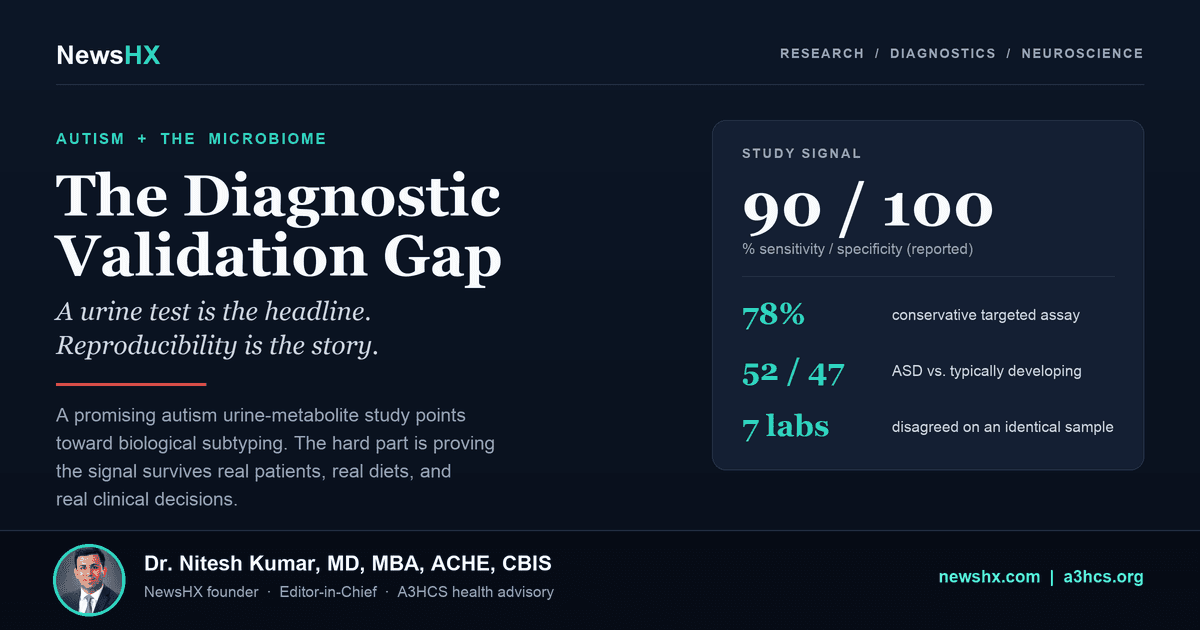
A new autism urine-metabolite paper is exactly the kind of result that attracts headlines: small sample, striking performance, non-invasive specimen, and a biology story that feels intuitive.1
But the most useful way to read it is not as "a urine test diagnoses autism." The better read is more disciplined: autism biomarker research is moving toward biological subtypes, and microbiome data may help define some of them.
This topic is also personal for me. My wife and I have twin boys with autism, which means autism research is not an abstract literature stream I check once in a while. It is something I stay close to because it touches my home, my parenting, and the questions families quietly carry every day. When a new autism diagnostic claim appears, I read it with two minds at once: the physician-executive asking whether the evidence is ready, and the father asking whether this could someday help families get clearer answers earlier.
That distinction matters. Autism spectrum disorder is still diagnosed clinically, based on developmental history and behavior. The CDC remains clear that there is no medical test, such as a blood test, that diagnoses ASD. The current clinical pathway still depends on screening, developmental monitoring, and formal evaluation by trained clinicians when concerns arise.2
So when a study reports 90 percent sensitivity and 100 percent specificity from a urine metabolite classifier, the right response is not to declare the diagnostic problem solved. The right response is to ask what biological signal was captured, how stable that signal is, whether it generalizes beyond the original cohort, and whether it can help identify a meaningful subgroup earlier than behavioral pathways alone.
That is where this story becomes more interesting than the headline. The urine test is not just a urine test. It is a downstream readout of microbial metabolism. It points to the gut microbiome as a data layer that may help psychiatry, neurology, oncology, and metabolic medicine move beyond broad clinical labels toward measurable biological states.
What the new autism study actually shows
The May 2026 paper in Molecular Psychiatry studied 52 children with ASD and 47 typically developing controls, ages 2 to 11. Investigators measured microbially-derived metabolites in urine using LC-MS methods. These metabolites included compounds derived from phenylalanine, tryptophan, and yeast-related pathways.1
The central finding was striking: many children with ASD had one or more microbially-derived metabolites at concentrations above the range seen in typically developing controls. Using one or more elevated metabolites as the classifier, the authors reported 90 percent sensitivity and 100 percent specificity in that cohort. A more conservative targeted assay placed sensitivity nearer 78 percent, a reminder that the headline number depends on the method.1
The paper proposes a subtype called ASD associated with microbially-derived metabolites, or ASD-MDM. That language is important. It does not say the microbiome explains all autism. It says a subset of children carrying the ASD label may also have an objectively measurable microbial-metabolic pattern.
Clinical caution: this should be framed as a promising non-invasive screening and subtyping signal, not as a standalone diagnostic test. The sample size is small, the classifier needs larger independent validation, and a clinical autism diagnosis still rests on developmental history, behavior, and formal evaluation.
The more mature interpretation is that urine metabolomics may help identify children who deserve faster developmental evaluation, earlier intervention referral, or metabolic and gastrointestinal phenotyping. It may also help researchers separate a large and heterogeneous diagnostic label into more biologically coherent subgroups.
The evidence is mixed, which is the point
The autism-microbiome literature is not one clean story. Some studies identify microbial or metabolomic differences. Others caution that the differences may be downstream of diet, stool consistency, medications, gastrointestinal symptoms, site effects, or sampling methods.
A major Cell study remains an essential counterweight. In a larger stool metagenomics cohort of 247 participants, investigators found negligible direct associations between ASD diagnosis and the gut microbiome. Their model suggested that ASD-related restricted interests may lead to less diverse diet, which then reduces microbial diversity and affects stool consistency. In plain language: microbiome differences may sometimes be a consequence of autism-related eating patterns, not a cause of autism.3
That does not make microbiome data irrelevant. It makes it more clinically interesting. A biomarker does not have to be causal to be useful. CRP does not cause every inflammatory disease it helps monitor. Hemoglobin A1c does not explain every mechanism of diabetes. The question is whether a signal is reproducible, interpretable, actionable, and useful in the clinical decision being made.
Four evidence layers show both the promise and the limits. The urine MDM study suggests a measurable ASD-MDM subgroup using microbially-derived urinary metabolites, but rests on a small cohort that needs larger independent replication. The Cell diet study shows diet and stool traits may explain many ASD-microbiome associations, yet does not rule out meaningful microbial-metabolic subtypes in selected patients. A Nature Communications study links tryptophan-related gut metabolites with brain activity and symptom measures4, though its cross-sectional design cannot prove causality. And a Cell Reports Medicine multi-omics analysis explores microbial genomic variants and host-microbe interactions9 that are promising for stratification but not yet routine clinical diagnosis.
This is the central tension in microbiome diagnostics. The signal is biologically plausible and increasingly measurable. The confounding is also real. If we ignore the signal, we miss a new diagnostic frontier. If we ignore the confounding, we turn exploratory science into premature clinical claims.
A good biomarker has to survive the real world
For a microbiome-linked autism test to matter clinically, it needs to pass through several gates. Analytical validity comes first: does the assay measure the target consistently? Clinical validity comes next: does the measured pattern distinguish the intended population across sites, ages, sexes, diets, medications, and comorbidities? Clinical utility is the final gate: does the result change what clinicians do in a way that improves outcomes?
That last gate is where many exciting biomarkers fail. A test that classifies children after they already have a confirmed ASD diagnosis may be scientifically interesting but clinically limited. A test that helps prioritize children for earlier specialist evaluation, identifies a treatable gastrointestinal or metabolic phenotype, or tracks response to a microbiome-directed intervention could be far more useful.
The most realistic near-term role is not "diagnose autism from urine." It is triage and stratification.
Which children with developmental concerns should move faster through the evaluation pathway? Which children with ASD have a microbial-metabolic phenotype that deserves gastrointestinal, dietary, or metabolic assessment? Which signals change with intervention, and do those changes correlate with meaningful clinical outcomes?
Those are not small questions. They are exactly the questions that turn biomarker science into medicine.
Why one-time microbiome testing keeps failing the moment
The microbiome changes over time. It changes with diet, sleep, infection, antibiotics, bowel habits, travel, collection timing, storage conditions, sequencing platform, and bioinformatics pipeline. A single stool sample is not a movie. It is one frame.
This is why the 2026 Communications Biology paper evaluating direct-to-consumer microbiome tests is so important. Using standardized NIST-developed fecal material, investigators sent samples to seven commercial gut microbiome testing services. They found major discrepancies within and across providers, with variability between companies on the same scale as biological variability between different donors. Their conclusion was direct: analytical performance is a prerequisite for sound clinical recommendations.5
That paper is a quiet warning to everyone building in this space. If two platforms cannot agree on what is in the same standardized sample, then clinical interpretation is not ready. Before microbiome diagnostics can scale, the field has to solve standardization, longitudinal sampling, quality control, and transparent reporting.
The hard part is not finding a microbiome signal once. The hard part is proving that the signal survives real patients, real diets, real sampling conditions, and real clinical decisions.
The 2025 international consensus statement in The Lancet Gastroenterology and Hepatology makes a similar point from a clinical governance perspective. It recognizes growing interest in microbiome testing for diagnosis, prognosis, risk assessment, therapy selection, and monitoring. But it also emphasizes that clinical utility remains limited for many uses and that testing needs standards for indications, pre-testing protocols, methodology, reporting, and interpretation.6
In other words, the microbiome is moving toward clinical practice, but the path is not a shortcut around evidence. It is a demand for better evidence.
Where BiomeSense fits
This is where BiomeSense becomes relevant to the autism story without needing to claim that BiomeSense diagnoses autism. The connection is not disease-specific. It is infrastructure-specific.
BiomeSense describes its GutLab and MetaBiome platform as a way to generate dense longitudinal microbiome data, automate continuous tracking in the home or clinical site, reduce per-sample cost, and apply AI-enabled bioinformatics to larger microbiome datasets.7 In a 2024 Pendulum collaboration, the company positioned GutLab around serial longitudinal sampling of Akkermansia muciniphila, a keystone strain often discussed in metabolic and inflammatory health.
That kind of platform matters because the next generation of microbiome diagnostics will not be built from isolated samples alone. It will require repeated measurements, controlled metadata, standardized workflows, and algorithms that can distinguish transient variation from stable biological patterns.
For autism, that could mean following microbial and metabolomic patterns over time in children with developmental concerns, while capturing diet, stool consistency, antibiotic exposure, sleep, gastrointestinal symptoms, and behavioral assessments. For oncology, it could mean tracking microbiome states before, during, and after immunotherapy. For metabolic disease, it could mean pairing microbial dynamics with glucose, diet, weight, medication changes, and inflammatory markers.
The point is not that every disease will have a microbiome test. The point is that many complex diseases may have microbiome-informed subtypes, risk states, or treatment-response signatures. Those signatures will only become clinically credible if the measurement layer is strong enough.
What this changes, and what it does not
For clinicians, the immediate takeaway is not to replace developmental evaluation with a lab test. It is to watch the biomarker space carefully and understand the difference between screening, diagnosis, subtype classification, prognosis, and treatment monitoring.
For families, the message must be careful. A positive microbiome or urine metabolite result should not become a label by itself. A negative result should not dismiss developmental concerns. The safest framing is that biological markers may eventually help accelerate referral, clarify subtypes, and guide supportive care, but they do not replace clinical judgment.
For clinical investigators, the implication is more immediate. If a study involves ASD, neurodevelopment, neuroinflammation, metabolic disease, gastrointestinal symptoms, immunotherapy, or treatment response, microbiome and metabolomic data should be considered early in the protocol rather than appended later. The field needs studies that are prospective, longitudinal, diverse, and designed around confounding from the beginning.
For health systems and payers, the operational question is coming. If microbiome-informed testing becomes valid for selected uses, where does it live in the care pathway? Primary care? Developmental pediatrics? Gastroenterology? Oncology? Precision medicine clinics? And who is responsible for explaining results in a way that does not overmedicalize noise?
Which signals deserve the next serious validation effort?
The autism urine-metabolite paper is not the end of the diagnostic story. It is a useful marker of where the story is going.
In oncology, the gut microbiome is already being studied as a predictor of immunotherapy response and recurrence. A 2026 Cell study in resected high-risk melanoma analyzed stool samples from 674 patients in a phase 3 adjuvant checkpoint blockade trial and found bacterial markers associated with recurrence. Prediction was strongest when validation samples had microbiome composition similar to the discovery cohort, which again highlights both the promise and the fragility of microbiome biomarkers.8
In neurology, Parkinson's disease has long raised interest because gastrointestinal symptoms can precede motor diagnosis by years, and gut-brain mechanisms are biologically plausible. In depression, short-chain fatty acids, inflammation, and gut-brain signaling remain active areas of research. In inflammatory bowel disease and metabolic disease, microbiome data may eventually help stratify flares, therapy response, or diet-intervention pathways.
But the lesson is the same across disease categories. The field does not need more hype about the gut explaining everything. It needs better ways to measure microbial function over time and connect those measurements to decisions clinicians actually make.
The urine test for autism is a window into that future, not because it proves a simple answer, but because it shows how a complex clinical label can begin to split into measurable biological patterns. The next step is harder and more important: proving which patterns are stable, which are useful, and which are only noise wearing the costume of precision medicine.
The gut is not just a digestive organ in this conversation. It is a data-generating system. We are finally learning how to read it. The question is whether we can build the measurement discipline fast enough to make that reading clinically trustworthy.
Building microbiome diagnostics, digital health strategy, or clinical product positioning?
A3HCS brings a physician-executive perspective to teams translating clinical evidence into market-ready strategy, reimbursement logic, and credible healthcare positioning.
References
- Flynn CK, Carr K, Whiteley P, et al. “Elevated microbially-derived metabolites in autism: a possible diagnostic screening test for a distinct ASD phenotype.” Molecular Psychiatry, 2026. nature.com/articles/s41380-026-03620-5
- CDC. “Screening for Autism Spectrum Disorder.” Updated April 15, 2025. cdc.gov/autism/diagnosis
- Yap CX, Henders AK, Alvares GA, et al. “Autism-related dietary preferences mediate autism-gut microbiome associations.” Cell, 2021 (erratum 2024). PubMed 34767757.
- Aziz-Zadeh L, Ringold SM, Jayashankar A, et al. “Relationships between brain activity, tryptophan-related gut metabolites, and autism symptomatology.” Nature Communications, 2025;16:3465.
- Servetas SL, Gierz KS, Hoffmann D, Ravel J, Jackson SA, et al. “Evaluating the analytical performance of direct-to-consumer gut microbiome testing services.” Communications Biology, 2026. nature.com/articles/s42003-025-09301-3
- Porcari S, Mullish BH, et al. “International consensus statement on microbiome testing in clinical practice.” The Lancet Gastroenterology & Hepatology, 2025;10(2):154-167.
- BiomeSense. “AI-powered Microbiome Analysis Platform.” biomesense.com/technology
- “Gut microbiome is associated with recurrence-free survival in patients with resected high-risk melanoma receiving adjuvant immune checkpoint blockade.” Cell, 2026 (CheckMate 915 correlative analysis).
- Chen W, Wang X, Zhu R, et al. “Integrative multi-omics reveals microbial genomic variants driving altered host-microbe interactions in autism spectrum disorder.” Cell Reports Medicine, 2025.