


When CMS announced a nationwide moratorium on new Medicare enrollment for home health agencies and hospices on May 13, the loudest reaction came from providers who cannot grow. The Pennant Group COO called it a wrench in access challenges. Industry press quoted operators who said the move makes no sense. Growth teams recalibrated their de novo expansion maps.
I understand the frustration. I also think the industry is focused on the wrong half of the announcement.
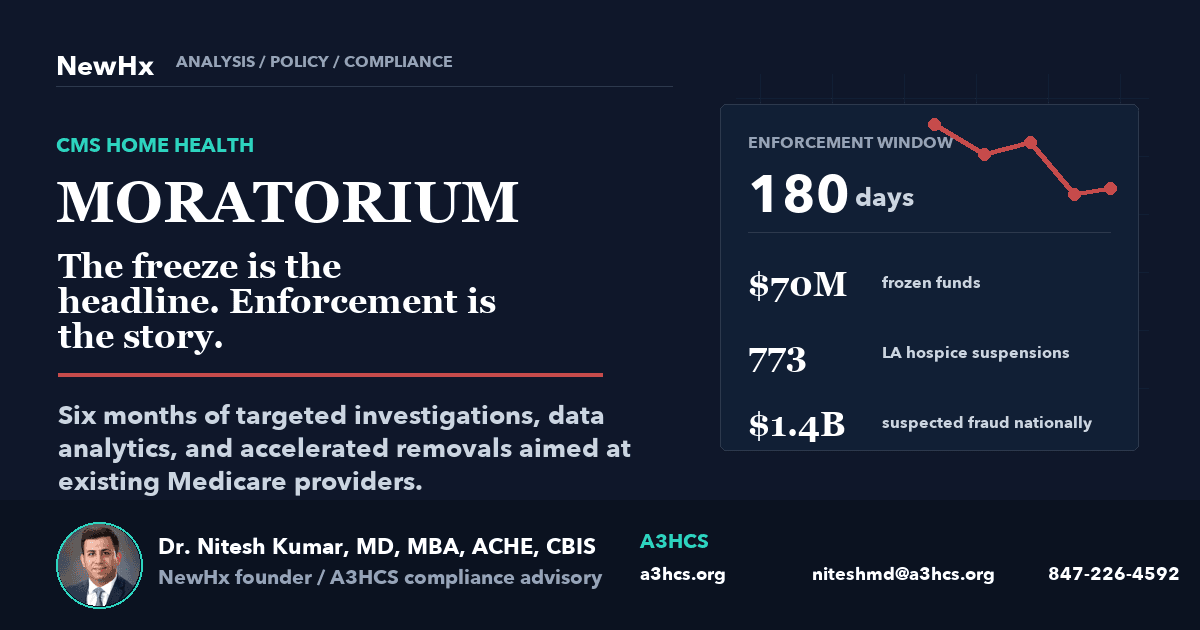
The enrollment freeze is the headline. The enforcement acceleration that comes with it is the story. And if you are running a home health agency or hospice that is already enrolled in Medicare, the part of the announcement that should have your full attention is not the new enrollment ban. It is the paragraph about what CMS intends to do with the six months it just bought itself.
What the announcement actually said
The moratorium itself is narrow in scope. It blocks new enrollments and most changes in majority ownership. It does not revoke existing ones. Providers already in Medicare can continue to operate and bill, assuming they remain in compliance. That is the sentence the industry heard and stopped reading.
CMS is acting under a durable grant of authority, not a one-time emergency power. Section 1866(j)(7) of the Social Security Act, added by Section 6401(a) of the Affordable Care Act and implemented at 42 CFR 424.570, lets the agency impose a six-month enrollment moratorium whenever it finds a significant potential for fraud, waste, or abuse, and extend it in six-month increments for as long as it sees fit. Six months is the floor, not the ceiling.
Here is the sentence most operators did not finish.
“During the moratorium, CMS intends to intensify targeted investigations, deploy advanced data analytics, and accelerate the removal of hospice and HHA providers from the Medicare program that are suspected of fraud.” — CMS, May 13, 2026
That sentence is not directed at new applicants. It is directed at providers who are already enrolled. At you.
CMS did not simply announce a moratorium. It announced a pause in new traffic while it clears the road of existing participants it considers dangerous. The enrollment freeze buys the agency six months of cleaner data, reduced noise from new applications, and concentrated investigative bandwidth aimed squarely at the existing provider pool. If your agency holds a Medicare enrollment, you are in that pool.
The scale of what CMS found
The numbers in the CMS announcement deserve to be read slowly. In Los Angeles County alone, CMS suspended payments to 773 hospices and 23 home health agencies suspected of fraud. That is $70 million in frozen funds, from one metro area.
773 hospices and 23 home health agencies had payments suspended in Los Angeles County alone. $70 million in frozen funds from a single metro. $1.4 billion in suspected fraudulent payments tied to the sector nationally under the federal task force.
Nationally, the effort sits under Vice President JD Vance's Anti-Fraud Task Force, which has tied roughly $1.4 billion in suspected fraudulent payments to the sector and uses AI-assisted billing review to flag providers en masse rather than one at a time. This is not a one-off audit cycle. It is a standing federal priority with political ownership attached, which is why the advance notice in the announcement should be read as a commitment, not a warning shot.
The agency is also deploying advanced data analytics at a scale not seen in prior enforcement cycles. Previous moratoria, mostly targeted at specific high-fraud states, relied heavily on manual review and complaint-driven investigation. This round involves pattern recognition capable of identifying anomalies invisible to individual auditors: billing outliers, referral clustering, service duration irregularities, and utilization curves that deviate from peer benchmarks.
Enhanced oversight is already live in specific markets. Hospices face heightened scrutiny in Arizona, California, Georgia, Nevada, Ohio, and Texas. Home health agencies face expanded pre- and post-claim review in Florida, Illinois, North Carolina, Ohio, Oklahoma, and Texas. If your organization operates in any of these states, you are already inside a tighter enforcement perimeter, whether or not you know it.
Fingerprint-based background checks and site verification are now required for new HHA screening. That standard, applied to new enrollment, signals the level of scrutiny CMS considers appropriate for the sector overall. It will not stay confined to new applicants.
The compliance exposure most agencies are underestimating
Here is the structural risk buried inside the “we are already enrolled, we are fine” framing. The moratorium does not protect your enrollment. It delays new competition while CMS audits the existing field.
The enforcement actions CMS is accelerating during this period include Medicare audits and claim reviews by Zone Program Integrity Contractors and Unified Program Integrity Contractors, investigations by the HHS Office of Inspector General, civil and criminal enforcement by DOJ, and False Claims Act qui tam actions filed by whistleblowers. That last category matters more than most operators appreciate. Whistleblower actions are brought by employees, former employees, and contractors who know the inside of your organization and are financially incentivized to report what they find.
Most home health operators I speak with treat compliance as a defensible posture: policies in place, billing staff trained, documentation meeting the letter of PDGM requirements. That posture was adequate when enforcement was diffuse and under-resourced. It is not adequate when CMS has explicitly stated it is deploying advanced analytics and accelerating enforcement against the exact sector you operate in.
The question is not whether your agency is fraudulent. The question is whether your compliance program can withstand the level of scrutiny that is now pointed at your sector.
Those are two different questions. Many organizations that would pass the first would not survive the second.
The access paradox CMS created
The industry reaction that deserves more attention is the one about patients, not providers. The Pennant Group COO is right that the moratorium complicates access. Rural communities will feel the constraint most acutely. Demand for home-based care is accelerating as an aging population pushes preference and medical necessity toward the home simultaneously. Freezing supply at the moment demand is rising is a tension CMS has not resolved cleanly.
CMS's stated rationale is defensible: fraudulent providers are not real supply. They represent billing without genuine care, and removing them restores rather than reduces access to legitimate services. Whether that logic holds at the volume CMS is moving remains an empirical question the agency has not yet answered publicly.
What the access argument clarifies for compliant providers is the clinical cost of inadequate compliance. An enrolled home health agency that loses its Medicare participation during an enforcement sweep does not simply face a revenue event. It displaces patients mid-episode, disrupts care transitions from hospital to home, and creates the access gaps the industry is warning about. The compliance risk is not only financial. It is clinical, and it falls on the patients your agency serves.
What a star rating means when it is your family
Policy arguments about access tend to stay abstract until they become personal. Mine stopped being abstract a long time ago.
I have sat in inpatient rehabilitation team conferences with physiatrists who are exceptional at what they do, rebuilding function, restoring gait, retraining cognition after traumatic brain injury, and heard the same quiet frustration repeated across years and institutions. A patient who spent three weeks relearning supervised household ambulation is being discharged to a home health agency the family picked because it was the first result that accepted their insurance plan. Not because anyone checked its quality rating. Not because anyone told them a rating existed.
CMS publishes quality scores for home health agencies, skilled nursing facilities, and inpatient rehabilitation facilities through its Care Compare tool at medicare.gov/care-compare. Five stars reflects exceptional care quality. Two stars means performance is below average. The gap between them is not a number on a website. It is the difference between a post-acute partner who consolidates the gains an inpatient rehab team spent weeks building and an agency that sends a different aide every visit, misses scheduled therapy sessions, and documents what the billing system requires rather than what the patient actually received.
I would not put my mother in a two-star home health agency. I would not put her in a two-star skilled nursing facility or a two-star inpatient rehab. Not because I am unaware that access is constrained and options are limited. I am aware of both. But because I understand what happens to a recovery in the sixty days after a serious illness or injury when care quality drops, I cannot treat the rating as a formality.
The stakes are granular. Neuroplasticity after TBI is time-limited. The functional gains achieved during intensive rehabilitation, the patient who is walking with supervision, the one regaining executive function, the one relearning basic ADLs, can be consolidated or reversed almost entirely based on what happens after discharge. A high-quality home health agency that maintains therapy frequency, sends consistent staff, and documents accurately is a clinical partner in a recovery that matters. A low-quality one is the quiet explanation for why a patient who was walking at discharge is no longer walking six months later, and no family ever connects the two because no one told them to look.
This is not only a business compliance issue. It is a community health issue. The fraud CMS is targeting in this moratorium is not abstract. It is billing for visits that never happened and therapy that was never delivered to patients who needed it. The agencies that survive this enforcement period with their enrollment intact are, in most cases, the ones actually delivering care worth billing for. And the families who check Care Compare before choosing a provider are the ones most likely to find them.
The moratorium is partly about protecting the Medicare trust fund. It is also, at its core, about protecting the patient who has no idea they are being under-served.
What the strategic read looks like
The operational leaders who will come through this period stronger are not the ones waiting to see how the enforcement wave lands. They are the ones who treat the next six months as a forced compliance audit with a known exam date.
CMS has told the industry exactly what it intends to do. Intensify investigations. Run analytics against billing patterns. Accelerate removals. That is an unusual level of advance notice, and it is an opportunity most organizations will underuse.
The agencies that use these six months well will find their documentation gaps, billing anomalies, and supervision weaknesses before a Zone Program Integrity Contractor does. The ones that do not will be reactive when the audit request arrives, and reactive is expensive.
There is also a consolidation signal embedded in the moratorium. Large, well-capitalized operators with clean compliance records are positioned to acquire distressed or exiting agencies that cannot survive heightened scrutiny. Some of the largest home health companies have already signaled that the moratorium barely affects their growth strategy because they grow through acquisition, not de novo expansion. The moratorium may slow new market entry, but it accelerates the competitive advantage of organizations that built durable compliance infrastructure before the enforcement environment tightened.
The agencies that emerge from this period with stronger standing will be the ones that read CMS's announcement as a brief, not a headline.
What to do with the next 180 days
If you lead a home health agency or hospice, the concrete priorities are clear. Conduct an internal billing audit against the specific patterns CMS and its contractors flag: high-visit episodes without documented medical necessity, referral concentration from a narrow set of ordering physicians, services billed for patients with atypical utilization profiles. For hospices specifically, the single pattern drawing the most suspension letters is the live discharge rate. The national non-death discharge rate runs roughly 17 to 18 percent. Many of the LA County suspension notices cite rates above 40 percent, with some between 50 and 100 percent. If your live discharge rate sits anywhere near that range, assume it is already visible to a Unified Program Integrity Contractor, and have the clinical justification documented before you are asked for it. Review your OASIS documentation for defensibility, not just completion. Assess your supervisory structure for skilled nursing and therapy services against what you can actually demonstrate in a record review.
If you operate in any of the six hospice-priority states or the six HHA enhanced-review states, act as though a pre-payment review request has already been submitted. And check your own Care Compare rating at medicare.gov/care-compare, because your referral sources, your hospital discharge planners, and the families of your patients are increasingly doing the same. The probability that a review request arrives is now materially higher than it was 30 days ago.
The moratorium is not the story. The environment it announces is the story. The providers who understand that distinction have 180 days to use it.
Assess your compliance exposure before CMS identifies it for you.
A3HCS helps home health agencies, hospices, and the health systems that refer to them understand what their compliance posture actually looks like under the level of scrutiny CMS is now deploying — the gap between “we have policies” and “we can defend our billing under a ZPIC review.”
References
- Centers for Medicare & Medicaid Services. “CMS Announces Aggressive Nationwide Crackdown on Fraud with Six-Month Hospice and Home Health Agency Enrollment Moratoria.” Press release, May 13, 2026. cms.gov
- Hospice News. “Pennant Group COO: Moratorium Throws Wrench in Access Challenges.” May 20, 2026. hospicenews.com
- Home Health Care News. “‘Makes No Sense’: Home Health Community Reacts to CMS’ Moratorium.” May 2026. homehealthcarenews.com
- Federal Register. “Medicare, Medicaid, and Children’s Health Insurance Programs: Announcement of Nationwide Temporary Moratoria on Enrollment of Home Health Agencies (HHAs).” Vol. 91, May 15, 2026. federalregister.gov
- WilmerHale. “CMS Announces Moratorium on New Medicare Enrollment for Hospices and Home Health Agencies.” May 21, 2026. wilmerhale.com
- Frier Levitt. “CMS Imposes Nationwide Medicare Enrollment Moratorium on Home Health and Hospice Providers.” May 2026. frierlevitt.com
- Home Health Care News. “CMS Moratorium: What a Nationwide Freeze Means for Home Health Growth.” May 2026. homehealthcarenews.com
- Home Health Care News. “Addus CEO: Moratorium Has Little to No Impact on Growth, Valuations.” May 2026. homehealthcarenews.com
- Centers for Medicare & Medicaid Services. Care Compare — Find and Compare Providers. medicare.gov/care-compare
- Newsweek. “Hospice Crackdown: JD Vance Task Force Halts $1.4B in Suspected Medicare Fraud.” May 2026. newsweek.com
- Hospice News. “CMS Reportedly Unresponsive to Hospice Payment Suspension Rebuttals.” May 29, 2026. hospicenews.com
- Electronic Code of Federal Regulations. “42 CFR 424.570 — Moratoria on Newly Enrolling Medicare Providers and Suppliers.” Statutory authority: Social Security Act § 1866(j)(7), added by Affordable Care Act § 6401(a). ecfr.gov