


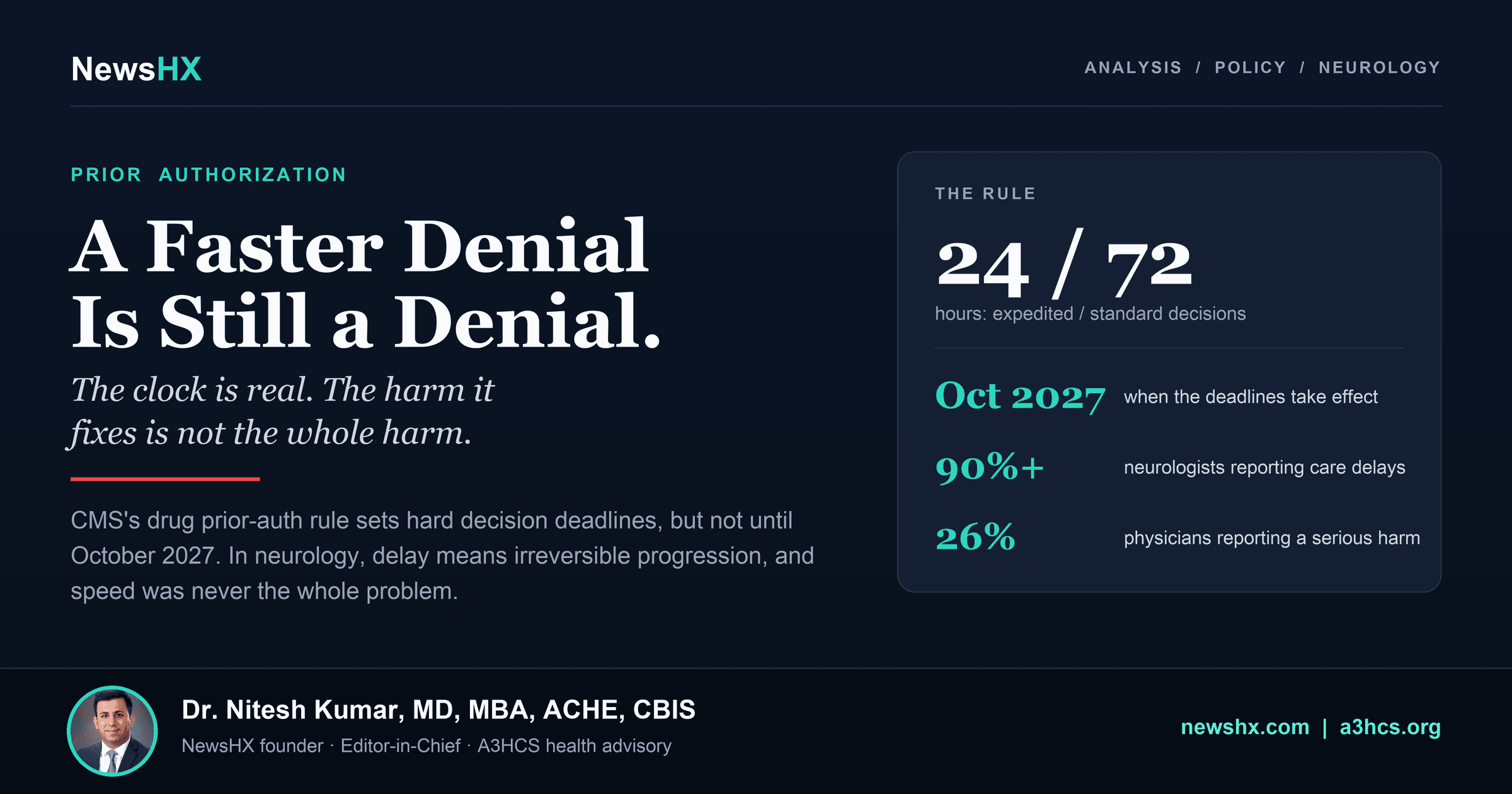
On its face, the news is good. In April, CMS proposed a rule that would force health plans to answer prior authorization requests for drugs within 24 hours for urgent cases and 72 hours for standard ones, move the entire process onto electronic standards, and publicly disclose how often they deny and how often those denials are overturned.1 The agency framed it as speeding up patient access, increasing transparency, and reducing administrative burden.2 The American Medical Association, which has spent years documenting the damage prior authorization does, called the direction right. The American Academy of Neurology, which has pressed for years to extend prior authorization protections to drugs, welcomed the direction and was finalizing formal comments ahead of the deadline.7
I support it too. The rule is a genuine step, and the people who built it understand the problem better than the last several attempts did. But I have sat in enough rehabilitation team conferences and read enough discharge summaries to know the difference between a policy that sounds like relief and one that actually reaches the patient in time. This is the first kind moving toward the second. It is not there yet.
The public comment window on the rule closed June 15, and as of this writing CMS is still working through the comments. No final rule has been issued.3 If finalized as proposed, most of it would not take effect until October 1, 2027.3 That is the first thing operators and clinicians should sit with. The relief everyone described in the present tense this spring is, at best, more than a year away, and not guaranteed even then. In neurology, that much status quo is not an administrative inconvenience. It is measured in disease that does not wait.
What the rule actually does
The proposed rule, CMS-0062-P, extends to drugs the electronic prior authorization framework CMS finalized for medical items and services in 2024.3 The core provisions are concrete and worth stating plainly.
Plans would have to decide urgent drug requests within 24 hours and standard ones within 72 hours.1 They would have to support electronic prior authorization through standardized data interfaces rather than fax and phone. And they would have to publish denial and appeal data, so the rate at which a given plan says no, and the rate at which it is later proven wrong, becomes visible instead of buried.1
The reach is broad but not total. The rule applies to Medicare Advantage plans, Medicaid fee-for-service and managed care, the Children's Health Insurance Program, and qualified health plans sold on the federally facilitated exchanges.1 It does not reach most employer-sponsored commercial plans, which is where a large share of working-age neurology patients actually get their coverage.
So the honest summary is this. The rule makes the process faster and more visible, for some of the patients, starting more than a year from now if it is finalized at all. Every one of those qualifiers matters.
The number that should stop you
Before arguing about whether the rule goes far enough, it is worth being precise about the size of the thing it is trying to fix, because most leaders underestimate it.
In the AMA's 2025 national survey of practicing physicians, the average physician reported completing 40 prior authorizations per week, and prior authorization consumed an average of 13 hours of physician and staff time each week.4 Two in five practices now employ staff who do nothing but prior authorization.4 Nearly one in three physicians said requests are often or always denied, and three-quarters said denials have grown over the past five years.4 More than nine in ten said prior authorization contributes to burnout.5
Then there is the number that should end the debate about whether this is a paperwork problem or a clinical one. More than a quarter of physicians, 26 percent, reported that prior authorization had led to a serious adverse event for a patient in their care, including hospitalization, permanent disability, or death.4
That is the baseline the rule is walking into. A faster process applied to that volume is real progress. But speed alone does not change the denial logic underneath, and a denial delivered in 24 hours is still a denial.
A faster denial is still a denial. The rule fixes how long patients wait for the answer. It does not touch how often the answer is no, or on what evidence.
How often is the answer simply wrong? Often enough that the government has measured it. When the HHS Office of Inspector General audited Medicare Advantage denials, it found that 13 percent of the prior authorization requests these plans denied actually met Medicare's own coverage rules, meaning the care would have been approved under traditional Medicare.9 The services the auditors flagged were not edge cases. They included advanced imaging and post-acute stays such as inpatient rehabilitation, the exact care a recovering neurology or brain-injury patient depends on. The plans were not slow in those cases. They were wrong, and a 24-hour clock does not fix a wrong answer.
Why neurology is the worst place to make a patient wait
Prior authorization is a burden in every specialty. Neurology is where the burden converts into permanent loss most reliably, because the diseases do not pause while the paperwork moves.
A scoping review published in JAMA Neurology in early 2026 examined prior authorization across six common neurologic conditions: Alzheimer disease, Parkinson disease, multiple sclerosis, migraine, cerebrovascular disease, and epilepsy.6 The most frequently documented consequence for patients was delay in care, identified in 60 percent of the studies reviewed. The second was an increase in disease activity, identified in 25 percent.6 Read those two together. The most common thing prior authorization does to a neurology patient is make them wait, and the second most common thing is let the disease advance while they do.
The mechanism is not subtle. In multiple sclerosis, a relapse that a disease-modifying therapy might have prevented can leave fixed neurological deficit. In epilepsy, the gap between the medication that controls seizures and the one the plan will pay for is measured in seizures that happen in the interim, each one carrying its own risk. In migraine, weeks of uncontrolled disease is weeks of a person unable to work or function. Surveys of neurologists have found that more than 90 percent say prior authorization delays patient care, and the high-cost agents that define modern neurology, the MS therapies and the CGRP migraine drugs, are precisely the ones that almost always require it.8
The appeals data makes the cost of the friction explicit. Initial denials for neurologic medications run roughly 20 to 30 percent, but 50 to 60 percent of appeals succeed.8 Sit with what that means. In a large share of cases, the first answer was wrong, and the system was structured so that the patient absorbed the delay while the clinician spent unbilled hours proving a point the plan eventually conceded. The 24-hour clock shortens the first wait. It does nothing about a denial logic that is wrong often enough to be overturned half the time on appeal.
The pattern is not unique to neurology. Across all of Medicare Advantage, plans made 46 million prior authorization determinations in 2022 and denied about 3.4 million of them, yet when a denial was appealed, more than 80 percent were overturned.10 The catch is in the next number: fewer than one in ten denials was ever appealed.10 The system runs on that friction. Most wrongly denied care is never contested, because appealing costs time and effort the patient and the clinician do not have, so the denial stands not because it was right but because no one could afford to fight it.
The provision nobody is talking about
If you want to find the part of this rule with the most durable power, do not look at the deadlines. Look at the transparency requirement.
Requiring plans to publish how often they deny drug prior authorizations, and how often those denials are reversed, does something the deadlines cannot. It converts a private decision into a public record. A 55 percent appeal-overturn rate is an abstraction until it sits in a published dataset next to a plan's name, visible to employers choosing coverage, to clinicians choosing which plans to warn patients about, and to regulators deciding where to look next.1
This is the same lever that gave Care Compare its quiet authority over post-acute care. Mandated public reporting changes behavior not because anyone is fined, but because the number becomes a fact everyone can see. The deadlines in this rule will help patients in 2027. The transparency data, if it survives the comment period intact, is the provision most likely to change how plans behave in the years after.
What this looks like when it is your family
Policy arguments about access stay abstract until they become personal. Mine stopped being abstract a long time ago.
I work at the intersection of brain injury and recovery, and the patients I think about are the ones discharged from inpatient rehabilitation after a traumatic brain injury, in the window where the brain is still capable of substantial recovery and every week of the right treatment matters. That recovery often depends on medication: an agent for post-traumatic seizures, a drug for spasticity that is keeping a hand from opening, a migraine therapy for the headaches that follow a brain injury and can flatten a person's ability to participate in their own rehabilitation.
When one of those prescriptions hits a prior authorization wall, the clock that matters is not the plan's. It is the patient's. Neuroplasticity after a brain injury is time-limited. The gains made in the weeks after discharge can be consolidated or lost depending on whether treatment is continuous. A two-week delay for a prior authorization that will eventually be approved anyway is not a two-week delay. It is two weeks subtracted from the only window in which certain recovery is possible, and that window does not reopen.
The plan experiences a prior authorization as a cost-control step that was resolved in 72 hours. The patient experiences it as a piece of recovery that did not happen and will not come back.
That gap, between how the system measures the delay and how the patient lives it, is the whole problem with treating prior authorization as an administrative metric. The rule narrows the gap. It does not close it. And for the conditions where the gap is most expensive, neurology chief among them, the residual delay still lands on the patient least able to absorb it.
The insurers say they will fix it themselves
There is a second promise in the air now, and it deserves the same scrutiny as the first. In June 2025, under public pressure that intensified after the killing of a health-insurance executive, the industry's trade group announced that more than 60 insurers, covering some 257 million Americans, had voluntarily pledged to streamline prior authorization: fewer services requiring it, a standardized electronic process by 2027, a commitment that medical-necessity denials would be reviewed by a licensed clinician, and honoring of existing approvals for 90 days when a patient changes plans.12 The insurers say they have already eliminated millions of authorizations.
I want that to work. But we have seen this movie before, and the reviews are not encouraging. The American Medical Association's own reading is that the voluntary pledge falls short of what physicians were promised, and outside experts have been blunter.5 A pledge is not a regulation. It carries no enforcement, it can be quietly narrowed, and several insurers declined even the technical piece of it.12 As one health-policy scholar put it, without clear rules and mandates, plans will do what makes financial sense for them. For a neurology patient whose therapy is stuck in a queue, a commitment a company can walk back is not a plan you can bank on. Which is exactly why the responsibility circles back to the provider organization.
What operators should do before October 2027
Here is the part most organizations will get wrong: they will wait for the rule. They will treat October 2027 as the date the problem gets solved and manage the year and more in between as business as usual.
That is a mistake, for two reasons. First, the rule does not reach commercial plans, so for a large share of your patients the burden does not change even after it takes effect. Second, the 13 hours a week, the dedicated prior authorization staff, the denials overturned on appeal, those are operating costs you carry today, and nothing in the rule lowers them before late 2027 if at all. The administrative burden of prior authorization is not a policy problem you are waiting on Washington to fix. It is an operational problem sitting inside your own organization right now.
The health systems that come through this well will use the time before it takes effect to do three things. They will map where prior authorization actually costs them, by service line and by payer, in clinician hours and in delayed care, instead of treating it as an undifferentiated tax. They will build the electronic prior authorization capability the rule will eventually require, early, so they are ready on day one rather than scrambling in 2027. And they will treat the soon-to-be-public denial and appeal data as a negotiating asset, because a plan that denies your neurology patients at twice the rate it overturns on appeal is a plan you now have a documented reason to push back on.
There is also a policy lever worth pushing on directly. A growing number of states, Texas among the first, now require "gold carding," which exempts clinicians who clear a high approval threshold, usually 90 percent, from prior authorization on the services they almost always get approved for anyway.11 The idea has bipartisan support and a version has been introduced in Congress. It is not a cure, and early evaluations warn that narrow thresholds and carve-outs limit how many clinicians actually qualify.11 But for a neurology practice whose CGRP and MS-therapy approvals already run well above that bar, gold carding is a concrete ask to bring to the payers you negotiate with, and the coming public denial data is the evidence that makes the case.
The rule sets a deadline for plans. The smarter response is to set one for yourself, ahead of it.
If your organization is carrying the cost of prior authorization and treating it as unavoidable, that is the work I do.
I help hospitals, health systems, and specialty practices quantify what prior authorization actually costs them, in clinician time, in delayed care, and in denials that should never have been denied, and build the operational and electronic infrastructure to reduce it. The plans have until late 2027 to comply, if the rule is finalized at all. Most provider organizations have that same window to stop absorbing a burden they already have the leverage to manage.
References
- Centers for Medicare & Medicaid Services. "CMS Proposes Major Reforms to Speed Up Patient Access to Drugs, Increase Transparency, and Reduce Administrative Burden." Press release, 2026.
- Centers for Medicare & Medicaid Services. "2026 CMS Interoperability Standards and Prior Authorization for Drugs Proposed Rule." Fact sheet, 2026.
- Federal Register. "Interoperability Standards and Prior Authorization for Drugs (CMS-0062-P)." April 14, 2026. Comment period closed June 15, 2026; most provisions effective October 1, 2027 if finalized.
- American Medical Association. "2025 AMA Prior Authorization Physician Survey." 2025. Source of the 40 requests per week, 13 hours per week, dedicated-staff, denial, and 26 percent serious-adverse-event figures.
- American Medical Association. "AMA Survey: Prior Authorization Reform Pledge Falls Short With Physicians." Press release, May 13, 2026. Source of the more-than-nine-in-ten burnout figure and the physician assessment of the voluntary pledge.
- Gotlieb EG, et al. "Barriers and Consequences of Prior Authorization for Neurologic Medications: A Scoping Review." JAMA Neurology. 2026;83(2):181-192. Delay in care in 60 percent of studies reviewed; increased disease activity in 25 percent.
- American Academy of Neurology. "Efforts to Address Prior Authorization Burden." AAN advocacy. The AAN was finalizing formal comments on CMS-0062-P ahead of the June 15, 2026 deadline.
- Neurology Today (American Academy of Neurology). "Neurology Drugs Are Getting Better, and More Expensive, With More Prior Authorization Hassles." Reported neurologist-experienced delay (more than 90 percent), neurologic-medication initial denial (roughly 20 to 30 percent), and appeal-overturn (roughly 50 to 60 percent) rates.
- U.S. Department of Health and Human Services, Office of Inspector General. "Some Medicare Advantage Organization Denials of Prior Authorization Requests Raise Concerns About Beneficiary Access to Medically Necessary Care." Report OEI-09-18-00260, April 2022. 13 percent of denied prior authorization requests met Medicare coverage rules; flagged services included advanced imaging and post-acute stays such as inpatient rehabilitation.
- KFF (Kaiser Family Foundation). "Medicare Advantage Plans Denied a Larger Share of Prior Authorization Requests in 2022 Than in Prior Years." August 2024 (2022 data). 46.2 million determinations; about 3.4 million (7.4 percent) denied; 9.9 percent of denials appealed; 83.2 percent of appeals overturned.
- American Medical Association. "Gold Card Approach to Prior Authorization." AMA advocacy and analysis, with reference to state gold-carding laws (Texas and others) exempting clinicians who clear a roughly 90 percent approval threshold, and to evaluations finding limited reach.
- AHIP and participating health plans. Voluntary prior authorization reform commitment, announced June 2025 (60-plus insurers, approximately 257 million covered lives); and KFF Health News, "Insurers Hedge on Pledge To Improve Denials Process," on the pledge's limits and physician skepticism.