


The patient had been with us for eleven days. She had come in after a moderate TBI with right-sided weakness and a fatigue that made her first few therapy sessions barely sustainable. By day nine she was ambulating with a front-wheeled walker, hitting her three-hour therapy threshold, and starting to feel like herself again. She had type 2 diabetes, well controlled on metformin and a careful diet before the injury, now harder to manage in an institutional food environment she did not choose.
She asked for ice cream. A staff member explained, kindly, that ice cream was not on her diabetic diet. She nodded, ate her sugar-free gelatin, and went to therapy.
I have had some version of this conversation dozens of times. So have the physiatrists I work alongside. So has nearly every clinician who has spent meaningful time in an inpatient rehabilitation facility or a skilled nursing facility. It is one of the most consistent, most human, and most consistently unaddressed gaps in post-acute clinical nutrition. Patients with diabetes want real food, and ice cream is not a trivial request. In a setting where autonomy has been reduced to a minimum and recovery demands maximum motivation, food satisfaction is a clinical variable. We have simply refused to treat it as one.
The clinical nutrition industry has produced extraordinary innovations in enteral and parenteral nutrition, in disease-specific formulas, and in oral nutritional supplements for patients who cannot eat normally. What it has not produced, in any meaningful way, is a clinically validated, good-tasting, diabetes-appropriate frozen dessert designed for the post-acute setting. That gap is not small. At the scale of the diabetes epidemic, it is a public health failure hiding in plain sight.
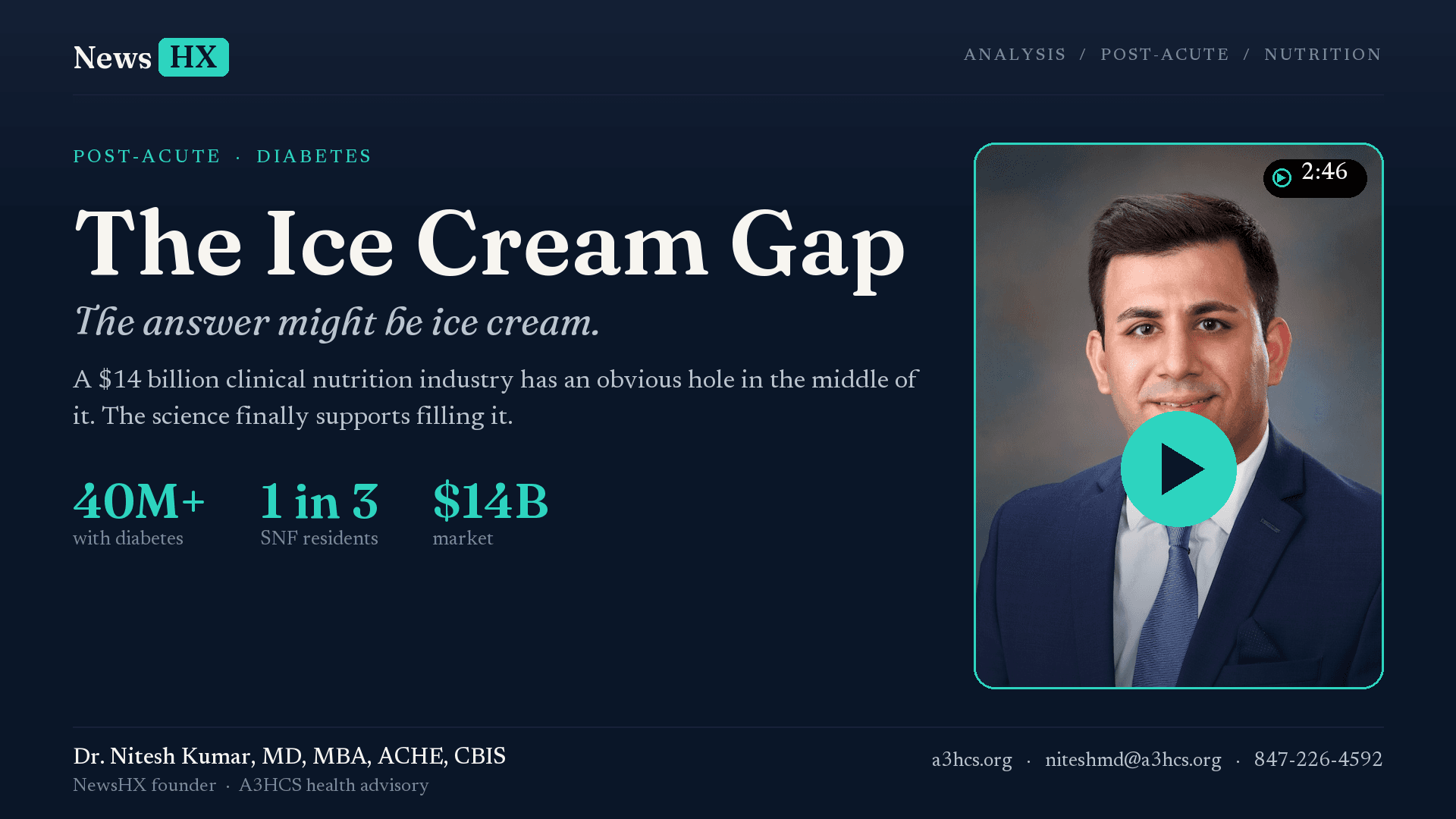
I made a short video version of this argument. The full piece continues below.
The scale of the problem in numbers
More than 40 million Americans live with diabetes today, roughly 1 in 8 people, or about 12 percent of the population. Another 115 million adults, more than 2 in 5, are living with prediabetes, and most of them do not know it. The economic cost of diagnosed diabetes in the United States reached $413 billion in 2022, up from $327 billion in 2017. One in four U.S. healthcare dollars is spent on people with diabetes.
In adults 65 and older, prevalence rises to roughly 29 percent. That age group is the primary population of skilled nursing facilities and inpatient rehabilitation units. The American Diabetes Association estimates that diabetes prevalence in long-term care and skilled nursing settings ranges from 25 to 34 percent of all residents. In some facilities and some markets, it is higher.
One in three patients in a skilled nursing facility has diabetes. They are living on institutional diets, in environments with limited food autonomy, often recovering from an illness or injury that makes dietary adherence harder, not easier. And the clinical nutrition industry has largely handed them sugar-free gelatin and vanilla-flavored formula.
The post-acute care market reached $490.6 billion in 2025 and is growing as the aging population expands demand faster than supply can keep up. The skilled nursing segment alone was $199.7 billion in 2024. Inside that market, clinical nutrition is a $14.7 billion industry in the U.S., on a path toward $99 billion globally by 2035. Diabetes is the dominant application segment. The products filling it are almost entirely liquids and formulas. A category for medically appropriate, good-tasting, clinically designed diabetic ice cream does not meaningfully exist.
That is a market gap. It is also a patient care gap. In a sector this large, those two things are usually the same opportunity.
What the science actually supports
The argument against ice cream for diabetic patients has always been framed as obvious. Sugar spikes glucose, ice cream has sugar, diabetic patients need stable glucose. The clinical reality is more nuanced, and the research published in the last several years has made the nuanced version considerably stronger.
A 2024 study in Frontiers in Nutrition tested a no-added-sugar ice cream, reformulated specifically to improve postprandial glycemic response, against a conventional product in people with type 2 diabetes. In a randomized crossover design, participants consumed 300 grams of each. The no-added-sugar version, built to a formulation standard capping fructose and glucose per serving, produced a meaningfully better postprandial glucose response. Just as important, the two were rated comparably for palatability. Patients did not have to give up the experience to get the better curve.
The same study is careful about a distinction that matters at the bedside. “No added sugar” is not the same as “zero sugar.” The lactose and naturally occurring milk sugars still produced a marked glycemic response, which is exactly the kind of detail a clinician has to be able to explain honestly to a patient. A properly formulated product, using low-glycemic bulking agents, sugar alcohols, and a high-fat dairy matrix, can substantially reduce postprandial impact while preserving the sensory experience that makes ice cream ice cream. It cannot make the sugar disappear, and it should not pretend to.
This is not speculative. The science exists. What does not exist is the commercial product, scaled for a clinical setting, validated for post-acute use, positioned for a formulary, and distributed through the channels that serve the 15,000-plus skilled nursing facilities and 1,200-plus inpatient rehabilitation facilities in the United States.
What I have seen in the rehabilitation unit
I want to be precise about what this looks like at the bedside, because the policy and market framing can obscure the human reality.
Inpatient rehab patients with diabetes are managing glucose at a time when their physiology is already stressed. Recovery from TBI, stroke, orthopedic injury, or prolonged acute illness creates metabolic demands that complicate glycemic management. Appetite is often suppressed or irregular. Food preference becomes one of the few things a patient feels they still control. When that is met with “no, that is not on your diet,” the message the patient hears is not a clinical instruction. It is confirmation that the institution does not have a good answer for them.
The physiatrists I have worked with across inpatient rehabilitation settings share this frustration consistently. The post-acute recovery window is psychologically demanding in a way acute care is not. In the ICU, patients are not deciding whether to comply. In inpatient rehab, compliance is everything: the motivation to attend therapy, to push through fatigue, to eat adequately, to engage with the care plan. All of it is volitional. And all of it is shaped by whether the patient feels the institution sees them as a person or a protocol.
Good-tasting diabetic ice cream is not a luxury. It is a compliance tool. It is a morale intervention. And in a setting where patient-reported outcomes and satisfaction scores are increasingly tied to reimbursement, it is a competitive differentiator for facilities willing to invest in patient experience at the level of the meal tray.
I would not settle for sugar-free gelatin while recovering from a serious injury. I would not put my mother on a food plan that denied her the sensory experiences that make a hard recovery bearable. The standard we accept in post-acute nutrition should not be lower than the standard we would demand for the people we love.
A call to the clinical nutrition industry
The major players know this space better than anyone. Abbott, through Glucerna, has invested heavily in diabetes-specific oral nutritional supplements and continues to expand its disease-specific portfolio. Nestlé Health Science has built a broad specialized-nutrition portfolio and made major acquisitions across adult and pediatric clinical nutrition. Danone Nutricia brings deep expertise in enteral nutrition and disease-specific metabolic support. Fresenius Kabi understands the needs of hospitalized and post-acute patients at a granular level few organizations match. B. Braun and Baxter round out a field with the scientific, regulatory, and commercial infrastructure to move a product from concept to formulary faster than any startup could.
The science is done. The market is documented. The patient population is enormous and growing. What is missing is the product: scaled for clinical use, validated for the post-acute setting, and distributed through channels that reach the facilities where it is needed.
This is a direct call to the people inside those organizations who work in product development, medical affairs, and clinical nutrition strategy. The frozen dessert gap in diabetic post-acute nutrition is not a niche. It is a mass-market clinical need sitting in the middle of the fastest-growing segment of U.S. healthcare. The organization that fills it first owns a category that does not currently exist.
The regulatory path is also more favorable than most people assume, as long as it is described accurately. A diabetes-appropriate frozen dessert most likely belongs in the food-for-special-dietary-use category rather than meeting the FDA's narrow definition of a medical food, since diabetes can generally be managed through modification of the normal diet. That is not a limitation. It is an advantage. It means a shorter, cleaner path to market than a medical food classification would require, provided the labeling and glycemic claims are honest and substantiated. The evidence base is already being built in the peer-reviewed literature. What is needed is the commercial will to build the product.
The distribution problem is already partially solved
One of the structural barriers to new clinical nutrition products is distribution. Getting a product into the dietary systems of skilled nursing facilities, inpatient rehab units, and home health requires navigating GPO relationships, dietary director buy-in, and institutional procurement. That is not unsolvable. It is a known problem with known channels.
Beyond the institutional channel, consumer distribution matters for the patients who leave post-acute care and keep managing diabetes at home. That is where scale changes by an order of magnitude. The right retail partnership can move a clinically designed diabetic ice cream from a niche medical product to a household staple for the 40 million Americans who need it.
I will say this part plainly, because the distribution conversation should not be the reason this product stays unbuilt. I have relationships at the executive level at Costco for nutritional products. If the right clinical nutrition company or emerging brand is developing a diabetes-appropriate frozen dessert for this population, the path to shelf is shorter than most people assume, and I am willing to help open it.
If you work in clinical nutrition, this is for you
I am writing this as a physician-executive who has watched this gap persist across years of post-acute clinical work, not as someone with a finished product to sell. I do not have one. What I have is a clear view of the clinical need, a network that spans inpatient rehabilitation, post-acute operations, and clinical nutrition strategy, and a genuine interest in helping build something that serves this population well.
If you work in clinical nutrition, food science, post-acute dietary management, or nutritional product development and you have been circling this problem, I want to hear from you. If you are at one of the major clinical nutrition companies and your pipeline has room for this conversation, reach out. If you are a smaller brand already building in this space and you need clinical credibility, distribution access, or a physician voice behind the product, let us talk.
Forty million Americans have diabetes. One in three post-acute patients has diabetes. A good-tasting, clinically designed frozen dessert for this population does not exist at scale. That is a problem someone should solve.
Connect with me on LinkedIn or reach out through NewsHX. This is the kind of public health problem that gets solved when the right people find each other.
Navigating nutrition strategy, post-acute quality, or clinical product positioning?
A3HCS brings a physician-executive perspective to health systems, post-acute operators, and the clinical nutrition companies building for them. The same analytical rigor applied in this piece, applied to your strategy, positioning, and growth.
References
- CDC. National Diabetes Statistics Report (2023 data, updated January 2026). Centers for Disease Control and Prevention. cdc.gov/diabetes
- American Diabetes Association. “Economic Costs of Diabetes in the U.S. in 2022.” Diabetes Care, 47(1), 2024. diabetesjournals.org
- American Diabetes Association. “Management of Diabetes in Long-term Care and Skilled Nursing Facilities: A Position Statement of the American Diabetes Association.” Diabetes Care, 39(2):308-318.
- Global Market Insights. “Post-Acute Care Market Size, Trends & Forecast 2026-2035.” gminsights.com
- Global Market Insights. “U.S. Clinical Nutrition Market Size & Forecast 2025-2034.” gminsights.com
- Al-Ozairi E, et al. “Reformulating ice cream to improve postprandial glucose response: an opportunity for industry to create shared value.” Frontiers in Nutrition, 11:1349392, 2024. frontiersin.org