


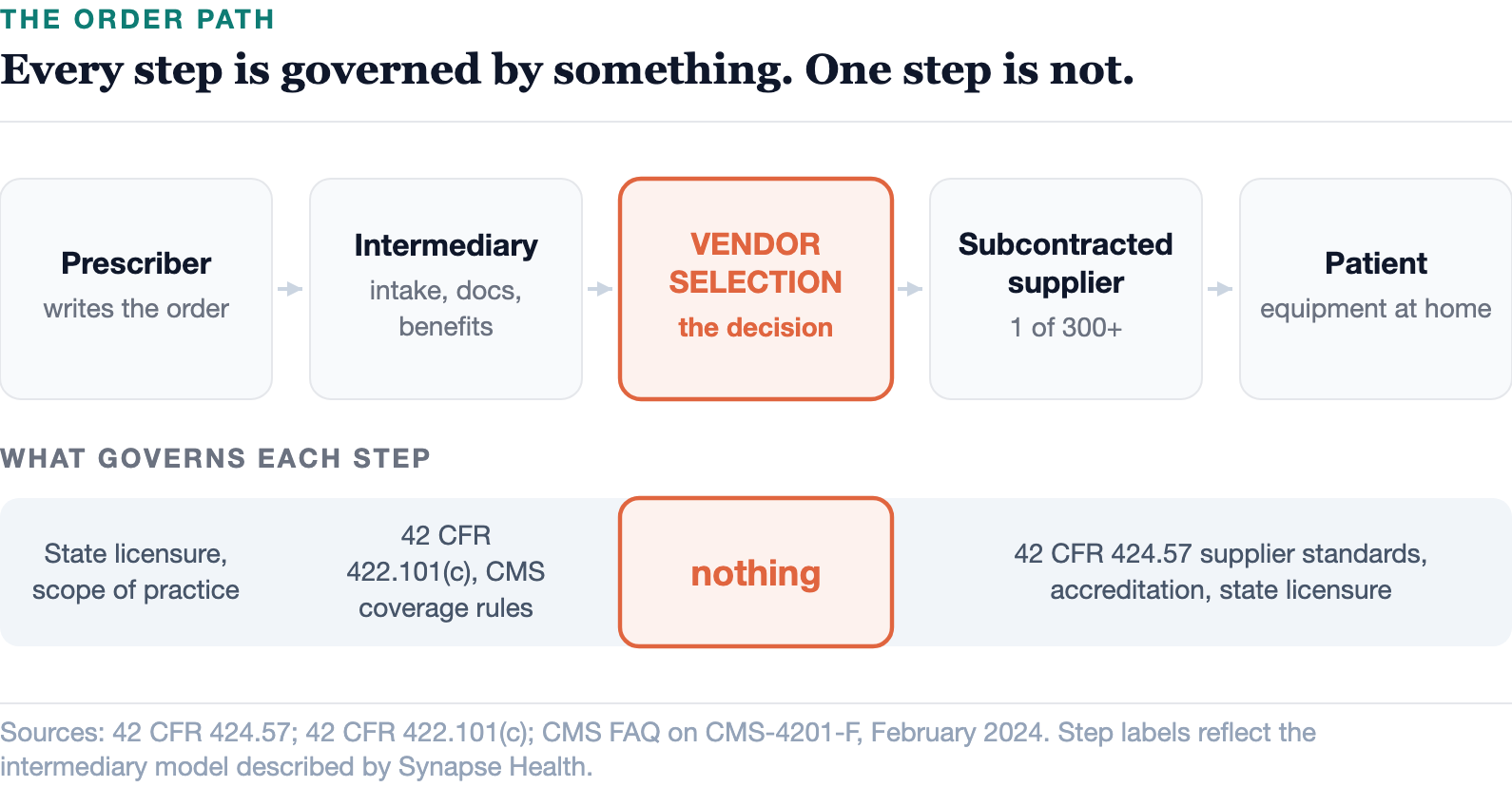
A patient with COPD is medically ready to leave the hospital on a Tuesday. The discharge depends on one thing: a home oxygen system arriving at the house before the patient does. A prescriber signs the order. It goes to a company that handles intake, documentation, benefits qualification and claims on behalf of the health plan.
Then something decides which of more than 300 subcontracted equipment companies actually loads the concentrator onto a truck.
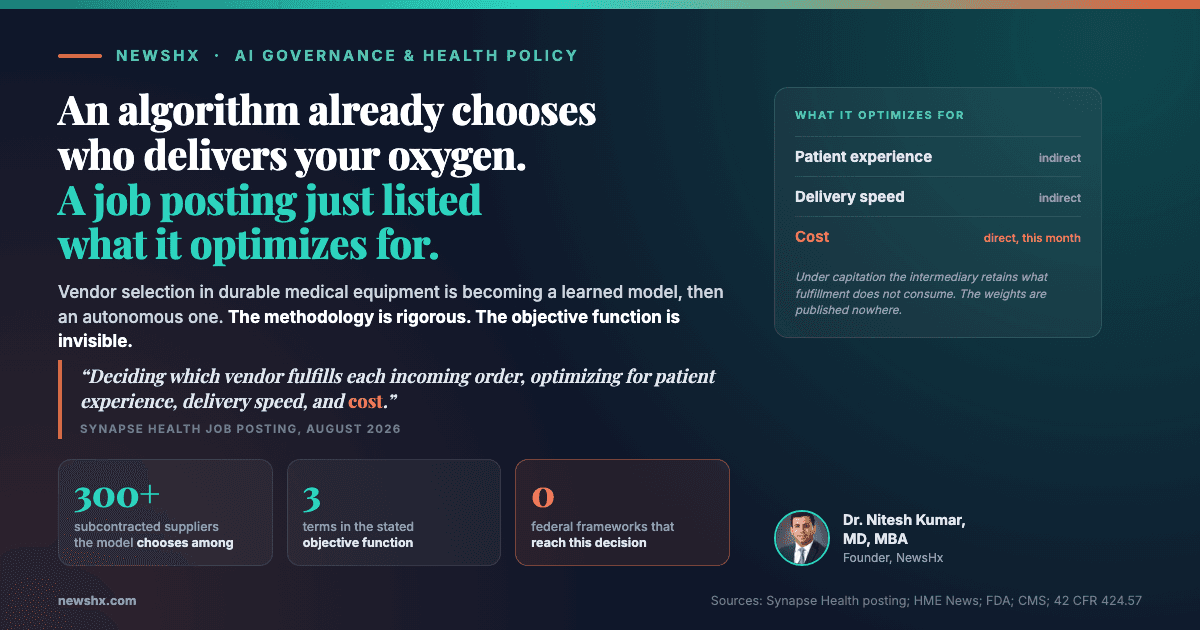
That decision has an owner, a method and a set of tradeoffs. Until recently the owner was a person, and the method was that person's judgment. It is becoming a model. A job posting published this month describes, in unusually plain language, what that model is being taught to optimize and what happens after it is trusted.
The posting is for a Director of Data Science and Analytics at Synapse Health, reporting to an SVP of Data, Analytics, and AI. Nothing in it describes wrongdoing, and this article does not allege any. Job postings are simply a candid genre. They state operational intent in language that a press release would smooth over and an investor deck would abstract, because their purpose is to tell a qualified stranger what the work actually is.
What this one says is worth reading closely, because the same shift is happening at CareCentrix, at Molina, and across the benefits-manager layer of home medical equipment generally.1 Synapse is the company that wrote it down.
What the posting says
Three problems anchor the role. The first is vendor matching, described as "deciding which vendor fulfills each incoming order, optimizing for patient experience, delivery speed, and cost."2 The second is order routing, including "flagging orders at risk of delay based on historical patterns" across equipment type, geography, supplier and processing team.2 The third is supply chain optimization, quantifying bottlenecks so that "every recommendation comes with a number attached, not just a hunch."2
The stated starting point is that the operations team "processes tens of thousands of DME orders every day, often relying on individual judgment to make routing and vendor decisions in the moment," and that the accumulated volume now supports "a real prediction engine to support and strengthen those decisions."2
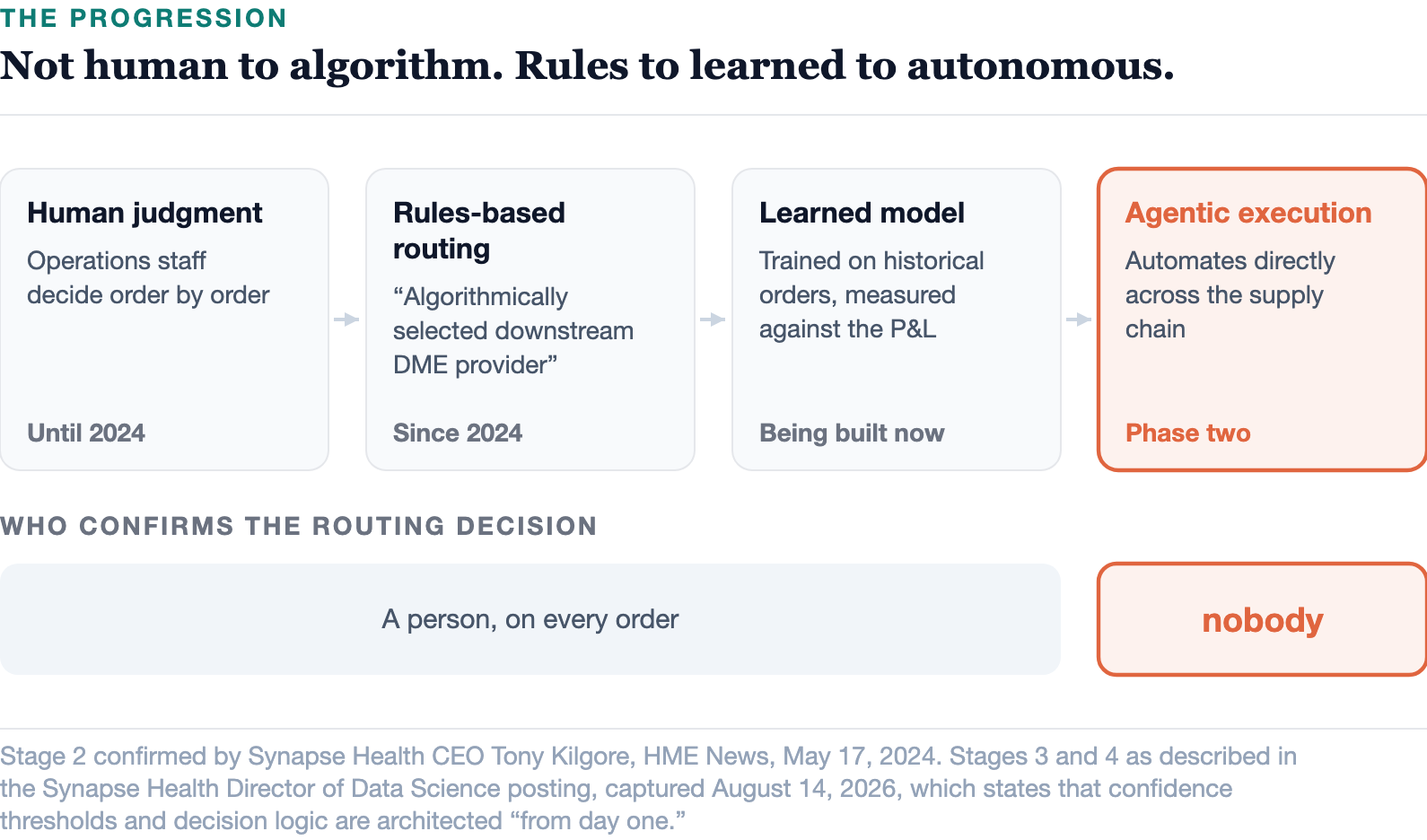
Then the roadmap: "phase two takes this into agentic AI, evolving the system from one that recommends analyzed actions to one that automates them directly across the supply chain," with "confidence thresholds and decision logic" architected "from day one so this transition doesn't require a rebuild."2
Give the methodology its due, because most healthcare AI never earns this
It would be easy, and wrong, to read that as a warning sign. The posting describes a standard of evidence that most deployed healthcare AI does not come close to meeting.
It asks the hire to "build the measurement infrastructure alongside the models, not after," standing up "the pre/post and counterfactual framework (holdouts, experiment design) as part of each build, so every recommendation ships with proof of impact."2 The desired skills list names difference-in-differences, regression discontinuity, heterogeneous treatment effects, queueing theory, and discrete event simulation.2
Holdouts on a live operational system are expensive. They mean deliberately routing some share of orders the old way to preserve a clean comparison, and eating whatever that costs. Most organizations deploying an algorithm say they will measure impact and then measure adoption instead. This posting asks for causal identification by name, before the first model ships.
That is a real methodological commitment and it deserves to be credited plainly. The concern in this article is not that the work is sloppy. It is that rigor and visibility are different properties, and only one of them is present.
First, a correction to the obvious reading
The tempting summary is that a company is about to hand a human decision to a machine. That is not quite what is happening, and the difference matters.
The algorithm already exists. In May 2024, Synapse CEO Tony Kilgore described the company's model to HME News in these words: partner with the health plan as the provider of record, take on intake, patient qualification, documentation and copay collection, "and then sending that equipment referral down to the algorithmically selected downstream DME provider."3
So algorithmic vendor selection has been in production for at least two years. What the posting describes is different and, in governance terms, more consequential: replacing whatever selection logic exists today with a model learned from millions of historical orders, measured against a P&L, and then, in phase two, removing the human confirmation step.
The move is not automation of a human decision. It is the conversion of a rules-based routing step into a learned, optimized, and eventually autonomous one. Those are not the same transition, and only the second one raises the question this article is about.
Why this particular decision carries clinical weight
Vendor selection sounds like logistics. In post-acute care it is closer to a clinical scheduling decision, because the equipment is frequently what gates the discharge.
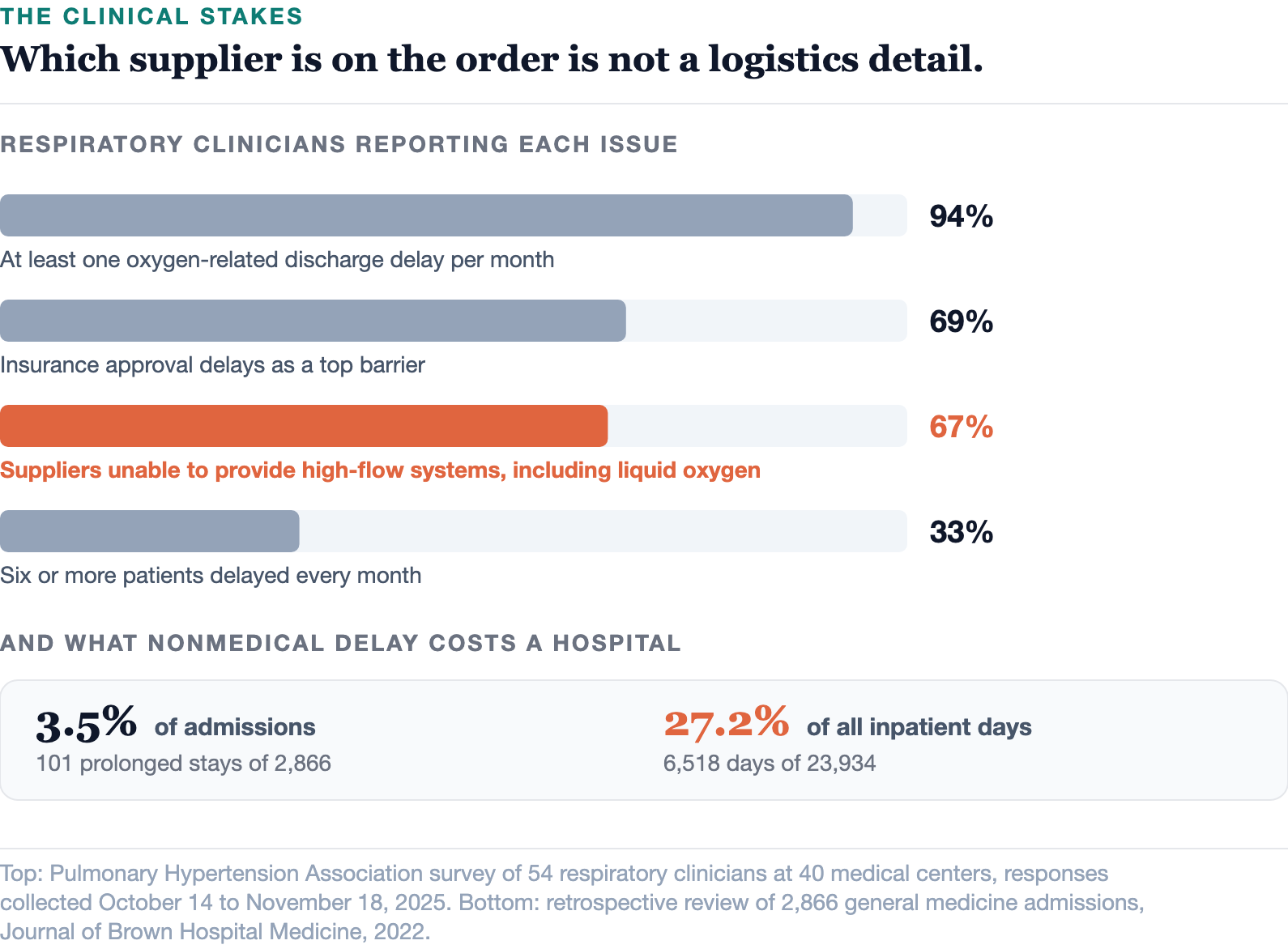
A national survey conducted by the Pulmonary Hypertension Association and distributed with the American Lung Association, the Pulmonary Fibrosis Foundation, the COPD Foundation and the Foundation for Scleroderma Research collected responses from 54 respiratory clinicians at 40 medical centers between October and November 2025. Ninety-four percent reported at least one discharge delay per month tied to oxygen access. One-third reported six or more patients delayed each month. Most delays added two or more days to the hospital stay.4
The two barriers respondents named most often are the ones that matter here: 69% cited insurance approval delays, and 67% cited suppliers' inability to provide high-flow systems, including liquid oxygen.4 Which supplier is on the order determines whether the second barrier applies.
Nonmedical barriers to discharge are also not a rounding error in hospital operations. A retrospective review of 2,866 admissions to a general medicine floor at an urban academic hospital found that 101 prolonged hospitalizations, 3.5% of admissions, accounted for 27.2% of all inpatient days, with nonmedical factors contributing to more than half of stays beyond 60 days.5
There is a second finding buried in the oxygen survey that deserves more attention than it has received. Liquid oxygen has become scarce, the association reports, because many suppliers stopped providing it "due to inadequate reimbursement from Medicare and other payers."4
Reimbursement levels already determine which equipment patients can actually get.
The cost term is not something an optimizer is about to introduce into a clean clinical system. It has been shaping the supply side for years, through a slower and less legible mechanism. The question is whether encoding it explicitly makes that better or worse.
I have been on the supplier side of exactly this decision. I ran MoveHx, which placed medical-grade exoskeletons into VA, Medicare and hospital rehabilitation channels under a Class II pathway and K1007 HCPCS reimbursement. When you are the company that either does or does not appear on the referral, you learn quickly that the selection step is where the economics of the whole category get settled. You also learn that nobody outside the transaction can see how the selection was made.
The clause that reframes everything
One line in the posting is the analytic key. The hire is asked to "anchor the roadmap to the P&L before writing a single model" and to quantify the cost of a bad vendor match, a mis-routed order, and network bottlenecks "against our capitated rate," so that "every project you take on has a dollar figure attached before it starts."2
That phrase is not incidental, and it is corroborated well beyond the posting. UnitedHealthcare entered a capitated arrangement with Synapse Health for standard DME covering Medicare Advantage HMO and PPO members in Georgia and North Carolina, announced May 1 and effective August 1, 2024, affecting roughly 480,000 people.6 Kilgore confirmed the structure directly: Synapse is the provider of record, "we own the claims risk," downstream providers are paid the following month on a standardized fee schedule, and "when the astute operators look at it from a unit cost analysis," the company has "built in a relatively healthy margin."3
The arrangement has since expanded substantially. As of June 1, 2026, Synapse manages DME ordering and fulfillment for UnitedHealthcare Medicare Advantage members across ten additional states for individual HMO and PPO plans, plus eleven states for chronic-condition special needs plans and three for dual-eligible special needs plans.7
Here is what capitation means structurally. The intermediary receives a fixed amount per member and retains the difference between that amount and what fulfillment actually costs. This is a legitimate, widely used, CMS-recognized payment design. Its entire purpose is to put an entity at risk so that it has reason to eliminate waste, and it frequently works. Synapse taking on claims risk, revenue cycle, bad debt and copay collection on behalf of 300-plus downstream suppliers is a real service with real value, and the suppliers who like the model like it for defensible reasons.
But it produces a specific and unavoidable asymmetry in the objective function. The posting names three terms: patient experience, delivery speed, and cost. Under capitation, exactly one of those three has a direct, immediate, measurable owner inside the company setting the weights. Cost savings land in the intermediary's P&L this month. Patient experience and delivery speed land there only to the degree they are instrumented, contractually enforced, or eventually reflected in plan retention.
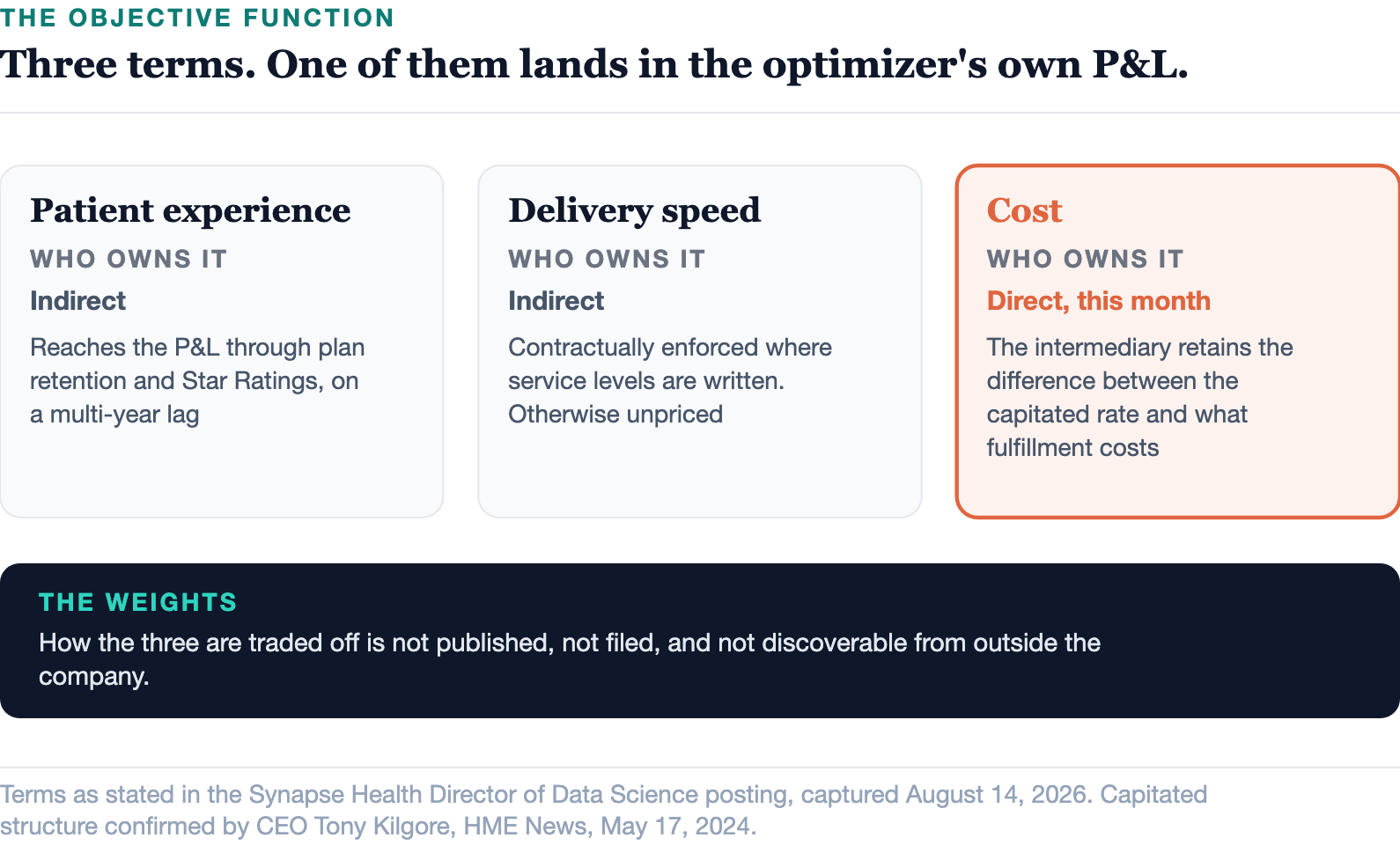
Note that the posting's own reporting instruction points the same direction. The hire is told to "manage up in numbers," reporting to the SVP and the executive team "in terms of dollars saved, orders recovered, and waste reduced."2 Two of those three are cost measures. None of them is a patient outcome.
None of this implies that patient experience will be underweighted. A rational operator holding capitated risk on a Medicare Advantage population has real reasons to care about speed and satisfaction, including readmissions, plan Star Ratings and contract renewal. The point is narrower and it is structural: the weights exist, they are consequential, and no one outside the company can see them.
Four federal frameworks touch this order. None reaches this decision.
The natural assumption is that an algorithm making consequential decisions about Medicare patients' medical equipment falls under somebody's oversight. It is worth checking that assumption against the actual texts rather than asserting it, and the result is more specific than a general complaint about regulatory lag.
The FDA governs clinical decision support, defined by who it speaks to and about what. FDA reissued its Clinical Decision Support Software guidance on January 29, 2026, superseding a January 6, 2026 version.8 The guidance states that it "clarifies the scope of FDA's oversight of clinical decision support software intended for health care professionals (HCPs) as devices," and interprets the four criteria in section 520(o)(1)(E) of the FD&C Act.8 The third criterion covers software "intended for the purpose of supporting or providing recommendations to an HCP about prevention, diagnosis, or treatment of a disease or condition."8
A vendor-matching engine does not make a recommendation to a health care professional, and it does not make a recommendation about prevention, diagnosis or treatment. It tells an operations team, or eventually tells itself, which company should fulfill an order that a clinician already wrote. It sits outside the framework by construction, not by exception.
CMS governs algorithms in Medicare Advantage coverage determinations. In its February 2024 FAQ on the CMS-4201-F final rule, CMS confirmed that MA organizations may use algorithms and AI, but that any such tool must comply with the medical necessity rules at 42 CFR 422.101(c), must base decisions on "the individual patient's circumstances" rather than a larger data set, and cannot apply internal coverage criteria that have not been publicly posted.9 CMS also warned that these technologies "can exacerbate discrimination and bias" and reminded plans of their obligations under Section 1557 of the Affordable Care Act.9
That is a meaningful framework. It governs whether an item is covered. Vendor matching happens after coverage is settled. The order has already been qualified; the question is who fills it. Nothing in the FAQ addresses that step.
ONC requires transparency for predictive algorithms inside certified health IT. The HTI-1 final rule, published at 89 FR 1192 on January 9, 2024, established first-of-their-kind requirements for predictive decision support interventions, including 31 source attributes developers must surface so users can evaluate the tool.10 Those requirements attach to certified health IT modules. An intermediary's internal operational routing engine is not certified health IT and does not trigger them.
And the DMEPOS supplier standards expressly contemplate subcontracting without addressing how you choose. Under 42 CFR 424.57(c)(4), a supplier "fills orders, fabricates, or fits items from its own inventory or by contracting with other companies for the purchase of items necessary to fill the order," and must produce contracts on request. The one constraint on that choice is that "a supplier may not contract with any entity that is currently excluded" from federal health care programs.11
The regulation tells a supplier who it may not use. It says nothing about how to choose among the hundreds it may.
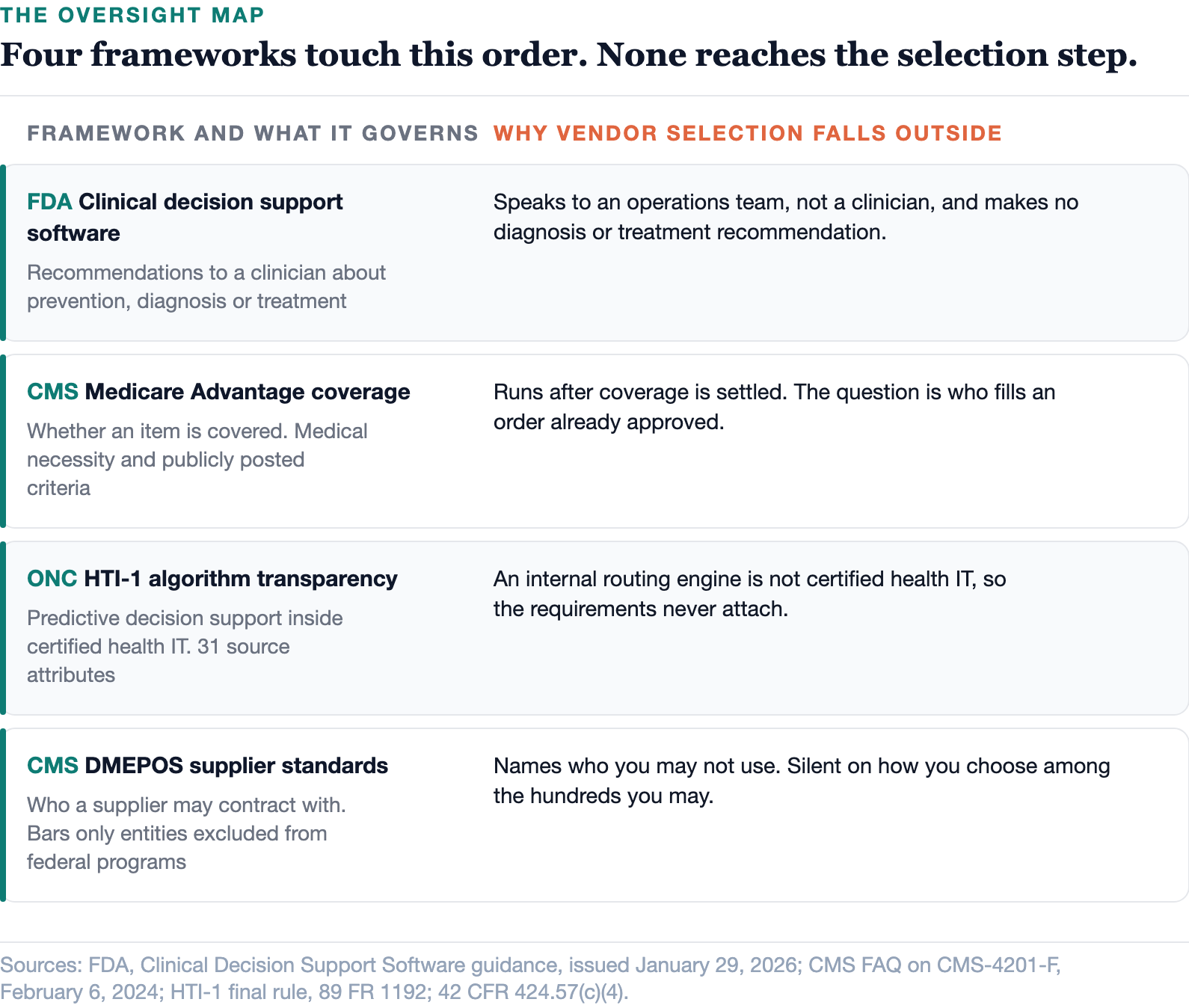
So the gap is not a loophole anyone engineered. Every one of these frameworks was written for a decision that either did not exist in algorithmic form or was assumed to be clinical. This decision is neither clinical nor a coverage determination nor resident in certified health IT, and it was a phone call until it wasn't.
Federal attention is at least pointed at the general question. On August 13, 2026, the American Hospital Association filed comments with FDA on the report the agency owes Congress under Section 3060 of the 21st Century Cures Act, covering the risks and benefits of non-device software functions.12 That report concerns software adjacent to clinical care. Operational allocation software of this kind is not obviously within its frame either.
The precedent worth reading first
There is one well-documented case of a healthcare allocation algorithm whose objective function was examined from the outside, and it is the closest available analogue.
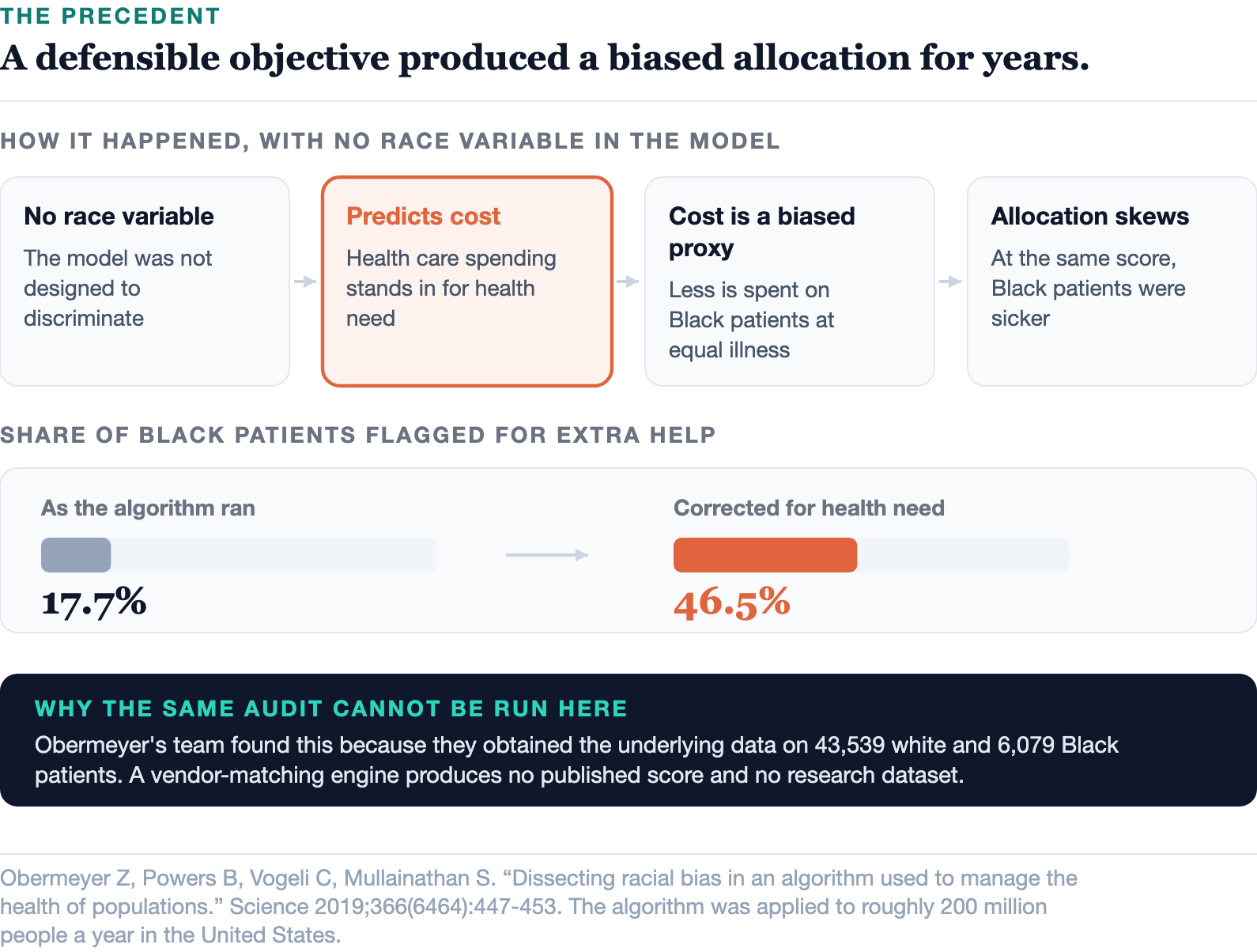
In 2019, Obermeyer, Powers, Vogeli and Mullainathan published an analysis in Science of a commercial risk-prediction algorithm applied to roughly 200 million people a year in the United States to identify patients for high-risk care management programs.13 They found substantial racial bias: at a given algorithmic risk score, Black patients were considerably sicker than white patients. Correcting the disparity would have raised the share of Black patients receiving additional help from 17.7% to 46.5%.13
The mechanism is the part to carry forward. The algorithm was not designed to discriminate and contained no race variable. It predicted health care costs as a proxy for health need. Because less money is historically spent on Black patients at equivalent levels of illness, cost was a biased proxy for sickness. The authors' conclusion was general: "the choice of convenient, seemingly effective proxies for ground truth can be an important source of algorithmic bias."13
Two honest differences from the DME case, and they cut in opposite directions.
The first is favorable. In Obermeyer's algorithm, cost was smuggled in as a stand-in for something else, and the designers appear not to have understood what they had built. In the posting, cost is named as an explicit term alongside patient experience and delivery speed. Explicit is better than hidden.
The second is not. Obermeyer's team found the problem because they obtained the underlying data on 43,539 white and 6,079 Black patients and could reconstruct what the algorithm was doing. There is no equivalent path here. A vendor-matching engine at a private intermediary produces no published score, no research dataset, and no external analytic surface. Nothing about the current structure would let an outside researcher discover a systematic pattern in which patients get slower or less capable suppliers, and no regulator is positioned to ask.
The lesson of Obermeyer is not that companies optimize maliciously. It is that a defensible objective can produce a harmful allocation for years before anyone notices, and that it took independent researchers with privileged data access to notice.
This is an industry pattern, not a company
It would be a misreading to treat this as a story about one firm. The trade press has been clear that the model is spreading fast.
Writing in June 2026, HME News editor Liz Beaulieu reported that the dominant topic at the March Medtrade conference was "the accelerating use of benefits managers and third-party administrators to manage durable medical equipment products and services," naming BlueCross BlueShield of Tennessee's adoption of CareCentrix's DME Navigator platform and Molina Healthcare's plans to do something similar in multiple states.1 The change she identifies is not the existence of the model, which is decades old, but "the pace and the scale at which more payers are now embracing" it, plus one new ingredient: technology capable of running it in ways "that may not have been feasible five years ago."1
The provider-side concerns she catalogs map onto the same allocation question from below. Suppliers worry they will not be in a network, that reimbursement will not sustain them, and that patients will be directed "to providers farther from home, or, in the view of some clinicians and suppliers, to providers that aren't as well equipped to meet their needs."1
That last worry is precisely a claim about the weights. And when UnitedHealthcare paused the original Georgia and North Carolina rollout by a month in July 2024 after AAHomecare reported "many calls" from members, the operational requirements at issue were the kind an optimizer would need to price: 24-hour on-call coverage seven days a week, two-hour response windows for standard orders, one-hour for STAT orders, and four-hour delivery for urgent requests.6
What to ask, and who should ask it
The useful response here is not opposition. Ad hoc human routing across tens of thousands of daily orders is very likely worse than a well-built model, and the posting's insistence on holdouts and counterfactuals suggests this one will be built carefully. The useful response is to attach visibility to the decision before phase two removes the human from it.
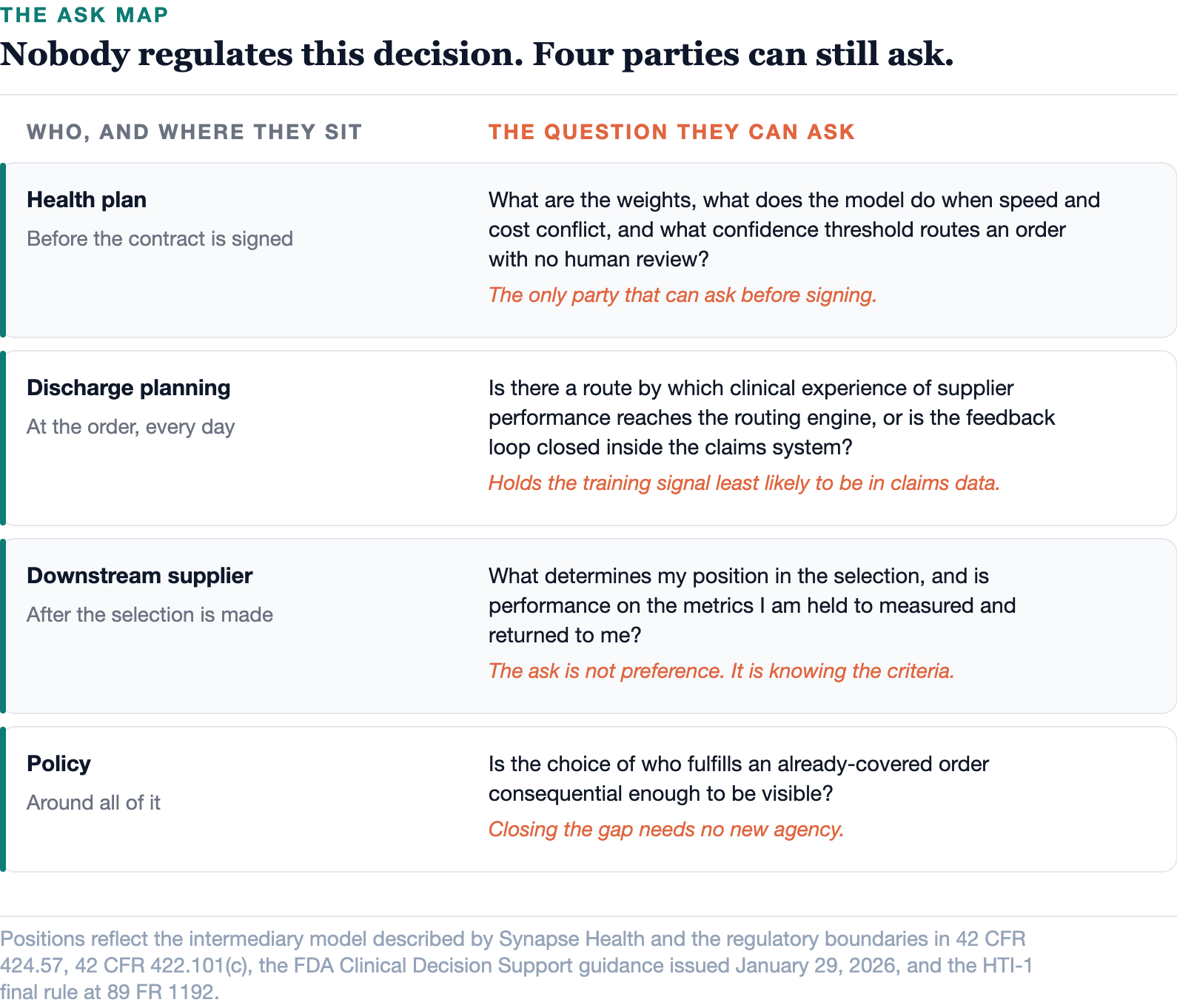
If you run a health plan contracting with an intermediary on a capitated basis, the objective function is a contractible object. Ask for the terms and the weights in writing. Ask what the model optimizes when speed and cost conflict, and what the confidence threshold is for automated routing without human review. You are the only party with the leverage to ask before signing.
If you run discharge planning or case management, you already know which suppliers reliably deliver high-flow oxygen on a Friday afternoon and which do not. That knowledge is exactly the training signal these models need and the thing most likely to be absent from claims data. Ask whether there is a route by which clinical experience of supplier performance reaches the routing engine, or whether the feedback loop is closed inside the claims system.
If you are a downstream supplier, ask what determines your position in the selection, and whether performance on the metrics you are held to is measured and returned to you. The reasonable ask is not preferential treatment. It is knowing the criteria.
If you write policy, the specific gap is narrow enough to name. Algorithmic allocation of covered benefits by a non-clinical intermediary sits outside FDA's clinical decision support framework, outside CMS's Medicare Advantage coverage-determination rules, outside ONC's certified health IT transparency requirements, and outside the DMEPOS supplier standards. Closing it does not require a new agency. It requires deciding that the choice of who fulfills a covered order is consequential enough to be visible.
The actual story
A consequential allocation decision affecting hundreds of thousands of Medicare Advantage beneficiaries is moving from human judgment to a learned model, and then to autonomous execution. The company doing it appears to be doing it more carefully than most. The financial structure it operates under gives it a direct stake in one of the three things the model balances. And there is no external visibility into how those three things are weighed, and no regulatory framework that treats the question as its business.
That is not a scandal. It is a structural blind spot, and it is being built into production right now across an entire layer of the industry while the frameworks that would govern it are all pointed somewhere else.
The oxygen concentrator either arrives before the patient or it does not. Somebody, or something, decides which company brings it. That decision is now a model with an objective function, and the objective function is the document that matters.
Nobody outside the building has read it.
Buying, building, or signing off on an algorithm that allocates care?
A3HCS runs evidence interrogations on healthcare AI before it goes into production: what the model optimizes, who owns each term, what the holdout design actually proves, and which questions belong in the contract rather than the pilot readout.
References
- Beaulieu L. "Providers didn't ask for it, but it's here." HME News, June 22, 2026. hmenews.com
- Synapse Health. "Director of Data Science and Analytics" job posting. Captured August 14, 2026. Passages quoted verbatim from the posting text.
- Flaherty T. "Synapse Health: There's something in this for everyone." HME News, May 17, 2024. Interview with CEO Tony Kilgore. hmenews.com
- "Survey finds oxygen access issues delay hospital discharges." HME News, July 8, 2026. Pulmonary Hypertension Association survey, 54 respiratory clinicians at 40 medical centers, responses collected October 14 to November 18, 2025. hmenews.com
- "Nonmedical Discharge Barriers in Prolonged Stays on a General Medicine Ward: A Retrospective Review." Journal of Brown Hospital Medicine, 2022. bhm.scholasticahq.com
- "UnitedHealthcare Pauses Implementation of New MA Model in NC, GA." HomeCare, July 26, 2024. homecaremag.com
- UnitedHealthcare. "Synapse Health will soon manage DME orders in select states." UHCprovider.com, posted December 18, 2025, last modified April 1, 2026. uhcprovider.com
- U.S. Food and Drug Administration. Clinical Decision Support Software: Guidance for Industry and Food and Drug Administration Staff. Issued January 29, 2026, superseding the version issued January 6, 2026. Docket FDA-2017-D-6569. fda.gov
- Centers for Medicare & Medicaid Services. FAQs Related to Coverage Criteria and Utilization Management Requirements in CMS Final Rule (CMS-4201-F). February 6, 2024.
- Health and Human Services Department. "Health Data, Technology, and Interoperability: Certification Program Updates, Algorithm Transparency, and Information Sharing" (HTI-1 final rule). 89 FR 1192, January 9, 2024. federalregister.gov
- 42 CFR 424.57(c)(4). DMEPOS supplier standards, application certification standards.
- American Hospital Association. "AHA Responds to FDA Request for Input on Development of 21st Century Cures Act Section 3060 Required Report." August 13, 2026. aha.org
- Obermeyer Z, Powers B, Vogeli C, Mullainathan S. "Dissecting racial bias in an algorithm used to manage the health of populations." Science. 2019;366(6464):447-453. doi:10.1126/science.aax2342