


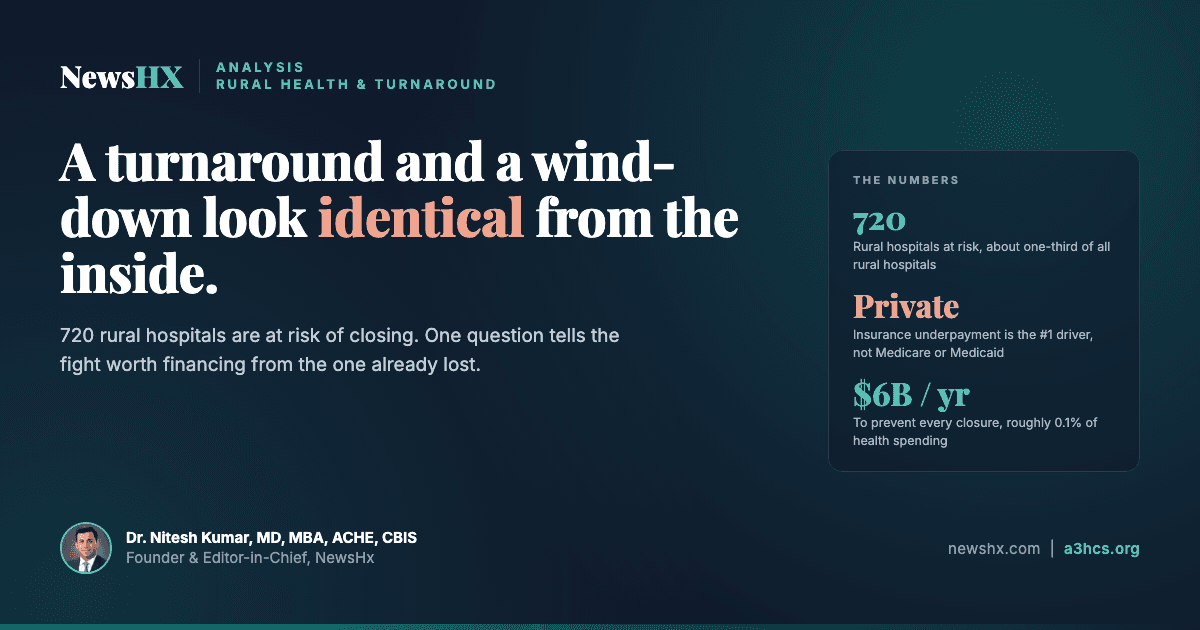
When Becker's Hospital Review asked me earlier this year what separates a rural hospital that can still be saved from one that is already gone, I gave them the honest answer, the one I believe most: a turnaround and a wind-down can look identical from the inside. The question that separates them is whether the next dollar you invest still moves the needle.3
That question is about to get asked several hundred times over. The Center for Healthcare Quality and Payment Reform now counts 720 rural hospitals at risk of closing, roughly one-third of every rural hospital in the country, and almost 300 of them at immediate risk because of the severity of their financial problems.1,2 Over the past decade more than 100 rural hospitals have already closed, and more than three million Americans no longer have an emergency room, inpatient beds, or the ordinary hospital services most of the country takes for granted.1 The University of North Carolina's Cecil G. Sheps Center, which maintains the field's definitive closure database, counts 154 rural closures and conversions since 2010.7 This is not a forecast. It is a running total, current as of this spring.
I want to do two things with this piece. First, correct the diagnosis, because the reason most of these hospitals are dying is not the one in the headlines, and getting it wrong sends leaders after the wrong fix. Second, lay out what a leadership team can actually control while Washington debates a rescue that, even if it passes, will not arrive in time for a hospital with six months of cash left.
The diagnosis almost everyone gets wrong
Ask a room of hospital executives why rural hospitals fail and you will hear the same answer: Medicare pays too little, Medicaid pays worse, and too many patients are uninsured. That story is intuitive, it is politically convenient, and the CHQPR data says it is wrong about the biggest driver.
More than 40 percent of rural hospitals lose money delivering patient care, that part is true, because it simply costs more to run a hospital in a small community.1 A rural emergency department has to be staffed around the clock for a population that may generate a fraction of an urban ED's volume. Fixed costs do not shrink to match a smaller town. But when CHQPR broke the losses down by who is actually paying, the surprise was in the private column. Among the three payer categories that lose these hospitals money, uninsured patients, Medicaid patients, and privately insured patients, losses on private-insurance patients are the single biggest cause of at-risk hospitals' overall losses.1,2
Sit with how counterintuitive that is. The patient with a commercial insurance card, the one every revenue-cycle team treats as the profitable customer, is at the center of why these hospitals are underwater. About half of the services delivered at the average rural hospital go to privately insured patients, and in the at-risk markets those private plans are not paying enough to cover the cost of caring for them.2
The rural hospitals that are not at risk are usually profitable on patient services. The ones that are dying are not being killed by the government payers everyone blames. They are being starved by the commercial plans everyone assumes are subsidizing the rest.
This is the clean line CHQPR draws between the hospitals that survive and the ones that do not. A healthy rural hospital gets paid enough by private plans to cover its privately insured patients and generate a margin that offsets its losses on Medicaid and the uninsured. An at-risk hospital has lost that offset, either because the commercial plans in its market pay too little or because it does not have enough privately insured volume to make up the difference.1 Layer on two more pressures, the pandemic-era federal support that has now ended and thin financial reserves, and you get the third fact in the report: almost a third of rural hospitals lost money overall in 2024 to 2025, not just on patient care.2
If you accept that diagnosis, a lot of the standard advice gets more complicated. Expanding Medicaid eligibility genuinely helps, and the evidence is strong, a Health Affairs analysis found Medicaid expansion was associated with substantially lower odds of hospital closure, an effect concentrated in rural markets.9 But it works mainly by shrinking uncompensated care, and it does not touch the commercial-underpayment problem CHQPR identifies as the biggest single driver. Which is exactly why the operator's job and the policymaker's job have to be understood separately.
The rescue is real, and it is slow
CHQPR's own fix is smart, and it is the right structural answer. Rather than simply raising Medicare rates, the group proposes Standby Capacity Payments: a standing payment from both private and public payers that covers the fixed cost of keeping essential services like the emergency department staffed and ready, paid alongside the usual fees for care delivered.2 It also asks Congress to require Medicare Advantage plans to pay rural hospitals at least what traditional Medicare pays, and to pay promptly, and it argues hospitals should not be forced to gut inpatient care just to unlock higher payments for everything else.2 The price tag to prevent every at-risk closure is about six billion dollars a year, roughly one-tenth of one percent of national health spending, almost certainly less than the cost of letting the hospitals fail and the communities get sicker.2
I hope that policy passes. But policy runs on legislative time, and a hospital in distress runs on cash. If you are the CFO watching your days-cash-on-hand fall, the Standby Capacity Payment that might exist in two budget cycles does nothing for the payroll you have to make in three weeks. So the rest of this is the operator's problem: what you do with the variables you actually control, starting now.
The next-dollar test
Here is the framing I gave Becker's, because it is the first decision a board has to make and most of them make it too late. The difference between a turnaround and a wind-down is not the size of the losses. It is what is driving them.
"A hospital crosses into 'point of no return' territory when the losses are driven by forces leadership can't reverse: workforce shortages that can't be staffed around, a shrinking or aging local population that can't sustain volume, or capital needs so large that no realistic financing path exists," I told Becker's. "The tell is whether the next dollar invested still moves the needle. If it doesn't, you're no longer managing a turnaround; you're managing a wind-down."
That is the test. Run every major loss through it. If your losses trace to variables leadership can control, unfavorable payer contracts, bloated vendor terms, a broken revenue-cycle process, avoidable leakage of your privately insured patients to the hospital two towns over, then the next dollar you put in moves the needle and you have a turnaround worth fighting for. If your losses trace to forces no operator can reverse, a population that is simply too small and too old to sustain the volume, a physical plant that needs forty million dollars nobody will finance, then the next dollar does not move the needle, and the responsible move is to stop pretending otherwise.
Most leadership teams fail this test in one direction. As turnaround veterans told Becker's, the most common failure is "for an administration to not face the hard realities of declining revenue and increase in expenses, and not balance those in advance of being in trouble. Too many places wait till they're too deep."3 By the time the board finally runs the next-dollar test honestly, it is running it on a wind-down it could have managed as a turnaround a year earlier.
When the runway is six months
Say the test comes back positive, the losses are controllable, but the cash is nearly gone. Six months of runway, maybe less. At that point the job narrows to two things, and their order is not negotiable: preserve cash, and protect continuity of care, in that order.3
Everything that does not serve one of those two goals comes off the table, including a lot of things that look like leadership. As I put it to Becker's:
"What's not worth their time at that stage is any initiative with a payback period longer than the runway itself, things like new technology rollouts, long-term strategic planning, or systemwide culture initiatives. Those are important in a stable hospital, but at six months of runway they're a distraction from the two things that actually matter: cash and continuity of care."
The move that does earn its place is renegotiation, and it should start immediately: vendor terms and, above all, payer terms.3 This is where the operator's lever finally lines up with the macro diagnosis. If private-plan underpayment is the single biggest driver of at-risk losses nationally, then the commercial contract is not a back-office document, it is the balance sheet. Reopening the largest commercial and Medicare Advantage agreements, pushing for rates that at least cover cost and for the prompt payment CHQPR is asking Congress to mandate, is the fastest controllable lever most rural hospitals have, and the one most likely to still be sitting untouched when the crisis hits.
The other thing you protect at six months is trust. Get ahead of the workforce and the community before the rumor mill does, because morale and confidence, once they dissipate, do not come back on command.3 In a small town the hospital's reputation is its volume. Let staff start leaving and patients start driving elsewhere "because they heard," and you convert a fixable cash problem into the population-and-volume death spiral that actually is unreversible.
Read the distress before it is terminal
The reason the next-dollar test gets run too late is that the early signals get misread as ordinary belt-tightening. They are not. They are the ladder down.
Service-line closures are the clearest tell. When a system moves to shut a specific unit, a pediatric floor, an obstetrics service, a behavioral-health wing, the press release will call it "right-sizing to community need." Sometimes that is true. Often it is the first visible crack in the finances, the point where fixed costs finally overran a low-volume service. When Prime Healthcare moved this year to close the pediatric unit at one of its Illinois hospitals, it was a reminder that even an operator known for buying and turning around distressed facilities will amputate a service line before it threatens the whole.5 The pattern is national, and best documented in obstetrics: a Health Affairs study tracking 2010 to 2022 found rural hospitals shed maternity units faster than urban ones and from a lower base, until in states like Florida, North Dakota, and West Virginia more than two-thirds of rural hospitals had no obstetric service left at all.10 If you are a board member and a service line is on the chopping block, do not treat it as an isolated budget decision. Treat it as a reading on the runway.
Layoffs are the next rung. The 2026 Becker's tracker of hospitals and systems cutting jobs runs long, and it includes systems explicitly citing rising costs and policy pressure while trying to hold access open in rural communities.4 Workforce reductions can be disciplined cost control or they can be the visible edge of a cash problem leadership has not yet named out loud. The distinction, again, is the next-dollar test: are you cutting to redeploy toward something that moves the needle, or cutting because the money is running out.
And the hardest lesson comes from the closures that were not primarily about money at all. Gregg Miller, MD, who worked at Martin Luther King Jr.-Harbor Hospital in Los Angeles when it closed in 2007 after regulators found patients in "immediate jeopardy," told Becker's the warning he would give any leadership team: "fix your broken systems and don't believe you're safe just because you provide a critical service. Unfortunately, closure can and will happen, even if that means people in your community reap the consequences."3 Being the only hospital for fifty miles does not make you too important to close. It makes the consequences of your closure worse.
The honest version of the fight
Not every hospital on that list of 720 is a turnaround. Some are wind-downs, and pretending otherwise wastes the one thing a distressed hospital has least of, which is time. But a wind-down is not the same as a failure, and it is not the same as abandonment.
The Rural Emergency Hospital designation exists precisely for this, an off-ramp that keeps the emergency department and outpatient services open even when inpatient care can no longer be sustained. Since the start of 2023, 52 hospitals have given up inpatient services to qualify as REHs.1 CHQPR's own critique is that the program should not force that trade, and I agree the incentive is built wrong.2 But used deliberately, as a managed conversion rather than a panicked last act, an REH transition can preserve the emergency access a community cannot afford to lose while retiring the inpatient service the numbers can no longer carry. That is what continuity of care looks like on the far side of the next-dollar test: not saving the building, but making sure the people who depend on it are still met with a lit emergency sign and a plan, not a locked door and a thirty-mile drive.
The stakes in that choice are not abstract. When a rural hospital actually closes, the surrounding community gets measurably sicker. An analysis from the National Bureau of Economic Research found that rural closures raised inpatient mortality by close to 9 percent for time-sensitive conditions like heart attack and stroke, with no comparable effect from urban closures and the sharpest harm falling on Medicaid patients and racial minorities.8 Closure does not even reliably save money. A 2025 Health Affairs study found that when rural hospitals closed, prices rose at the surviving hospitals that absorbed their patients, because the hospital that closed had usually been the lower-priced option in its market.11 That is the evidence behind CHQPR's warning that letting these hospitals fail can cost the system as much as saving them would.
That is the real leadership question buried in the CHQPR report. The 720 number is a policy problem, and the six-billion-dollar fix is the right one to fight for. But underneath it sits a couple hundred boardrooms that will each have to answer, honestly and soon, whether the next dollar still moves the needle, and then have the discipline to act on the answer, whichever way it comes back. The fight is worth it. So is knowing which fight you are actually in.
If your hospital is running the next-dollar test, that is the work I do.
I have worked inside struggling hospitals and advised facility turnarounds, and A3HCS exists for exactly this moment: telling the difference between a turnaround worth financing and a wind-down worth managing with dignity, then doing the controllable work fast, renegotiating payer and vendor terms, protecting cash and continuity of care, and holding the workforce and community trust that a small hospital cannot operate without. If your board is somewhere on that ladder, the most expensive thing you can do is wait until you are too deep.
References
- Center for Healthcare Quality and Payment Reform. "Rural Hospitals at Risk of Closing." May 2026. Source of: more than 700 rural hospitals (approximately one-third of all rural hospitals) at risk of closing and almost 300 at immediate risk; more than 100 rural hospitals closed over the past decade and more than 3 million Americans losing local hospital access; more than 40 percent of rural hospitals losing money on patient services; private-insurance losses as the single biggest cause of at-risk hospitals' overall losses; the survival-versus-at-risk distinction on private-payer offset; and 52 hospitals eliminating inpatient services since the start of 2023 to qualify as Rural Emergency Hospitals. chqpr.org / ruralhospitals.org
- Cass, Andrew. "Why 720 rural hospitals are at risk of closing." Becker's Hospital Review, 2026. Reporting on the CHQPR analysis (current as of May 2026): the 720 figure; the three compounding financial problems (losses on patient services, insufficient offsetting revenue, low reserves); about half of average rural-hospital services going to privately insured patients; almost a third of rural hospitals losing money overall in 2024-25; the Standby Capacity Payment proposal; the Medicare Advantage pay-parity and prompt-payment recommendations; and the roughly $6 billion per year (about 0.1 percent of national health spending) cost estimate.
- "‘The fight is worth it’: How rural hospitals can recover from the brink of closure." Becker's Hospital Review, 2026. Source of all direct quotations attributed to Dr. Nitesh Kumar (the next-dollar / point-of-no-return test; the six-months-of-runway priorities; the payback-period-versus-runway guidance; renegotiating vendor and payer terms; workforce and community communication); the turnaround-veteran quote on administrations waiting "till they're too deep"; and Gregg Miller, MD's "fix your broken systems" account of the 2007 MLK Jr.-Harbor Hospital closure.
- Scheetz, Madeline. "The hospitals, health systems cutting jobs in 2026." Becker's Hospital Review, 2026. Source of the 2026 layoff tracker and the rural-access context cited for workforce reductions.
- "Prime seeks to close Illinois hospital pediatric unit." Becker's Hospital Review, 2026. Source of the service-line-closure example.
- Chartis. "2025 Rural Health State of the State." Corroborating context on rural-hospital financial distress (negative operating margins, hospitals vulnerable to closure, and closures/conversions since 2010). Cited as secondary corroboration only.
- Cecil G. Sheps Center for Health Services Research, University of North Carolina at Chapel Hill. "Rural Hospital Closures." Closure and conversion tracking database. Source of the 154 rural closures and conversions since 2010 (86 complete, 68 converted) and 197 since 2005. Accessed July 2026.
- Gujral, Kritee, and Anirban Basu. "Impact of Rural and Urban Hospital Closures on Inpatient Mortality." National Bureau of Economic Research Working Paper No. 26182, August 2019 (revised June 2020). doi:10.3386/w26182. Rural closures raised inpatient mortality by 0.78 percentage points (about 8.7 percent) for time-sensitive conditions, with no comparable effect from urban closures and disproportionate harm to Medicaid patients (11.3 percent) and racial minorities (12.6 percent).
- Lindrooth, Richard C., Marcelo C. Perraillon, Rose Y. Hardy, and Gregory J. Tung. "Understanding the Relationship Between Medicaid Expansions and Hospital Closures." Health Affairs 37, no. 1 (2018): 111-120. doi:10.1377/hlthaff.2017.0976. Medicaid expansion was associated with a substantially lower likelihood of closure, concentrated in rural markets.
- Kozhimannil, Katy B., Julia D. Interrante, Caitlin Carroll, et al. "Obstetric Care Access Continues to Decline at Rural and Urban Hospitals Across U.S. States, 2010-2022." Health Affairs, 2025. doi:10.1377/hlthaff.2024.01552. Rural hospitals lost obstetric services faster than urban hospitals and from a lower base, leaving most rural hospitals in several states without any obstetric unit by 2022.
- Carroll, Caitlin, and Jino Y. Chang. "Rural Hospital Closures Led to Increased Prices at Nearby 'Surviving' Hospitals, 2012-22." Health Affairs 44, no. 5 (2025): 563-571. doi:10.1377/hlthaff.2024.00700. Rural closures were followed by higher prices at surviving hospitals, because the closed hospital had typically been the lower-priced option.