


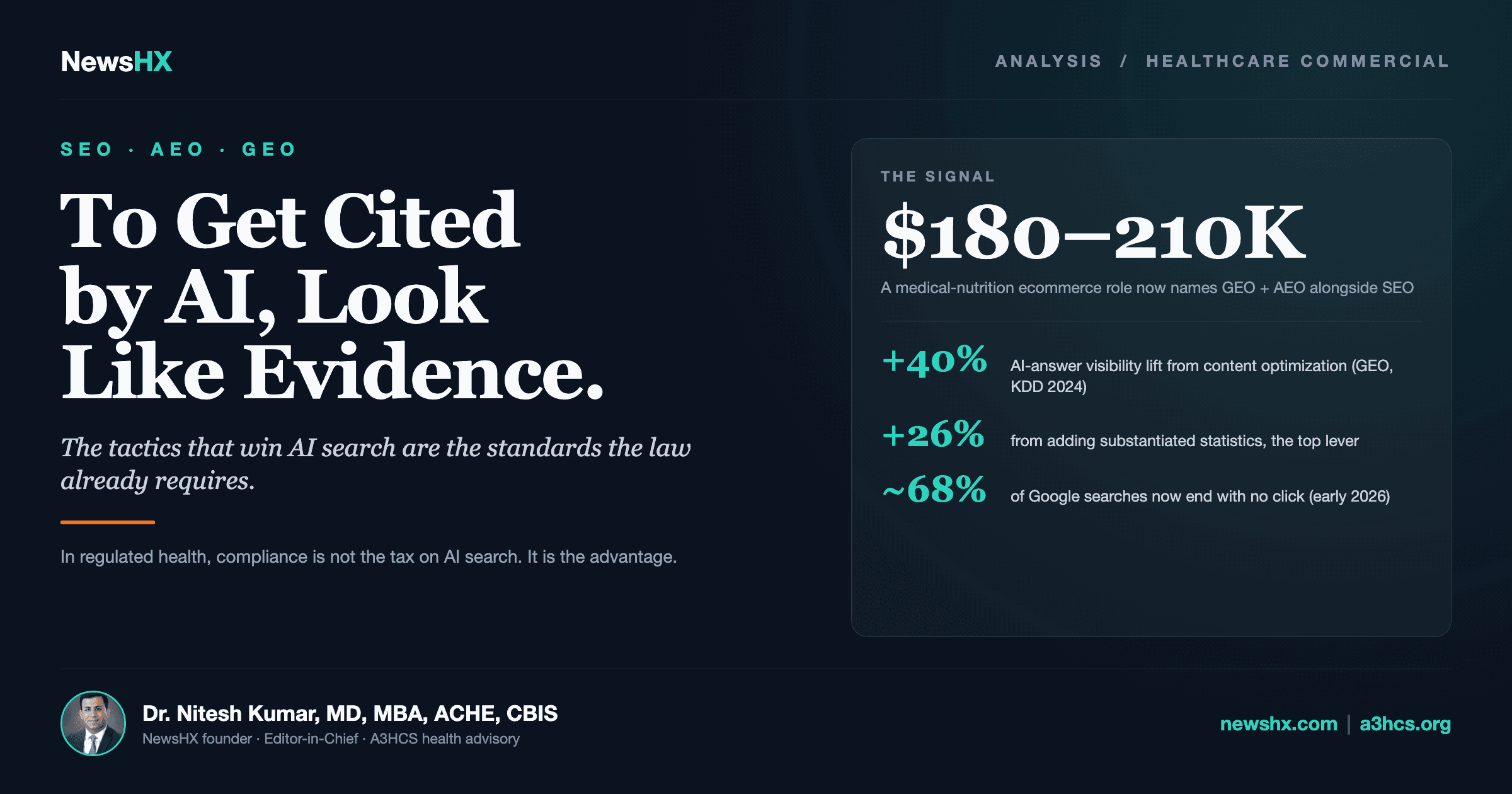
A director-level job posting is a company telling you, in public and against its own budget, what it has decided it can no longer live without. So when a large medical-nutrition company writes a role that pays up to $210,000 to run its consumer ecommerce, and that role lists Generative Engine Optimization and Answer Engine Optimization as named competencies alongside conventional SEO, that is not a marketing department chasing a trend. That is a P&L owner deciding that being found, cited, and recommended by AI answer engines is now a revenue line worth a senior hire and a compliance review.
The instinct is to file this under "marketing acronym inflation" and move on. That would be a mistake, because the healthcare version of this story is genuinely different from the version you have read on every SEO blog since 2024. In an unregulated category, GEO and AEO are a tactics race. In clinical nutrition, supplements, and any direct-to-consumer health product, the same tactics collide head-on with the FDA's rules on what you may claim and the FTC's rules on what you must prove. Most of the industry is reading that collision as a problem. It is closer to the opposite. It is the clearest competitive advantage a credible healthcare brand has been handed in a decade, and almost nobody is set up to use it.
A job description is a company betting its budget on what it can no longer live without. This one bet on being recommended by a machine, and stapled FDA compliance to the same page.
First, the acronyms, because even the experts disagree on one of them
Three terms are doing the work here, and one of them is actively booby-trapped.
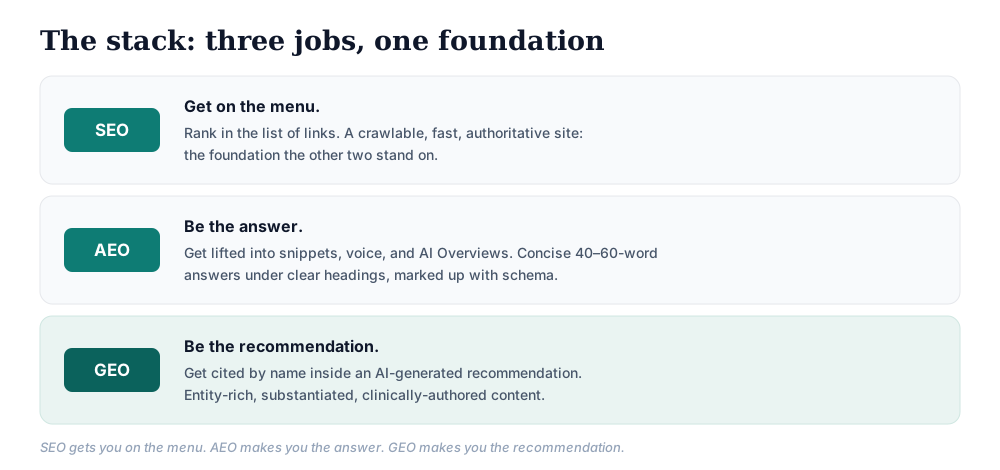
SEO, Search Engine Optimization, is the one everyone knows: earning a ranked spot in the classic list of blue links on Google or Bing. The mental model is a menu. The engine hands the user a set of links and the user chooses. Your job is to be high on the menu.
AEO, Answer Engine Optimization, is the discipline of being the extracted answer itself, the text a search engine lifts into a featured snippet, a "People Also Ask" box, a voice reply, or the top of an AI Overview. The user never has to choose a link because the answer is already on the screen. The practitioner consensus on how to win it is unglamorous and specific: answer real questions in 40 to 60 words under a clear heading, and mark the content up with structured data so the machine can find and trust the answer.
GEO, Generative Engine Optimization, is the newest and the one to be careful with. In the sense the job posting means, and the sense this article uses, GEO is getting your brand synthesized and cited by name inside an AI-generated recommendation, the paragraph ChatGPT or Perplexity or Google's AI writes when someone asks "what should I take for X." Here is the trap: a large amount of the "GEO" content circulating in training decks and interview-prep guides uses GEO to mean geographic or local SEO, the older discipline of ranking in map packs and "near me" searches. Two different skills, one abbreviation. If your marketing team or your agency says "GEO," make them tell you which one they mean before you approve a budget, because a plan built to win map-pack visibility will do nothing to get you cited by a generative model, and vice versa.
The clean way to hold the three: SEO gets you on the menu. AEO makes you the answer. GEO makes you the recommendation. They stack. SEO's fundamentals, a crawlable, fast, authoritative site, are the ground the other two stand on, which is why the job posting asks for all three from one leader rather than treating them as rival religions.
Why this landed in healthcare now
The reason a nutrition company is hiring for this in 2026 and would not have in 2023 is that the front door to health information has quietly moved.
Start with behavior. Roughly two-thirds of Google searches now end without a click, about 68 percent in the US in early 2026 by SparkToro's clickstream analysis, up from 60 percent two years earlier, resolved on the results page itself because the answer, increasingly AI-generated, is already there.1 Bain's research puts it more bluntly: about 80% of consumers now rely on zero-click, AI-summarized results for at least 40% of their searches, and estimates the shift has already cut organic web traffic by 15 to 25%.2 The link, the thing SEO spent 20 years optimizing, is losing its monopoly on attention to the synthesized answer above it.
Health is not an average case here; it is the leading edge. Analyses of search behavior through 2025 found that health and science queries saw the steepest growth in AI Overview triggers of any category, health rising more than 20%.3 That makes intuitive sense. Health questions are exactly the anxious, complicated, "just tell me" questions a synthesized answer serves well, which is why an AI Overview or a chatbot answer now sits on top of a large share of them. Precise prevalence figures vary widely by study and method, and I would treat any single "X% of health queries" statistic with suspicion, but the direction is not in doubt.
And people are, cautiously, accepting the answers. In an Annenberg survey in 2025, 79% of US adults said they were likely to search online for a health symptom, and among those who encountered an AI-generated answer, roughly six in ten found it at least somewhat reliable.4 The caution is real and worth respecting: Pew found only 22% of Americans use an AI chatbot for health information, and just 18% of those users rate the answers highly accurate, with physicians still by far the most-trusted source.5 So the honest read is not "everyone trusts Dr. ChatGPT." It is that a large and growing minority is forming purchase-relevant health impressions inside AI answers, and a brand that is absent from those answers is absent from that decision entirely.
The front door to health information moved. Roughly two-thirds of searches now end with no click, and health queries are where AI answers grew fastest. A brand absent from the answer is absent from the decision.
What actually makes an AI engine cite you, according to the one study that ran the experiment
This is where the healthcare story turns, so it is worth being precise about evidence rather than vibes.
Almost everything written about GEO is vendor opinion. There is, however, one piece of real research: a peer-reviewed study out of Princeton and Georgia Tech, presented at KDD 2024, that did the actual experiment. The authors built a benchmark of 10,000 queries and systematically tested which changes to a source made a generative engine more likely to surface and cite it. They found content-side optimization could lift a source's visibility in AI answers by up to 40%.6
The interesting part is which changes won. The biggest, most durable gains came from adding relevant statistics (roughly +26% visibility), quoting authoritative sources (+28%), citing sources inline, and writing with clear, fluent authority.6 The tactic that did the least, barely better than doing nothing, was old-school keyword stuffing.6 In a real-world test against Perplexity, the statistics and quotation effects held, statistics lifting citation likelihood by more than a third.6
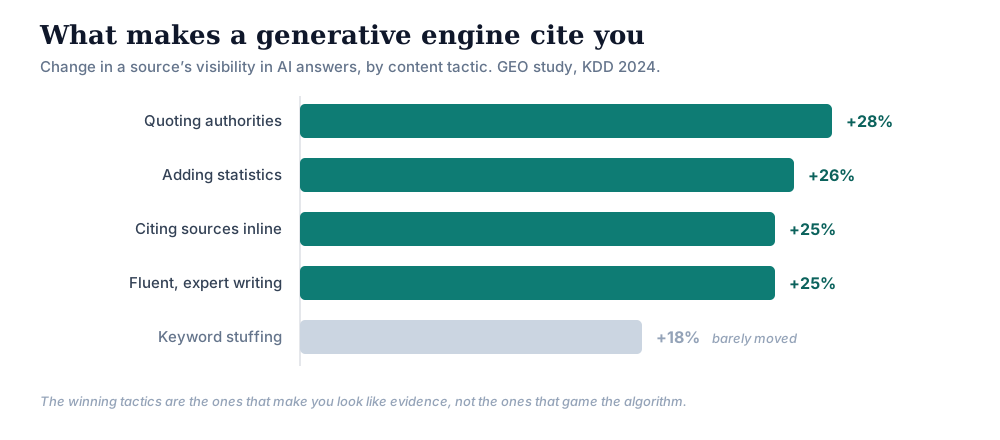
Sit with what that says. The machine does not reward you for gaming it. It rewards you for looking like a well-sourced, statistically grounded, authoritatively written reference, because that is what a language model is pattern-matching to when it decides whom to cite. The winning move in GEO is, essentially, to be a good clinical document.
The one real study on getting cited by AI found the winning tactics are statistics, authoritative quotation, and inline citations. Keyword tricks barely moved. To get recommended by the machine, you have to look like evidence.
The collision, and why it is a gift to healthcare brands
Now bring in the regulator, because this is the exact point where the generic marketing advice becomes dangerous, and where the healthcare-specific opportunity opens up.
A direct-to-consumer nutrition or supplement product does not get to say whatever wins the algorithm. Under DSHEA, the 1994 law that governs dietary supplements, a product may make a structure/function claim, describing a nutrient's role in the body's normal structure or function, such as "protein supports muscle maintenance." It may not make a disease claim, that it treats, prevents, cures, or mitigates a disease, without becoming, legally, an unapproved drug.7 Every structure/function claim must carry the verbatim FDA disclaimer, "This statement has not been evaluated by the Food and Drug Administration. This product is not intended to diagnose, treat, cure, or prevent any disease," must be substantiated by competent and reliable scientific evidence, and must be notified to the FDA within 30 days of marketing.7 Layered on top, the FTC's Health Products Compliance Guidance, updated in 2022 for the first time in a generation, requires that same standard of competent and reliable scientific evidence for any health-related claim, in any medium, and it explicitly does not carve out new formats.8 An AI-surfaced claim is still a claim.
Now watch the collision. The peer-reviewed GEO research says: add statistics and strong, authoritative claims to get cited. FDA and FTC law says: every statistic and claim about a health product must be substantiated, and must never imply disease treatment. The naive marketer hears the first sentence and writes punchy, stat-laden, benefit-maximizing copy that wins the algorithm and fails the audit. There is a specific, underappreciated failure mode here that belongs in every healthcare marketing review: an AI engine, summarizing your carefully lawful structure/function claim, can paraphrase it into a disease claim you never made, and it will be your brand's name attached to the sentence. "Supports respiratory function" becomes, in the machine's synthesis, "helps treat COPD." That is not a hypothetical compliance risk. It is the native behavior of a summarization engine pointed at health copy.
Here is the turn. The very thing that makes this hard for everyone is the thing that makes it winnable for the credible few. The GEO research says the machine rewards substantiated statistics, authoritative quotation, and expert tone. FDA and FTC law require substantiated statistics, defensible sourcing, and disciplined, non-overreaching claims. The compliance standard and the citation standard are pointed in the same direction. A brand that already writes to survive an FTC challenge, cites its evidence, quotes real clinicians, and refuses to overclaim, is producing exactly the content a generative engine is most inclined to cite. The unregulated competitor spraying unsubstantiated superlatives is optimizing for a machine that is increasingly trained to distrust them, and is one paraphrase away from a warning letter. In regulated health, rigor is not the cost of doing GEO. Rigor is the mechanism of doing GEO well.
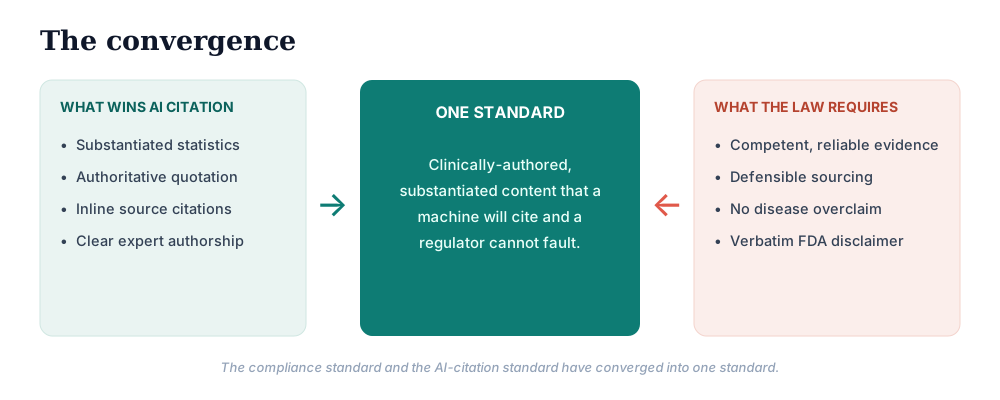
GEO research says the machine cites substantiated statistics and authoritative sourcing. FDA and FTC law require substantiated statistics and authoritative sourcing. The compliance standard and the AI-citation standard are the same standard. That is the whole opportunity.
Why clinical authorship is the asset, not the overhead
There is a second regulatory-flavored force pushing the same way, and it comes from Google's own rulebook.
Google classifies health among its "Your Money or Your Life" (YMYL) topics, the categories where bad information can do real harm, and it instructs its quality raters to hold that content to a higher bar of E-E-A-T: Experience, Expertise, Authoritativeness, and Trustworthiness.9 The guidelines, updated in September 2025 to explicitly cover AI Overviews, state that high-quality medical content "should be written or produced by people or organizations with appropriate medical expertise or accreditation."9 This is not a suggestion a health brand can route around with cleverness. It is the documented standard by which the systems feeding AI answers judge whether health content deserves to be surfaced.
You can see the standard operating in the wild. When AI engines answer health questions, they overwhelmingly cite government and major academic-medical sources, the NIH, Mayo Clinic, Cleveland Clinic, and the large clinical publishers.10 The exact citation-share percentages come from vendor studies and should be read as directional, but the pattern is consistent and unsurprising: the machine reaches for the most authoritative health entities it can find. A direct-to-consumer nutrition brand is not going to out-rank the NIH. That is the wrong goal. The achievable and valuable goal is to be the credible, clinically-authored source the engine pulls in alongside the NIH, the brand whose structure/function explanation is specific, sourced, and written by a named clinician with real credentials.
This is why a physician byline, an author schema with genuine credentials, and content reviewed by clinical and regulatory staff are not compliance overhead bolted onto a marketing program. In the AI-search era they are the growth asset itself. The credential that satisfies your Medical Affairs reviewer is the same credential that satisfies Google's E-E-A-T rater and the same signal a generative engine weighs when it decides whose explanation to trust. Most healthcare marketing organizations have this exactly backwards, treating clinical review as the thing slowing the content down, when it is the thing that will make the content win.
The playbook, ranked by how much evidence actually backs it
For an operator who has to turn this into a plan next quarter, here is the honest hierarchy, strongest evidence first, because a lot of what is sold as "AI-search strategy" is unproven and priced as if it were settled.
Do first, because the evidence is real. Write to be cited: lead sections with substantiated statistics, quote named clinical authorities, and cite your sources inline. This is the one set of tactics with peer-reviewed backing,6 and in a regulated product it is also the content most likely to pass legal review. Put a credentialed clinical author on the byline and mark it up so the credential is machine-readable. Structure your product-adjacent education as direct questions with concise, correct answers, the format both AEO extraction and FDA-safe claim language reward.
Do next, as high-value hygiene, but do not oversell it. Implement structured data, JSON-LD schema for Organization, Product, Article, FAQ, and author/Person, plus medical-content schema where it fits. Schema demonstrably helps traditional rich results and gives machines a clean read of your entities. What it does not have is confirmation from Google or the AI labs that it directly lifts generative citations, so treat it as foundational infrastructure, not a magic lever. Build topical authority through clusters of genuinely useful content rather than one thin page per keyword.
Do experimentally, with clear eyes. Publish an llms.txt file if you like, but know that no major AI engine has confirmed it reads or honors it; it is a proposed convention, not an adopted standard, and anyone selling it as essential is ahead of the evidence. Treat reputation and third-party citation building as brand hygiene that plausibly helps, not as a measurable growth channel.
And govern the whole thing, because this is healthcare. Route AI-search copy through the same Regulatory, Legal, and Medical Affairs review as any other promotional claim, and specifically test how the leading engines paraphrase your claims, not just how you wrote them. On data, retire the reflexive assumption that "we are not a hospital, so HIPAA does not apply." For most DTC health sellers that is true and beside the point. The live exposure is the FTC, whose updated Health Breach Notification Rule now reaches consumer health apps and platforms, and whose Section 5 authority governs how you collect and use customer health data regardless of HIPAA.8 The privacy risk in DTC health did not disappear because HIPAA does not reach you. It moved to a regulator that does.
Most of what is sold as AI-search strategy is unproven and priced as if it were settled. The tactics with real evidence are the ones that also pass legal review. Fund those first.
What has to be true
The signal in that job description is correct, and health-system and healthcare-brand leaders should read it as a directive rather than a curiosity. Being found, cited, and recommended by AI answer engines is becoming a primary way consumers form health-purchase decisions, and it is worth owning at a senior level. But the version of this that works in regulated health is not the version in the marketing playbooks.
Two things have to be true at once. The AI-search discipline has to be run as a commercial function, with a real owner, real budget, and the evidence-ranked priorities above, not as a side quest for the SEO contractor. And it has to be run as a regulated commercial function, wired into Medical Affairs, Regulatory, and Legal from the first draft, because in health the compliance standard and the AI-citation standard have converged into one standard. The company that treats that convergence as a burden will produce cautious, generic content that no engine bothers to cite. The company that treats it as the strategy, that puts credentialed clinicians on the byline, substantiates every number, refuses to overclaim, and tests how the machine reframes its words, will be the one the machine recommends.
Clinical nutrition brands have spent years being told that rigor is what slows them down. AI search has quietly inverted that. For the first time, the most compliant, most clinically credible source in the category is also the one most likely to win the machine. The brands that understand this are not going to advertise that they understand it. They are just going to be the answer.
If you are standing up an AI-search function and it is not wired into Medical Affairs and Legal yet, that is the work I do.
I help health systems and healthcare brands build AI search as a regulated commercial function: a real owner, evidence-ranked priorities, credentialed clinical authorship, and Regulatory, Legal, and Medical Affairs wired in from the first draft. In regulated health the compliance standard and the AI-citation standard have converged into one standard. The brands that treat that convergence as the strategy are the ones the machine will recommend.
References
- Fishkin R. "In 2026, Less Than One-Third of Google Searches Still Send a Click." SparkToro, 2026. US zero-click share 68.0% in early 2026, up from 60.5% in 2024 (Similarweb clickstream).
- Bain & Company. "Goodbye Clicks, Hello AI: Zero-Click Search Redefines Marketing." 2024. About 80% of consumers rely on AI-summarized results for at least 40% of searches; organic traffic cut 15-25%; roughly 60% of searches end without progressing to a website.
- Semrush / industry analysis of AI Overview trigger growth by vertical, January-March 2025 (health +20.3%, science +22.3%). Treated as directional. https://thedigitalbloom.com/learn/2025-organic-traffic-crisis-analysis-report/
- Annenberg Public Policy Center. "Many in U.S. Consider AI-Generated Health Information Useful and Reliable." April 2025. 79% of US adults likely to search online for a health symptom; roughly six in ten consider AI-generated health information at least somewhat reliable.
- Pew Research Center. "Where Do Americans Get Health Information, and What Do They Trust?" Survey conducted October 2025; published April 7, 2026. 22% use AI chatbots for health information at least sometimes; among those users, 18% rate the answers extremely or very accurate; providers (used by 85%) remain the most-trusted source.
- Aggarwal P, Murahari V, Rajpurohit T, Kalyan A, Narasimhan K, Deshpande A. "GEO: Generative Engine Optimization." Proceedings of KDD 2024. arXiv:2311.09735. Peer-reviewed. Visibility lift up to ~40%; largest gains from quotation addition, statistics addition, citing sources, and fluent authority; keyword stuffing barely moved.
- U.S. Food and Drug Administration. "Structure/Function Claims" (dietary supplements; DSHEA 1994; 21 CFR 101.93). Verbatim disclaimer, substantiation-before-claim standard, and 30-day notification requirement.
- U.S. Federal Trade Commission. "Health Products Compliance Guidance." December 2022 (first revision in roughly 25 years; "competent and reliable scientific evidence," extended to all health-related products). See also the FTC Health Breach Notification Rule (updated 2024): https://www.ftc.gov/business-guidance/resources/collecting-using-or-sharing-consumer-health-information-look-hipaa-ftc-act-health-breach
- Google. "Search Quality Rater Guidelines (General Guidelines)." September 11, 2025. YMYL and E-E-A-T; guidance that high-quality medical content should be produced by people or organizations with appropriate medical expertise or accreditation; adds AI Overviews evaluation criteria.
- Surfer SEO. "AI Citation Report." 2025. In the health vertical, AI citations are dominated by government and academic-medical sources (NIH, Mayo Clinic, Cleveland Clinic, and large clinical publishers). Vendor study; the pattern is consistent across studies, the exact percentages are single-source and directional.