

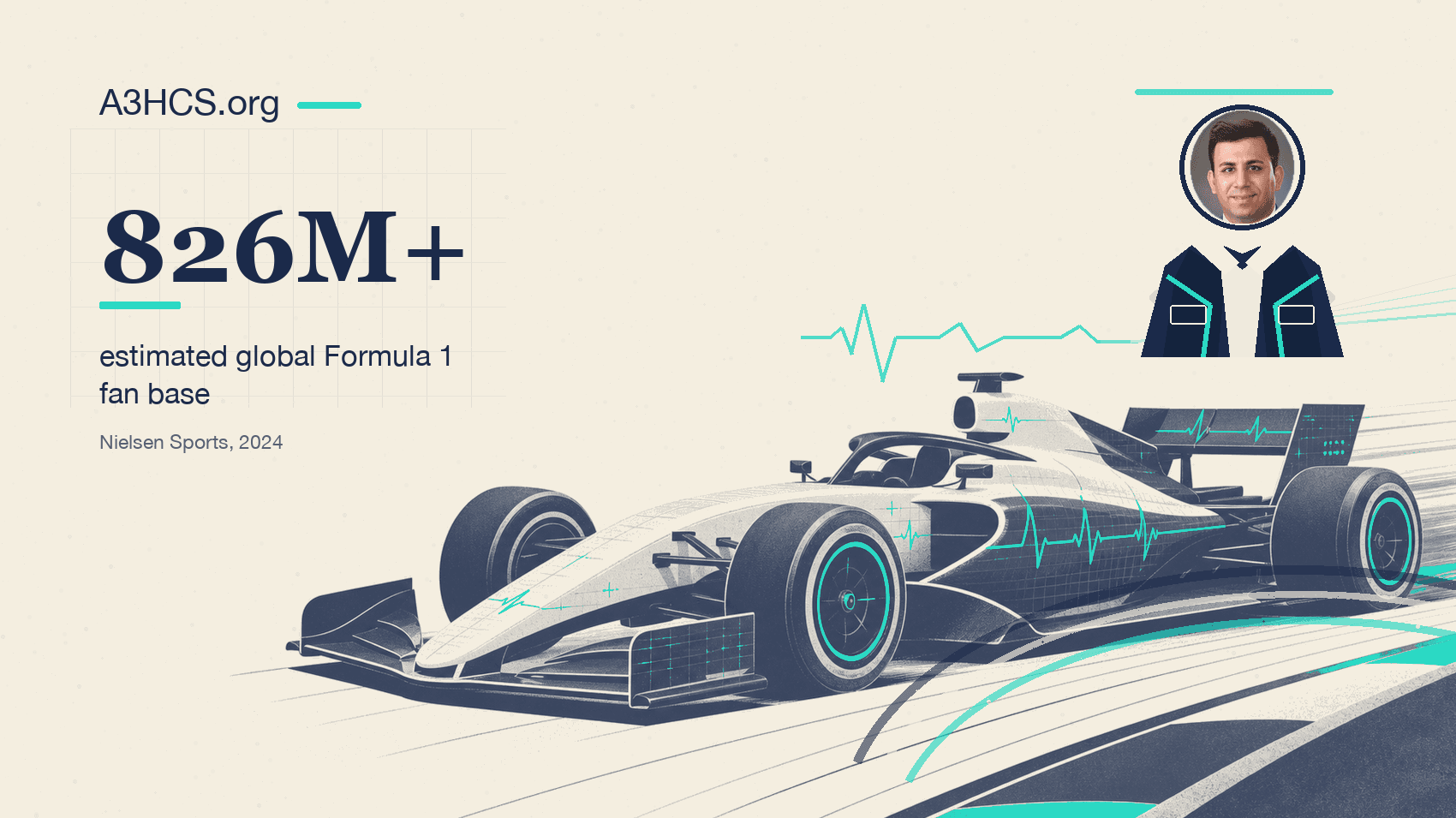
When the news broke that UChicago Medicine had become the first health system in the world to sponsor a Formula 1 team, the reaction in my feed was almost unanimous, and almost entirely wrong. A hospital spending money on a race car while nurses burn out and margins stay thin. Vanity. Mission drift. A logo where a bedside should be.
I understand the reflex. I also think it is exactly backward. Strip away the spectacle and what UChicago Medicine actually did is one of the more disciplined strategic bets I have seen an academic medical center make in years. It is not a marketing stunt. It is a read on where healthcare competition is moving, and a move made early, while the price was still low.
The partnership with the MoneyGram Haas F1 Team launched in late 2024 and steps up from Official Supporter to Official Healthcare Partner through 2027. Thomas Jackiewicz, who runs the University of Chicago health system, framed it plainly.
“Formula 1's global reach aligns with our vision to connect with more national and international communities.” That sentence is the whole strategy, and it deserves to be taken seriously rather than dismissed.
What the logo is actually buying
An academic medical center does not compete for one kind of customer. It competes simultaneously for four scarce things, and brand is the single asset that moves all four at once.
The first is the destination patient. The complex, high-acuity, often international or self-funded case is one of the few genuinely high-margin volumes left in American medicine. Those patients, and the physicians who refer them, do not choose a hospital from a local billboard. They choose from a short list of globally recognized names. Formula 1 reaches the exact affluent, international, mobile audience that this market is made of, in the Gulf, in Asia, in Latin America, in markets where UChicago has no physical footprint and no other affordable way to be seen.
The second is talent. Two in five healthcare workers entered 2026 describing their job as unsustainable. In that environment, the academic centers that recruit best are the ones clinicians already feel proud to be associated with. Brand is a recruiting instrument, not a billboard.
The third is philanthropy and research capital. The donors and partners who fund academic medicine sit in precisely the demographic that fills an F1 paddock. Proximity to that world is not frivolous. It is donor development. The fourth is the referring institution and the payer, where reputation is quiet leverage in every contract an academic center negotiates.
When clinical quality becomes table stakes, brand stops being decoration and becomes the differentiator. UChicago is buying salience in the four markets that decide whether an academic center thrives or merely survives.
Why brand became the battleground
There is a deeper reason this move is timed well, and it is the part most healthcare leaders have not fully absorbed. Clinical quality is commoditizing as a marketing claim. Not as a reality, the work is as hard as ever, but as a differentiator. Outcomes are now public. Care Compare, Leapfrog, and the quality scorecards have made “we have great outcomes” a statement every competent system can make. When everyone can credibly claim quality, quality stops sorting the market. Something else has to.
At the same time, the front door to healthcare is being rebuilt by AI. Patients, caregivers, and referring physicians increasingly ask a model where to go, not a search bar. In that world, the institutions that get named are the ones with the strongest entity authority and the highest brand salience. This is the same logic that governs whether a publication gets cited by an answer engine, and it now governs whether a health system gets recommended by one. Brand is becoming a discovery mechanism, not just a feeling.
So the question for any health system board is no longer whether brand matters. It is whether you are building brand on a platform that is growing and global, or one that is shrinking and local. UChicago picked the one that is growing, and global, and aimed squarely at the audience it actually wants.
The move only the academics could make
Here is the part that turns a good marketing decision into a genuinely smart one, and it is the part the cynics missed entirely. UChicago Medicine did not just buy ad space on a car. It built a research program around the sponsorship, studying sleep, circadian health, and human performance under the most extreme conditions a body endures outside of medicine itself, an F1 team across a global season.
That detail changes the entire character of the spend. A pure logo is a cost. A logo attached to a first-of-its-kind study on elite human performance is a research asset, a faculty recruiting story, a donor narrative, and a stream of citable, peer-reviewable science all at once. It makes the budget defensible to the people inside the building who would otherwise resent it, the faculty and the clinicians, because it advances the academic mission rather than competing with it.
This is the discipline I look for when I advise systems on a brand investment. The test of whether a sponsorship is strategy or vanity is whether it converts into the things the institution actually needs. UChicago engineered the conversion in from the start. The science is not decoration on the sponsorship. The science is the sponsorship working.
The honest objection, and the honest answer
I will not pretend the criticism has no merit. A health system can absolutely spend on brand while its operations are broken, and that would be indefensible. The objection is not wrong in principle. It is just wrong in this case, and the way to tell the difference is simple.
If the sponsorship is a flywheel, it is strategy: brand drives destination volume, volume drives margin, margin funds the mission, and the research output feeds the brand again. If it is just a logo, with no conversion path and no academic anchor, it is vanity. The structure UChicago built is the structure of a flywheel, not a logo.
And then Chicago gets a race
Now the part that makes this look less like marketing and more like foresight. Chicago has already proven it can host a marquee street race. The NASCAR street course on the lakefront put a grid through the heart of the city and onto global television. Formula 1 is in the middle of the most aggressive U.S. expansion in its history, with three American races already on the calendar and an appetite for more iconic urban backdrops. A Chicago Grand Prix is not a fantasy. It is a logical next entry on a trajectory that is clearly pointed at major American cities.
If, or when, that race comes, consider who is already positioned. UChicago Medicine is not a system scrambling to buy relevance after the circus arrives and the sponsorship price has tripled. It is the established healthcare face of the sport, on home soil, with a multi-year relationship and a research story already running. The official medical and human-performance narrative of a Chicago Grand Prix would have an obvious owner, and that owner bought the position years before the asset appreciated.
The smart corporate move is not sponsoring Formula 1. It is buying the relationship before the race comes to your backyard, while it is still cheap, instead of after, when it is not.
Being early on a platform that is heading toward your own city is the rare brand bet that compounds. Everyone who follows UChicago into Formula 1 over the next five years, and there will be many, will pay more for less, and will be the second health system to do something rather than the first.
What the future looks like
I expect this to become a category, not a curiosity. Within a few years, the marquee academic systems and the well-capitalized international ones will treat global sports and human-performance science the way they currently treat research institutes, as a pillar of the brand rather than a marketing line item. The convergence is already visible. Sleep, circadian health, longevity, and performance medicine are moving from the lab into a consumer category, and the institutions that own credible performance science will own a market that barely exists today.
The healthcare leaders who internalize this early will stop asking whether brand spending is appropriate and start asking whether it is structured to convert. The ones who do not will keep reading a race car as a vanity project right up until the moment a competitor's logo, and a competitor's research, is the one the world associates with excellence under pressure.
UChicago Medicine saw that future, priced it correctly, and bought in before the rest of the field showed up to the grid. Whatever you think of the spectacle, the strategy is sound. The honest read is not that a hospital wasted money on racing. It is that a hospital understood, earlier than its peers, what brand is actually for.
Is your brand structured to convert, or just to be seen?
A3HCS works with health system and academic medical center leaders on the strategic side of brand — turning reputation into destination-patient volume, recruiting strength, and philanthropic reach, rather than treating it as a marketing line item to defend.