


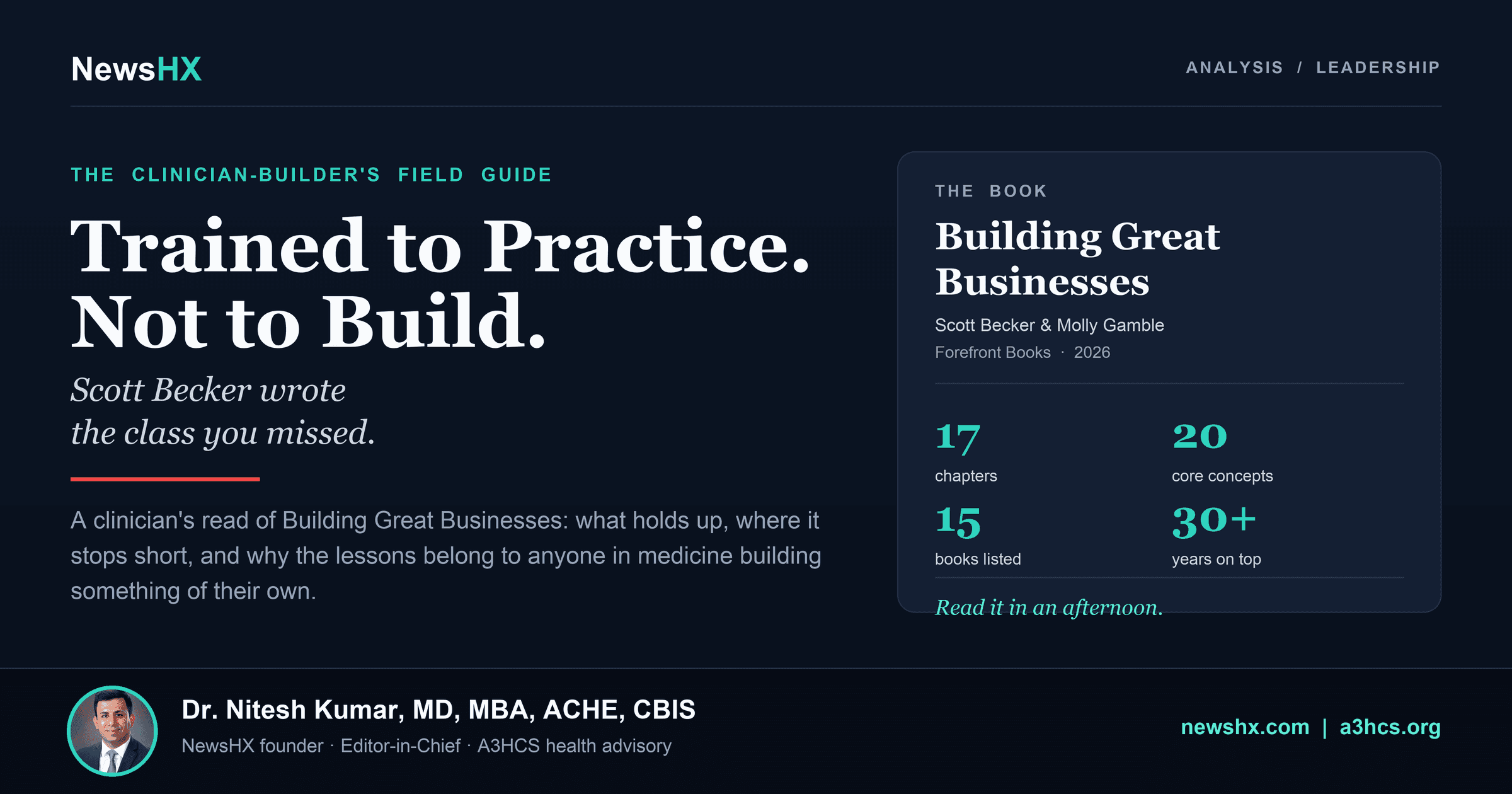
We train for a decade to deliver care and almost not at all to build the thing that delivers it. A clinician learns physiology to three decimal places and never reads a page on cash flow, niche selection, or how to hold a team accountable. That gap does not stop physicians from building. It just means most of us learn the lessons the hard way: a practice that never finds its footing, a service line that stalls, a side venture that drains a savings account before it ever turns the corner.
So it is worth paying attention when the person who built one of healthcare's most-read media companies sits down and writes the manual. Scott Becker, founder of Becker's Healthcare and a longtime partner at McGuireWoods, has a new book out with Molly Gamble called Building Great Businesses. It is short: seventeen chapters, readable in an afternoon. I read it cover to cover, not as a fan, but as someone in the middle of building. What follows is the clinician's field guide to what is inside. 1
First, the reason this lands the way it does. Becker did not build a hospital or a device company. He built a legal practice and, alongside it, a media company. That media company started as nothing more than what he calls thought leadership: a few articles, some speeches, a small website, a rudimentary newsletter, and one small conference, all aimed at branding himself as the go-to healthcare lawyer in a narrow niche, ambulatory surgery centers. That effort grew into one of the nation's leading healthcare media companies. It is the exact pattern a lot of us are running right now, and the pattern behind NewsHX. When the author's origin story is the thing you are living, you read the book differently. 1
The book is aimed squarely at people like us. Its praise pages are stacked with physician-builders: Stephen Klasko, the former CEO of Jefferson Health; Nisha Mehta, who built Physician Side Gigs; Imamu Tomlinson, the physician-CEO of Vituity, sitting alongside the usual venture and private-equity names. For all of its general-business framing, this is really a healthcare-builder's book, written by the lawyer who had a front-row seat while a generation of them built.
“You have to dig ten ditches before they dig themselves”
The first line that stopped me was this: you have to dig ten ditches before they start to dig themselves. Becker pairs it with Jim Collins's flywheel from Good to Great. The argument is that no single defining moment, no killer innovation or lucky break, builds a great company. There is only relentless, repeated effort until the momentum compounds on its own. 2
This is the part clinicians most need to hear, because medicine conditions us to expect feedback fast. You give the medication, the pressure comes up. You reduce the fracture, the alignment holds. Building does not work that way. The articles you write, the talks you give, the early version of a service nobody asks for yet: those are ditches one through nine, and they feel like failure right up until the moment they do not.
Medicine trains you to expect a response to every intervention. Building asks you to keep intervening for months with no response at all, and to call that progress.
I have felt this one personally. Every NewsHX piece, every Brain Revives module, every early consulting conversation has been a ditch dug with no momentum visible at the bottom of it. Becker's point is mechanical, not inspirational. The flywheel only turns if you keep pushing it long past the point where pushing still feels worth it.

Find a niche, not a nation
The strongest chapter in the book is on niche-driven businesses, and it is the one with the most direct bearing on anyone in healthcare. Becker's advice is unequivocal: niche down, but test several niches first. He frames every market choice with two questions. Can you win in this niche? And is it worth winning? 1
He tells his own story plainly. He started in the brutal, overcrowded world of major corporate law, where the elite firms had sharper elbows and deeper resources, and he made a deliberate decision to leave it for a specific corner of healthcare: surgery centers. Not healthcare. Surgery centers. He borrows Seth Godin's line, find a niche not a nation, and he is blunt that a giant total addressable market does not impress serious investors. It signals that you have not focused. 3
The economics of that choice are worth sitting with, because they are the opposite of glamorous. A surgery-center client, he writes, might bill ten to thirty thousand dollars a year in legal fees, a rounding error next to a health-system account. But the elite firms were not chasing surgery centers, which is exactly why he could win them, build a stable of them, and develop real expertise fast. He calls it the big-fish-in-a-small-pond bet, and he backs the focus with a number: the most concentrated companies, he notes, run profit margins well above their unfocused peers. Going narrow, in his telling, was never a compromise; it was the entire point. 1

This is the lesson healthcare professionals resist the hardest. The instinct, especially for a credentialed clinician, is to claim the widest possible mandate: I can serve all of cardiology, all of primary care, all of post-acute. Becker's entire career is a thirty-year argument for the opposite. Pick the pond where you can actually be the big fish, prove you can win it, and only then expand.
It is the principle behind the narrowest bet I have made. Brain Revives is not brain health. It is the post-discharge window for traumatic brain injury: the first 90 days home, the part of the journey the system funds least and patients survive worst. That is a niche, not a nation. Becker's book is the clearest case I have read for why that kind of narrowness is an advantage rather than a limit.
Cash flow is king, and the goalposts are not allowed to move
Becker devotes real attention to the unglamorous financial discipline the entrepreneurship highlight reel skips, and clinicians should read these pages twice, because money is precisely what our training omits.
Cash flow is king sounds obvious until he dissects how founders rationalize their way out of profitability. They tell themselves this kind of business takes twenty-six months to turn, or that one more hire, one more feature, one more market will fix everything, all while raising their own monthly expenses and moving the goalpost they were supposed to be running toward. He pairs this with two rules that belong on a wall. Keep two balance sheets: stay financially secure both inside and outside the business, so you can keep taking risks without being destroyed if the venture goes sideways. And know when to turn off the lights: a self-funding founder needs a loss limit, like a player at a blackjack table, because Becker has watched capable people sell income-producing assets to feed a business that was never going to pay them back.
For physicians, this is the most protective material in the book. We are high earners who are statistically terrible at the discipline of building. The two-balance-sheets rule, in particular, is the difference between a clinician who can afford to take an entrepreneurial swing and one who bets the house on it.
Physicians are high earners and, too often, undisciplined builders. The rule that protects you is simple: never let the business you are building put the life you have already built at risk.
Nobody builds it alone
Becker is direct that he is not a believer in the one-man army, the solopreneur. Great companies, he argues, are not built alone, and he offers a clean test for whether you are actually building one. Leaders should be measured on three things: whether they deliver results, how many other leaders they develop, and how well the organization performs after they are gone. 1
He makes the case with numbers rather than sentiment. He sat on the board of one 'supernova' company built around a single charismatic founder, and it eventually exited for a few million dollars. He sat on another whose CEO built the team incrementally, leader by leader, and it sold for more than $800 million. The leadership structure was not the only difference, he is careful to say, but he puts it at the root of most of them. Staying the only indispensable person in the room, it turns out, is an expensive place to get comfortable. 1

Two of his team principles are worth carrying into any clinical enterprise. The first is addition by subtraction: the difficult client or the toxic team member almost always costs more than the void their departure leaves, and removing them is a net gain immediately and over time. The second is the case for an accountability leader, the person every organization needs to hold teams to their goals, who, Becker notes honestly, will periodically be attacked for doing exactly what the company needs. Any physician who has run a department, a practice, or a committee has felt both of these in their bones, and probably acted on neither soon enough.
His own example for addition by subtraction could have come from any medical group. A surgeon leader told him, two decades ago, that he wanted at least twenty orthopedic surgeons in his group for one specific reason: so the group could never be held hostage by the two or three who were impossible to work with. Depth is what lets you hold the line. Any physician who has built a call schedule around a single toxic partner, or kept a difficult referrer happy because the volume felt indispensable, already knows the feeling. You earn the room to say no by building enough that no one relationship can sink you.
Where the book stops short
A useful review names the limits, so here are two.
It is a business-to-business book wearing a general-business cover. Becker is refreshingly honest that nearly all of his success came in B2B, and that he does not know much about business-to-consumer beyond watching a few failures. That candor is admirable, but it means clinicians building direct-to-patient tools, cash-pay practices, or anything that lives or dies on reaching individuals will find the distribution side underdeveloped.
And it is a distillation, not a deep operating manual. Across seventeen short chapters, the last of which runs through twenty of his favorite business concepts, several ideas that deserve a chapter get only a few pages. That is a feature if you want the mental models fast, and a limit if you want the granular how. The book partly solves this itself: it doubles as an annotated reading list from someone who has read everything, capped by an appendix of fifteen books and threaded with Collins, Drucker, Thiel, Grove, Koch, and McKeown. Becker is not just teaching here. He is handing you his syllabus. 2,4,5
The levers worth keeping
Think of these seven as the clinician-builder's operating system, pulled straight from the book.
Dig the ten ditches. The unglamorous, repeated work is not the thing you do before the building. It is the building.
Niche, not nation. Answer both questions honestly: can you win here, and is it worth winning?
Get to cash-flow positive, and stop moving the goalposts. Name the rationalizations out loud.
Keep two balance sheets. Never let the venture endanger the life you already built.
Judge yourself by how many leaders you develop, not how much you personally produce.
Practice addition by subtraction. The difficult client and the toxic hire cost more than the gap they leave.
Keep it simple. Every great result comes from obsessively focusing on a few things; every average one from trying to do too much.
The bottom line
Is the book worth a clinician's time? In the foreword, Jessica Cole, Becker's longtime partner and now the CEO of Becker's Healthcare, says her measure of a great book is whether you walk away with two or three solid takeaways. By that test it overdelivers, and I say so as someone primed to be skeptical of any business book a successful person hands me. It will not teach you to build a consumer brand, and it will not give you the granular detail of a Horowitz or a Ries. What it will do is hand you the hard-won models of someone who built two real businesses in the most complex industry there is, and stayed at the top of one of them for three decades, without the clinical training the rest of us lean on. 1,6
Medicine gave us the hardest part: the expertise, the trust, the standing in front of patients and systems. What it never gave us was the class on how to build something around that expertise. Becker just taught it. The highest compliment I can pay the book is that I picked it up to assess it and put it down with a to-do list.
Sitting on clinical expertise, wondering how to build around it?
A service line, a practice, a venture. That is the gap between knowing medicine and building in it. A3HCS helps clinicians and healthcare operators turn expertise into operating discipline: niche and market strategy, cash-flow rigor, team and accountability structures, and the unglamorous execution that actually compounds.
References
- Scott Becker and Molly Gamble. Building Great Businesses: Create Momentum, Overcome Setbacks, and Scale with Confidence. Foreword by Jessica Cole, CEO of Becker's Healthcare. Forefront Books (distributed by Simon & Schuster), 2026. ISBN 978-1-63763-540-7. simonandschuster.com/books/Building-Great-Businesses/Scott-Becker/9781637635407
- Jim Collins. Good to Great: Why Some Companies Make the Leap... and Others Don't. Harper Business, 2001.
- Seth Godin, “find a niche, not a nation.” Cited in Becker & Gamble, Building Great Businesses, ch. 10 (orig. Seth Godin, The Bootstrapper's Bible, Upstart, 1998).
- Peter Thiel with Blake Masters. Zero to One: Notes on Startups, or How to Build the Future. Crown Business, 2014.
- Greg McKeown. Essentialism: The Disciplined Pursuit of Less. Crown Business, 2014.
- About the authors: Scott Becker, entrepreneur, lawyer, and investor with more than three decades at the intersection of healthcare, media, and law; founder and publisher of Becker's Healthcare, partner at McGuireWoods, Harvard Law graduate, and host of the Becker's Healthcare Podcast and the Becker Private Equity & Business Podcast. Molly Gamble, vice president of editorial at Becker's Healthcare. In Becker & Gamble, Building Great Businesses, 2026.