


The argument over whether ADHD is overdiagnosed has been running for thirty years and has not moved, which is usually a sign that the question is badly posed. One side points to prescription volume and a diagnostic label that keeps expanding. The other points to adults who spent decades being told they were careless. Both sides are describing something real, and they keep talking past each other because they are answering different questions. One is asking whether the condition exists. The other is asking who gets identified as having it. Those have entirely different answers.
What ADHD actually is
Before the argument, the thing itself. ADHD is a neurodevelopmental disorder, not a behavior problem and not a personality type, and it is diagnosed clinically. There is no biomarker for it. No blood test, no scan, no imaging finding. What a clinician has is a symptom count, a duration, a setting requirement and an impairment threshold, applied to behavior that other people observed and reported.
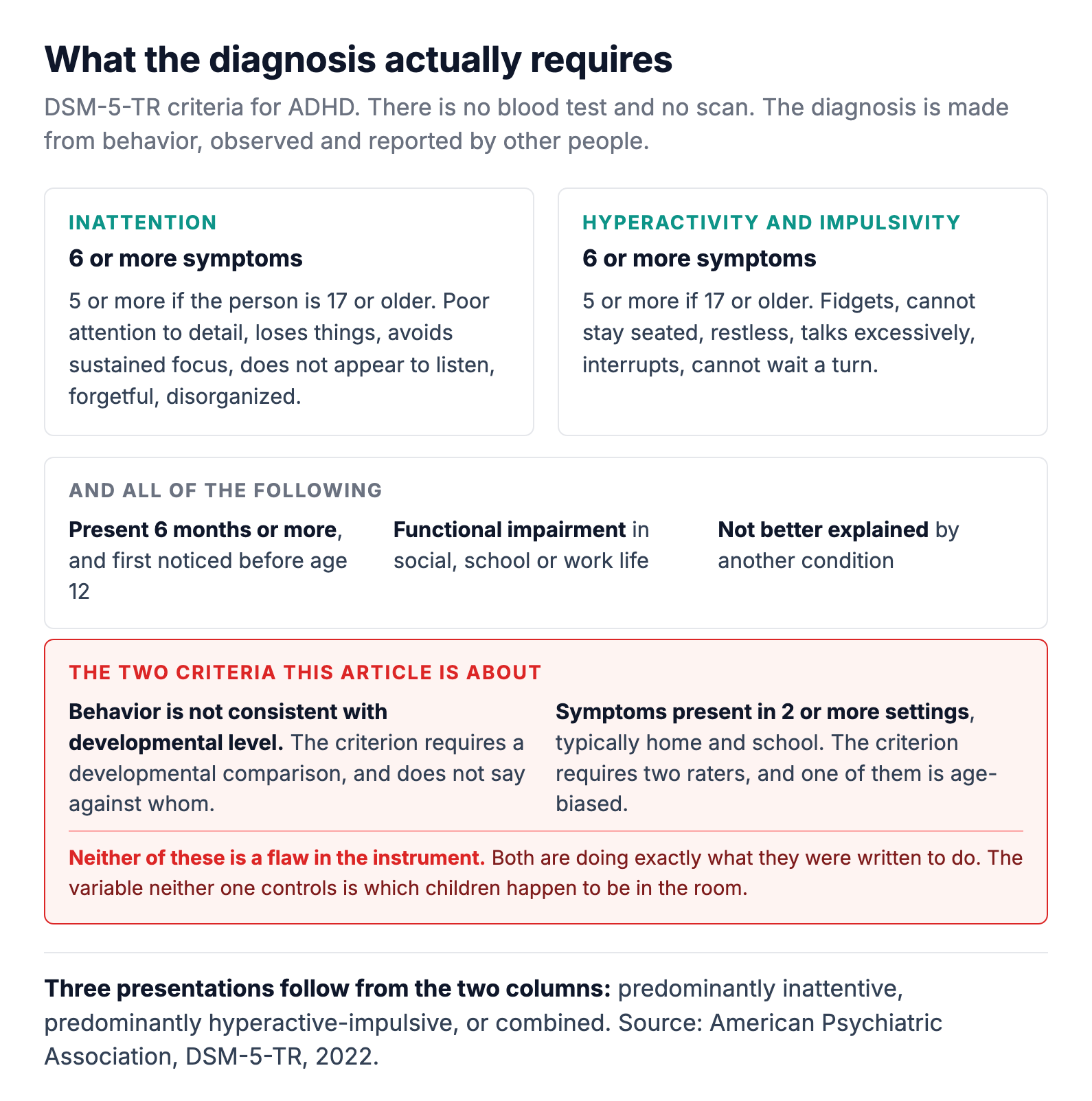
The criteria are specific. Six or more symptoms of inattention, or six or more of hyperactivity and impulsivity, or both, dropping to five once the person is seventeen. Present for at least six months. First noticed before age twelve. Impairing in social, academic or occupational life. Not better explained by another condition, which means the workup also has to clear a long differential including sleep disorders, hearing and vision impairment, absence seizures, thyroid disease, anxiety and specific learning disorders, any of which can present as inattention. Meeting one column gives a predominantly inattentive or predominantly hyperactive-impulsive presentation. Meeting both gives the combined presentation.5
Two of those requirements are where this entire article lives, and both are worth reading slowly. The first is that the behavior must be inconsistent with developmental level. That is a comparison, and the criterion does not say against whom. The second is that symptoms must appear in two or more settings, in practice home and school, which means the diagnosis requires two raters. Neither requirement is a defect. Both are doing exactly what they were written to do. What neither one controls is which children happen to be sitting in the room when the comparison gets made.
The threshold, not the condition
Here is the argument I want to make. ADHD is among the most heritable conditions in psychiatry, and that is not seriously contested in the genetics literature. What varies enormously, across countries and within them, is the threshold at which a society notices it. That threshold is not set in a clinic. It is set in a classroom, by comparison to whichever children happen to be sitting in the room. Four independent lines of evidence converge on this, and the most persuasive one does not require crossing a border at all.
The biology is not the part in dispute
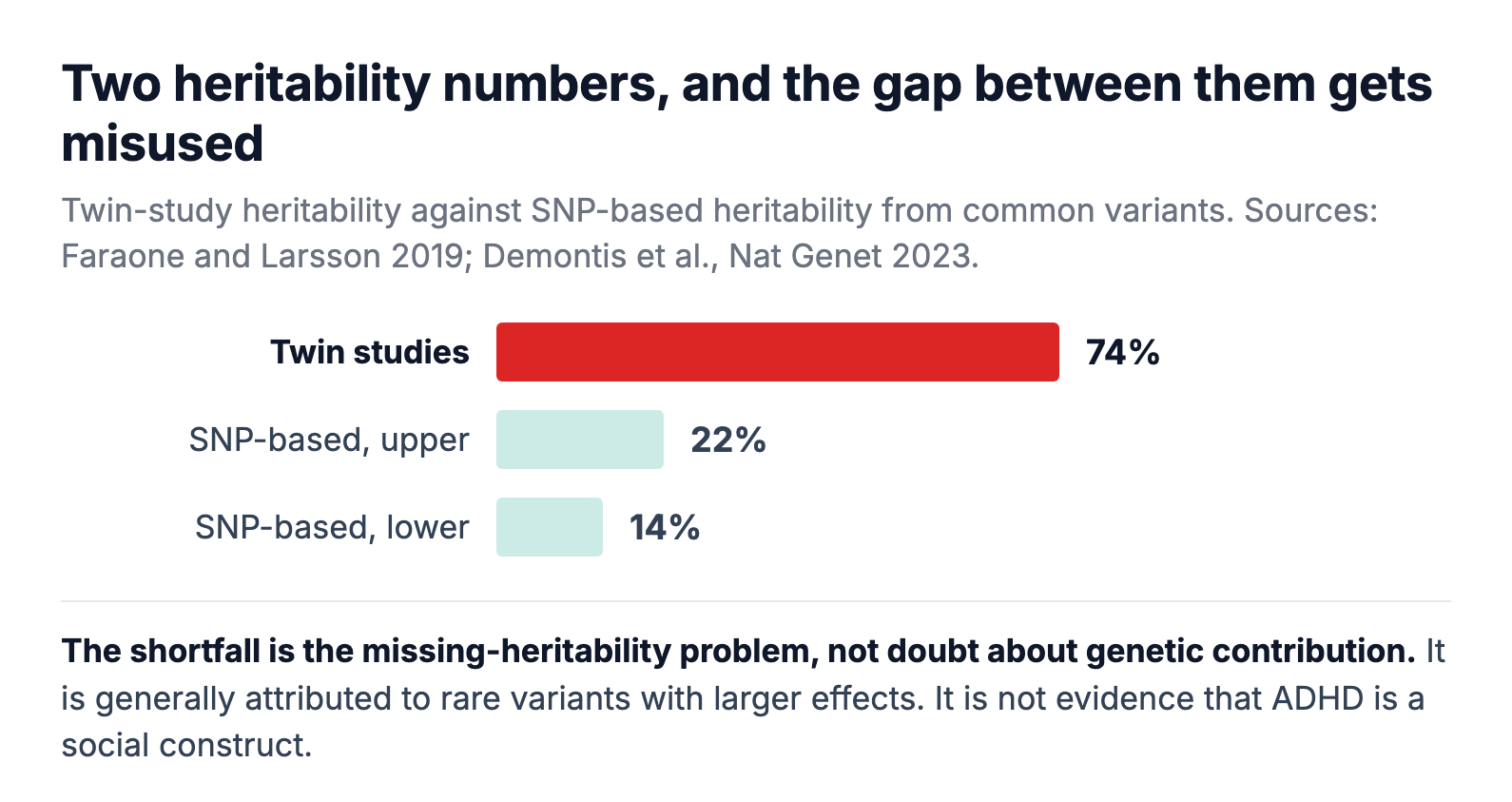
Start with what is settled, because the rest of this piece is easy to misread without it. Twin studies converge on a heritability for ADHD of approximately 74 percent.1 That places it alongside height and above most conditions psychiatry treats. The molecular picture caught up more slowly but is now substantial. A 2023 genome-wide association study analyzing 38,691 individuals with ADHD against 186,843 controls identified 27 genome-wide significant loci.2
There is a gap between those two numbers worth naming, because it gets misused in both directions. SNP-based heritability from common variants runs only 14 to 22 percent, well short of the 74 percent from twin studies.1,2 That gap, the familiar missing-heritability problem, is generally attributed to rare variants with larger effects rather than to any doubt about genetic contribution. It is not evidence that ADHD is a social construct. It is evidence that common-variant arrays do not capture everything a twin design does.
So the neurobiology is real, substantially inherited, and present in every population that has been studied. Which makes what follows more interesting, not less. If the underlying rate is broadly stable, then large differences in who carries a diagnosis have to come from somewhere else.
A birthday is worth thirty-four percent
The cleanest evidence comes from a natural experiment inside a single country, which removes culture, health system, and diagnostic tradition as explanations. Researchers examined 407,846 children born between 2007 and 2009 using insurance claims, comparing children in the 18 states that use a September 1 kindergarten cutoff.3 In those states, a child born in August is among the youngest in the class. A child born in September starts a year later and is among the oldest.
The rate of ADHD diagnosis was 34 percent higher among the August-born children, and the rate of ADHD treatment was 32 percent higher.3 Nothing about neurodevelopment changes across a three-week span in a birth calendar. What changes is who the child is sitting next to.
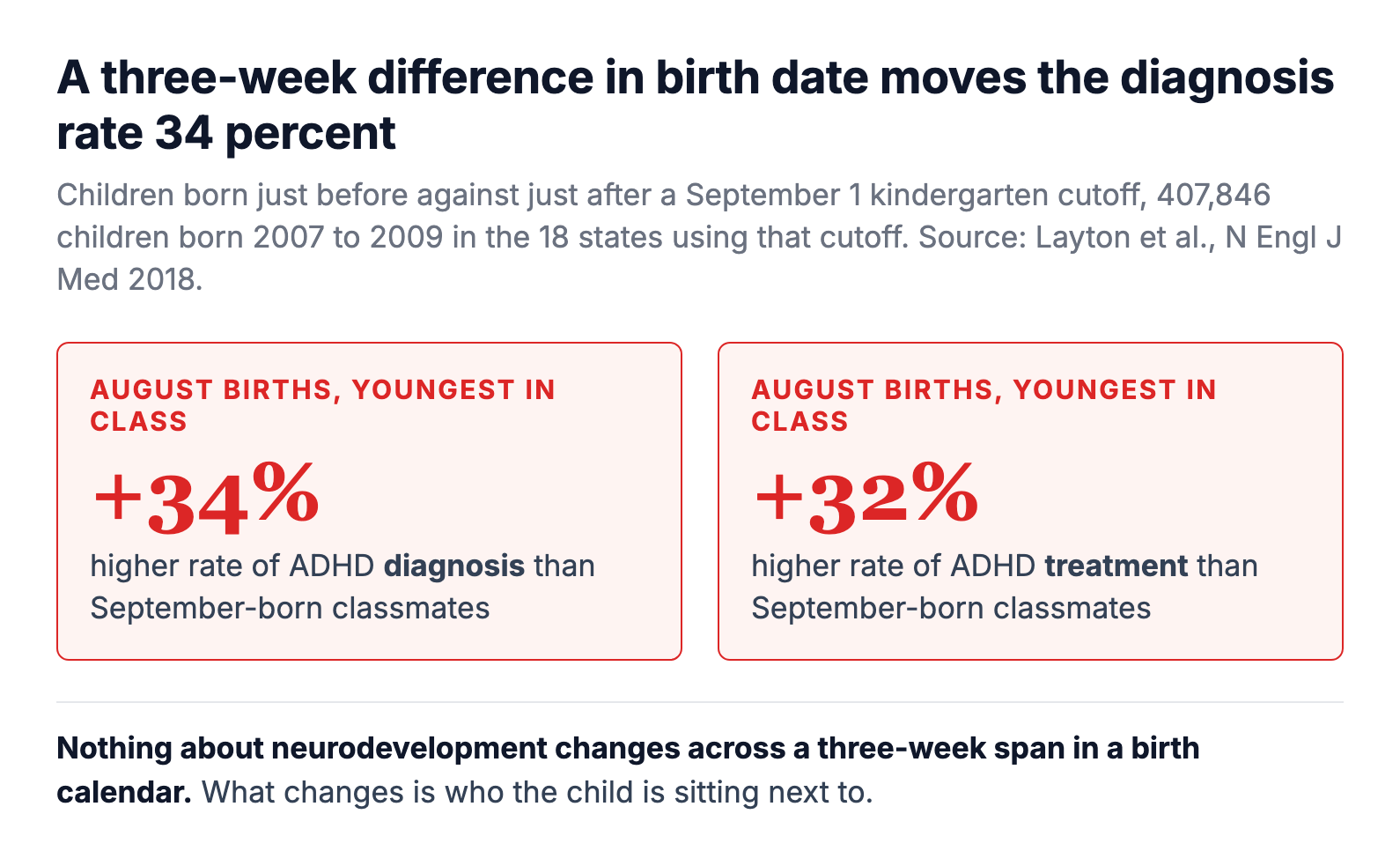
Nothing about neurodevelopment changes across a three-week span in a birth calendar. What changes is who the child is sitting next to.
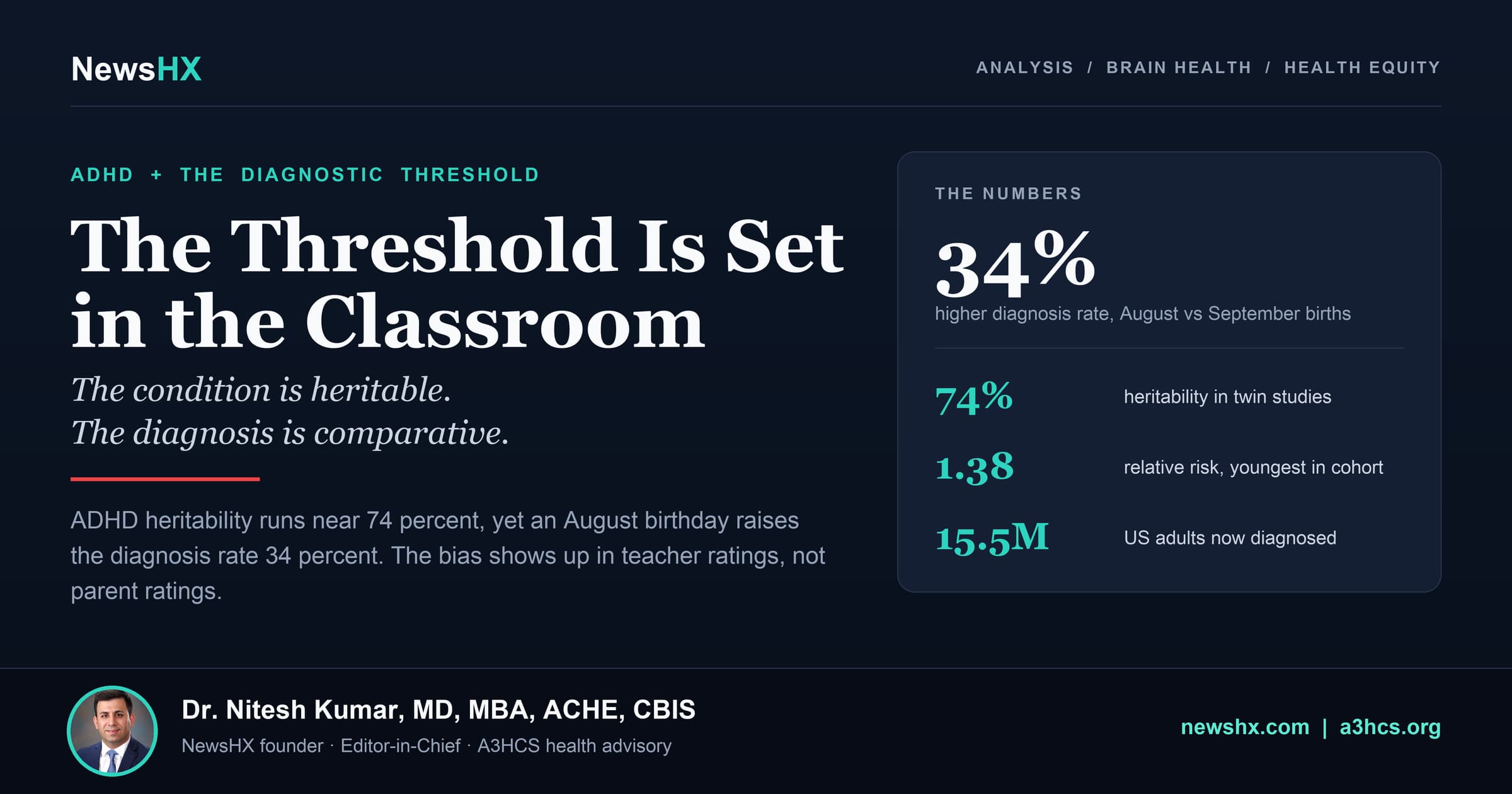
74 percent heritability in twin studies. 34 percent higher diagnosis rate for August births against September births under a September 1 cutoff. 15.5 million United States adults with a current ADHD diagnosis.1,3,12
That is one study in one country, so the obvious question is whether it replicates. It does, at scale. A 2024 systematic review and meta-analysis pooled 32 studies and found that relatively younger children in a school cohort carried a relative risk of 1.38 for an ADHD diagnosis and 1.28 for ADHD medication.4 The effect was most pronounced in primary-school children and faded through adolescence, which is exactly the pattern you would expect if the mechanism is developmental comparison rather than pathology.4
It is worth walking through what that finding actually describes, and I want to be explicit that the following is an illustration of the published study design rather than a case I am reporting. Picture two children in the same kindergarten room in a September 1 cutoff state. One was born in late August, the other in early September of the prior year, so they are nearly a full year apart in development while sitting in identical chairs. Both fidget. Both interrupt. One of them is the youngest child in the room and is being compared against peers with twelve additional months of frontal-lobe maturation. The diagnostic criteria require that symptoms be inconsistent with developmental level and impairing across two or more settings.5 The instrument is sound. The comparison group is the variable nobody controls.
This is not an argument that those children do not have ADHD. Many of them do. It is an argument that relative immaturity and the condition itself produce overlapping presentations at age five, and the reporting adults cannot reliably separate them. The referral originates there, not with a clinician.
The bias is in the teacher's rating, not the parent's
Which reporting adult, though? The same meta-analysis answers that, and the answer is the most important finding in this piece. A relative-age effect appeared in teacher ratings of ADHD symptoms. It did not appear in parent ratings.4
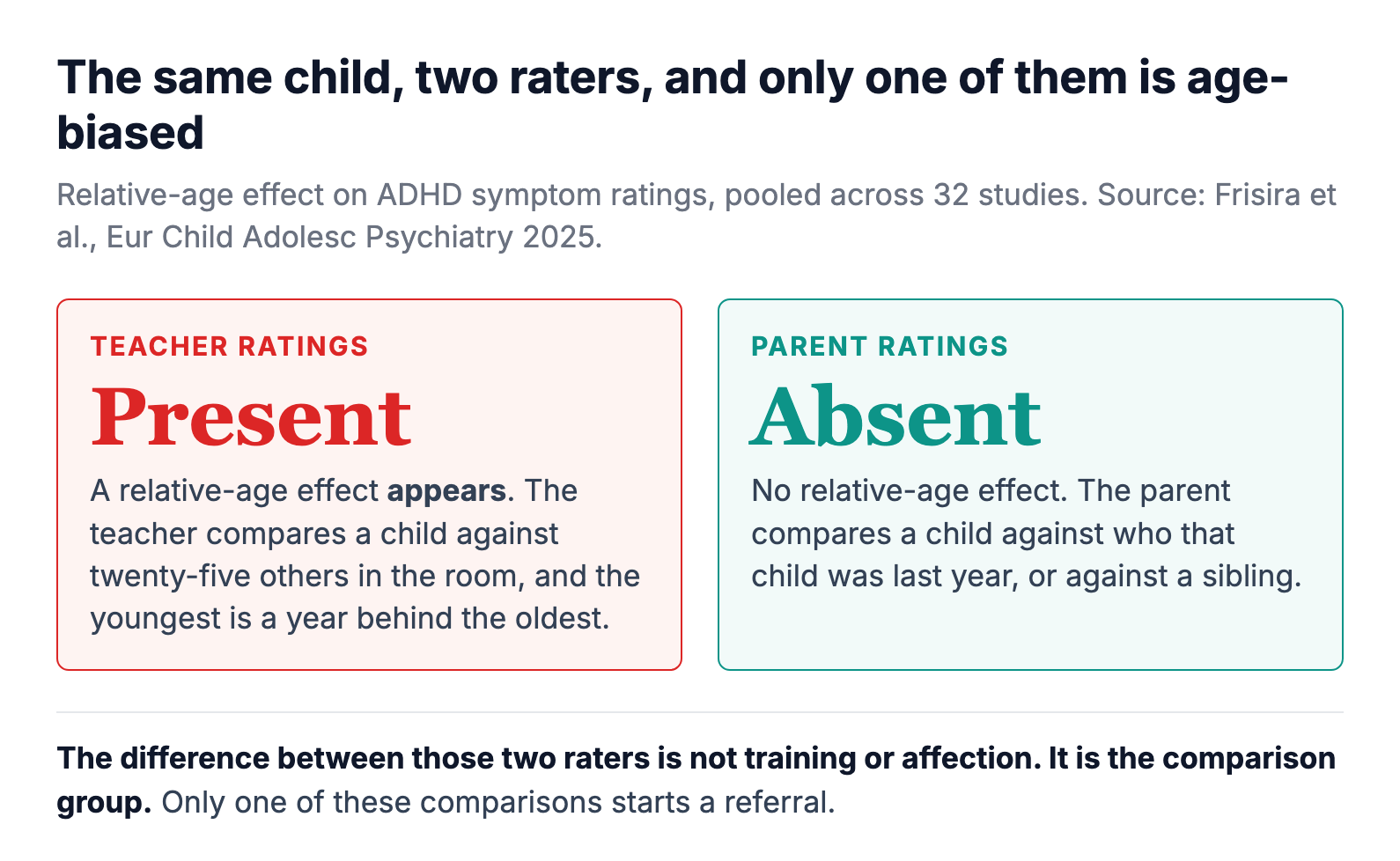
Sit with what that means. The same child, rated in the same month, on instruments measuring the same construct, produces an age-biased score from the teacher and an unbiased one from the parent. The difference between those two raters is not training or affection. It is the comparison group. A parent compares a child to that child last year, or to a sibling. A teacher compares a child to twenty-five other children in the room, and in a single-cutoff system the youngest of them is a year behind the oldest.
A parent compares a child to who that child was last year. A teacher compares a child to the twenty-five others in the room. Only one of those comparisons is age-biased, and only one of them starts the referral.
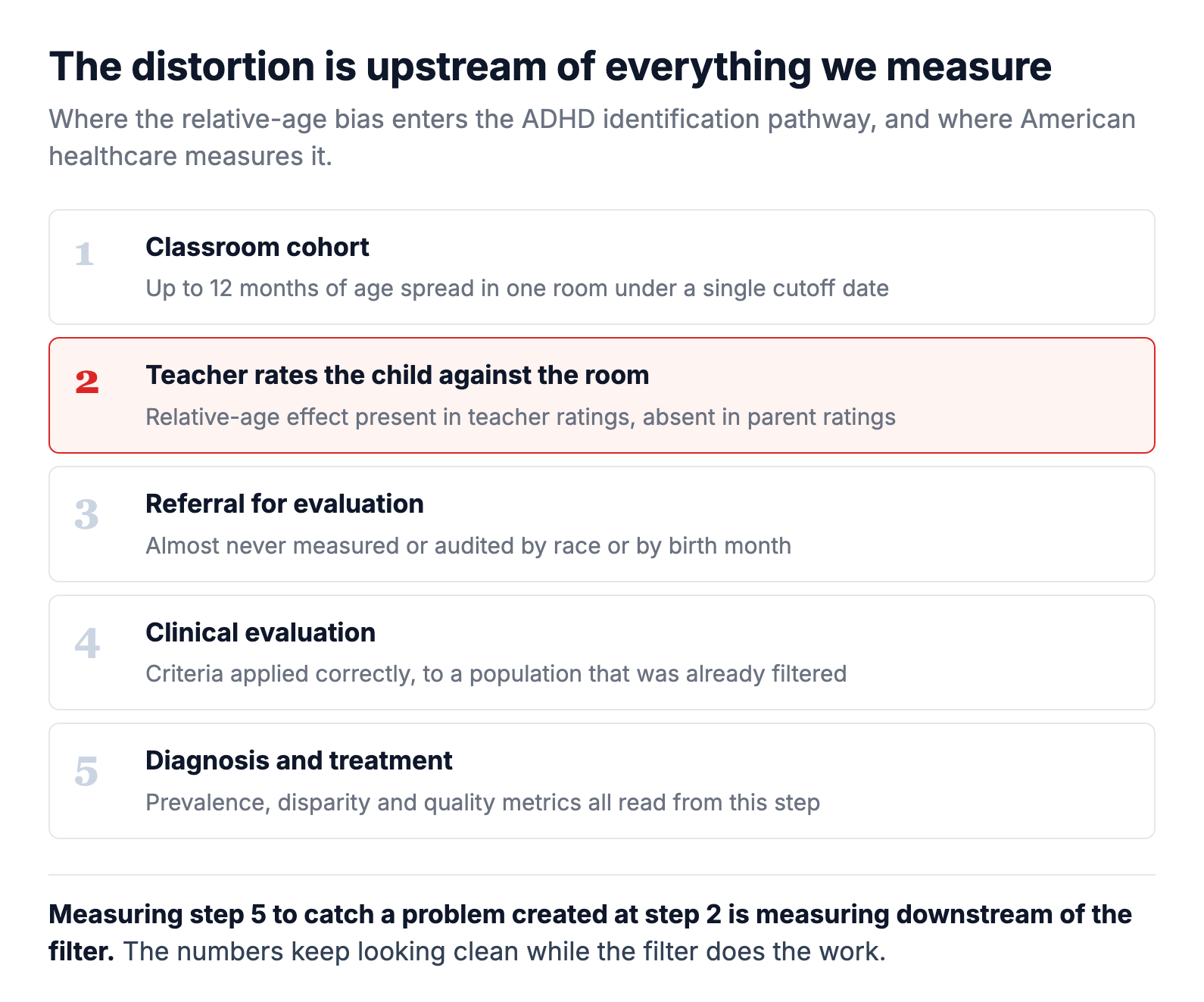
That is the mechanism, stated precisely. The classroom is not a metaphor here. It is the measuring instrument, and it has a known, quantified, replicated calibration error that nobody corrects for.
Most of the international variation is measurement
The cross-country picture points the same direction. The landmark meta-analysis pooled 102 studies covering 171,756 subjects across every world region and found a worldwide prevalence of 5.29 percent.6 The finding that matters is not the headline number. It is what explained the spread around it. In multivariate metaregression, the significant predictors of a study's prevalence estimate were diagnostic criteria used, source of information, and whether functional impairment was required for the diagnosis.6 Geographic origin contributed, but the authors concluded it plays a limited role once methodology is accounted for.
Put plainly: when a country reports a low ADHD rate, the first hypothesis should be that it asked a different question, not that its children are different. Requiring impairment lowers estimates. Asking teachers rather than parents changes them, and we now know exactly how. ICD hyperkinetic-disorder criteria are stricter than DSM criteria and produce systematically lower numbers for the same children.
India shows what the threshold does in practice
India is a useful worked example because the range in its own literature is wider than the difference usually claimed between nations. A June 2026 review in Frontiers in Psychiatry reports Indian prevalence estimates spanning 1.5 percent to 22.9 percent depending on region and methodology, with southern Indian studies running 5.76 to 22.9 percent and northern and northeastern studies 6.34 to 12.66 percent.7 A Delhi study of young adults found 14 percent screening positive for symptoms.7 Those figures bracket United States rates rather than sitting below them.
What the review describes is not absence of the condition but failure to see it. The authors write that ADHD in India is “markedly under-diagnosed, with pervasive gaps in awareness, delayed identification, and limited access to specialized interventions.”7 The mechanism they name is the one that should interest anyone building diagnostic pathways: in many communities children are “socialized to obey authority and adhere to collective norms, leading behaviors such as impulsivity or inattentiveness to be perceived as signs of indiscipline or poor upbringing rather than as manifestations of a neurodevelopmental condition.”7
That is the threshold operating. The behavior is identical. The interpretation assigned to it determines whether a referral ever happens. A child read as poorly raised does not get evaluated. A child read as struggling does.
The overdiagnosis story is not the only story running
Here is the finding that should complicate anyone's confident position, mine included. Within the United States, the disparity does not run the direction the public conversation assumes. Following 17,100 children in a nationally representative cohort from kindergarten through eighth grade, and controlling for confounders, the odds of receiving an ADHD diagnosis were 69 percent lower for African American children and 50 percent lower for Hispanic children than for white peers.8 The authors report that measured confounders did not explain the gap.8
Critically, this is not lower symptom burden. A separate Pediatrics study following 4,297 children across fifth, seventh and tenth grade found Black children exhibiting ADHD symptoms at a higher rate than white children while being diagnosed considerably less often.9 The treatment gap was starker still. Among children who had already received a diagnosis, 36 percent of Black children and 30 percent of Latino children were taking medication, against 65 percent of white children.9 The authors concluded the pattern reflects underdiagnosis and undertreatment of Black and Latino children rather than overdiagnosis of white children.9
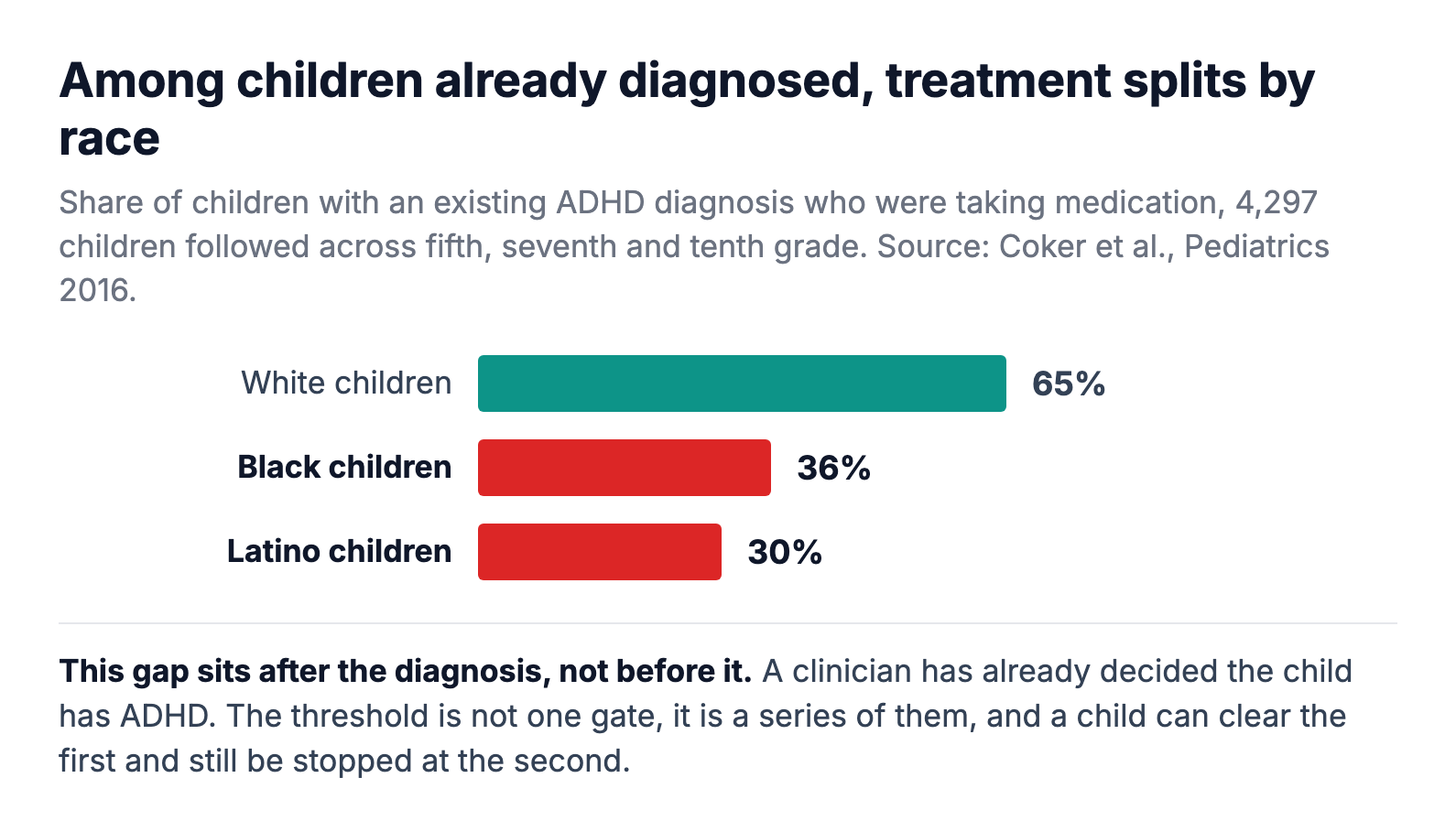
Note where that second failure sits. The first gap is at identification, which is the classroom step. The second is at treatment, which happens after a clinician has already made the diagnosis. The threshold is not a single gate. It is a series of them, and a child can clear the first and still be stopped at the second.
The national picture confirms there is room for both stories at once. In the 2022 National Survey of Children's Health, 11.4 percent of United States children aged 3 to 17, roughly 7.1 million, had ever been diagnosed with ADHD, and 10.5 percent had current ADHD.10 Among those with current ADHD, 30.1 percent, about 1.9 million children, were receiving neither ADHD medication nor behavioral treatment, up from 23.0 percent in 2016.10 A country can be simultaneously accused of handing out a label too freely and be leaving three in ten diagnosed children with neither arm of the standard treatment, a share that is growing.
So the same country that produces a 34 percent birth-month effect is also failing to identify the condition in the children least likely to be extended the benefit of the doubt, and then failing again at the treatment step for those it does identify.
Both things are true at once, and they are the same phenomenon. A threshold that responds to the observer's expectations will over-identify in some populations and under-identify in others. That is not a contradiction in the data. It is the signature.
Where this lands for health systems right now
The adult side is where this stops being an academic argument. CDC survey data put 15.5 million United States adults, roughly 6.0 percent, with a current ADHD diagnosis, and approximately half of them were diagnosed at age 18 or older.11,12 Adult diagnosis is not a fringe phenomenon or a recent fashion. It is half the diagnosed adult population, which is exactly what you would predict if childhood identification has been operating on a threshold that missed large groups.
Capacity did not follow. About one third of adults with ADHD took a stimulant in the prior year, and 71.5 percent of those reported difficulty filling the prescription because the medication was unavailable.12 Roughly half have used telehealth for ADHD services.12 A 2024 CDC Health Advisory flagged that medication shortages combined with disrupted access raise the risk of injury and overdose.12 The identification pathway expanded and the supply chain did not, which is a health system failure rather than a psychiatric one.
And the guideline that would standardize adult practice is still not here. The United States has never published a dedicated clinical guideline for adult ADHD comparable to its pediatric standards. The American Professional Society of ADHD and Related Disorders has been building the first set since 2022, and as of this writing it remains unpublished; CHADD, its dissemination partner, now describes the guidelines and the accompanying provider toolkit as arriving in 2027.13,14 So roughly 15 million adults are being managed through a national medication shortage without a national standard, and will be for at least another year.
What operators should do
Three moves are available now, and none of them require waiting for a guideline.
From the field · Dr. Kumar
First, put relative age on the referral form. The evidence for the effect is strong enough to act on and the correction is arithmetic. Any school-entry screening instrument or pediatric intake that triggers an ADHD workup should capture the child's age rank within the cohort, not just chronological age, the same way a growth chart adjusts rather than comparing every child to a single mean. A clinician who knows the referred five-year-old is the youngest of twenty-six has information that materially changes the pre-test probability, and right now that information is thrown away before it reaches the exam room. Second, audit referrals, not diagnoses. This is the operational consequence of the teacher-versus-parent finding. If the distortion enters at the classroom-comparison step, then every metric measured at the diagnosis step is measured downstream of the filter and will keep looking clean while the filter does the damage. A pediatric network or school district that reports who was referred, broken out by race, ethnicity, insurance and birth month, will see the bias where it actually occurs. One that reports only who was diagnosed will not, and has not. Third, build the adult pathway before the guideline lands. Half of diagnosed adults were identified at 18 or older, a third are on a stimulant, and most of those cannot reliably fill it.12 That is a defined population with a known access failure and no published standard of care. Health systems that stand up an adult ADHD pathway now, with an explicit shortage protocol and a documented diagnostic process, will be ready when APSARD publishes rather than starting then.
The organizations that win a transition are the ones that treat the announced date as a reason to move early, not as a deadline to meet. When the guidelines do land, the question to ask is whether they address the threshold problem or only the treatment algorithm. A guideline that standardizes what to prescribe without standardizing who gets evaluated will leave the disparity data untouched.
I work on brain health, and this is the finding I have found hardest to put down. The takeaway I would offer is narrow. A diagnosis this heritable should not swing 34 percent on a birth month, and the fact that it does is information about the measurement rather than about the children. Treat every ADHD prevalence figure, including a favorable one, as a statement about who was asked and what they were asked to compare against. That single habit resolves most of the argument.
The condition is not in dispute. Who gets identified as having it is, and that is an operations problem.
A3HCS builds the referral-side instrumentation this article argues for: capturing age rank within the cohort at intake, auditing who gets referred rather than only who gets diagnosed, and standing up an adult ADHD pathway with an explicit shortage protocol before the first US guideline lands.
Brain Revives works the patient and family side of attention and executive function, supporting brain-injury and stroke survivors through the return to school and work, where the same comparison problem decides who gets recognised as struggling and who gets called careless.
References
- Faraone SV, Larsson H. Genetics of attention deficit hyperactivity disorder. *Mol Psychiatry.* 2019;24(4):562-575. doi:10.1038/s41380-018-0070-0
- Demontis D, Walters GB, Athanasiadis G, et al. Genome-wide analyses of ADHD identify 27 risk loci, refine the genetic architecture and implicate several cognitive domains. *Nat Genet.* 2023;55(2):198-208. doi:10.1038/s41588-022-01285-8
- Layton TJ, Barnett ML, Hicks TR, Jena AB. Attention Deficit-Hyperactivity Disorder and Month of School Enrollment. *N Engl J Med.* 2018;379(22):2122-2130. doi:10.1056/NEJMoa1806828
- Frisira E, Holland J, Sayal K. Systematic review and meta-analysis: relative age in attention-deficit/hyperactivity disorder and autism spectrum disorder. *Eur Child Adolesc Psychiatry.* 2025;34(2):381-401. doi:10.1007/s00787-024-02459-x
- American Psychiatric Association. *Diagnostic and Statistical Manual of Mental Disorders, Fifth Edition, Text Revision (DSM-5-TR).* Washington, DC: American Psychiatric Association Publishing; 2022.
- Polanczyk G, de Lima MS, Horta BL, Biederman J, Rohde LA. The worldwide prevalence of ADHD: a systematic review and metaregression analysis. *Am J Psychiatry.* 2007;164(6):942-948. doi:10.1176/ajp.2007.164.6.942
- Mahin A, Joseph BB, Sunaina F, Rasana F, Raju R. Attention-deficit/hyperactivity disorder in India: epidemiology, diagnostic inequities, treatment gaps, and public mental health implications. *Front Psychiatry.* 2026. doi:10.3389/fpsyt.2026.1860515
- Morgan PL, Staff J, Hillemeier MM, Farkas G, Maczuga S. Racial and ethnic disparities in ADHD diagnosis from kindergarten to eighth grade. *Pediatrics.* 2013;132(1):85-93. doi:10.1542/peds.2012-2390
- Coker TR, Elliott MN, Toomey SL, et al. Racial and ethnic disparities in ADHD diagnosis and treatment. *Pediatrics.* 2016;138(3):e20160407. doi:10.1542/peds.2016-0407
- Danielson ML, Claussen AH, Bitsko RH, et al. ADHD prevalence among U.S. children and adolescents in 2022: diagnosis, severity, co-occurring disorders, and treatment. *J Clin Child Adolesc Psychol.* 2024;53(3):343-360. doi:10.1080/15374416.2024.2335625
- Centers for Disease Control and Prevention. Data and statistics on ADHD in adults. National Center on Birth Defects and Developmental Disabilities. cdc.gov/adhd/data
- Staley BS, Robinson LR, Claussen AH, et al. Attention-deficit/hyperactivity disorder diagnosis, treatment, and telehealth use in adults: National Center for Health Statistics Rapid Surveys System, United States, October-November 2023. *MMWR Morb Mortal Wkly Rep.* 2024;73(40):890-895.
- American Professional Society of ADHD and Related Disorders. US guidelines for adults with ADHD. apsard.org/us-guidelines-for-adults-with-adhd (accessed August 13, 2026)
- Children and Adults with Attention-Deficit/Hyperactivity Disorder (CHADD). Adult ADHD guidelines development. chadd.org/adhd-advocacy/adult-adhd-guidelines-development (accessed August 13, 2026)