


We are living through the most consequential shift in metabolic medicine in a generation. Semaglutide and tirzepatide have moved obesity from a behavior the system blamed patients for into a treatable disease with double-digit weight reduction and a widening list of downstream benefits across cardiovascular, renal, and hepatic outcomes. The upside is real and it is large. That is precisely why the quiet part deserves a louder conversation.
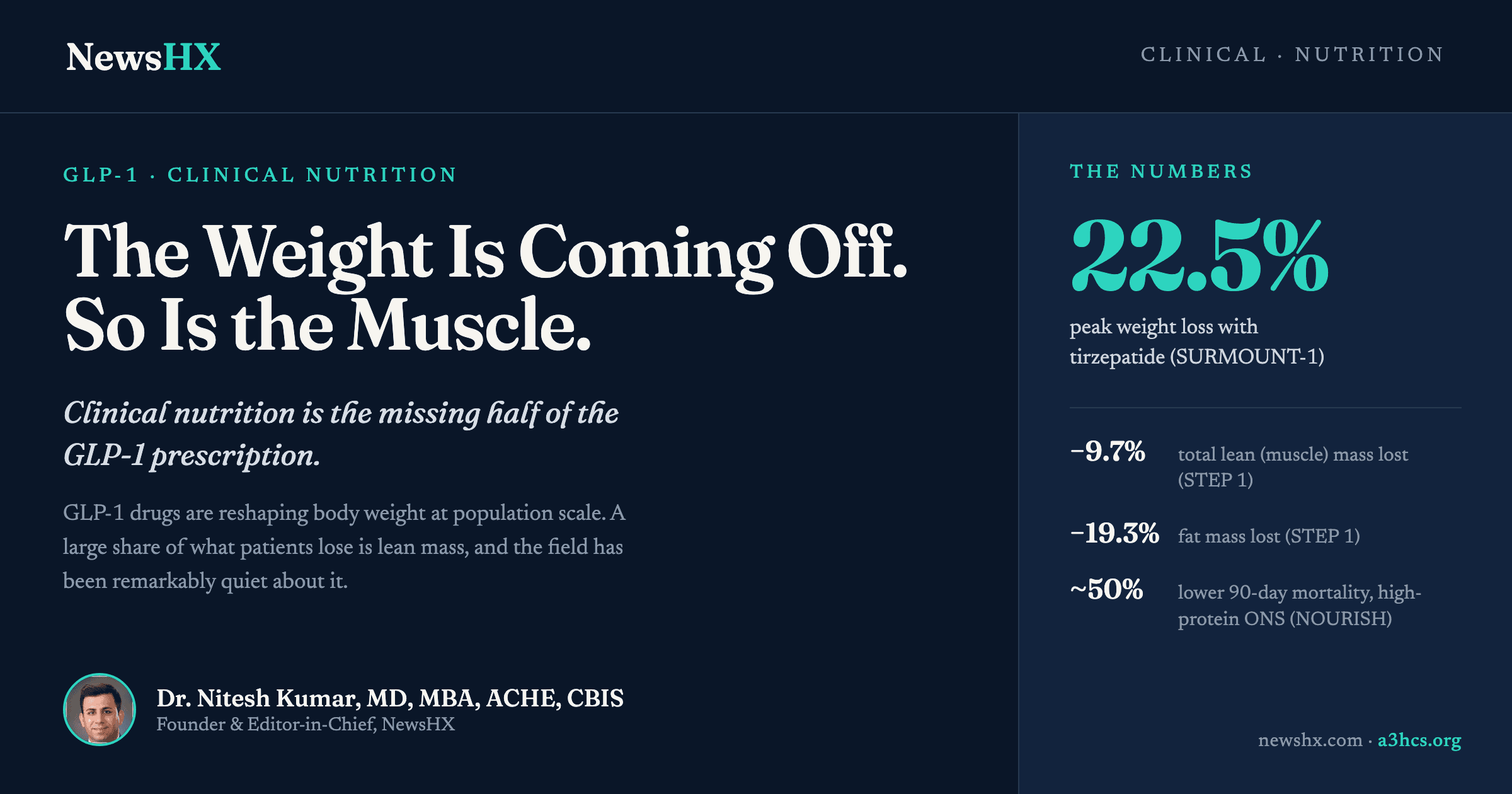
When a patient loses weight on a GLP-1 receptor agonist, they do not lose fat alone. They lose lean mass too. In the dual-energy X-ray absorptiometry substudy of the STEP 1 trial of semaglutide, total fat mass fell about 19.3 percent while total lean body mass fell about 9.7 percent. With tirzepatide in SURMOUNT-1, mean total body weight loss reached up to 22.5 percent at 72 weeks, the largest seen from a drug to date. The drugs work. The question medicine has not answered at scale is which tissue we are willing to lose, and what we are doing to protect the tissue we cannot afford to.
The drug is doing what we asked. It is shrinking the patient. We just have not decided, as a field, how much of the shrinking should be muscle.
How the drug works, and where it goes wrong
The mechanism is elegant, and the side effect is baked into it. A GLP-1 receptor agonist, the class that runs from exenatide and liraglutide through dulaglutide and semaglutide, with tirzepatide adding a second incretin target, acts in three places at once. In the pancreas it raises insulin and lowers glucagon in a glucose-dependent way. In the stomach it slows gastric emptying. In the brain it raises satiety and lowers appetite. The sum is a large, sustained drop in energy intake, and weight follows.
The effect does not stop at appetite. The class's most common side effects, nausea, vomiting, and an early and strong sense of fullness, push intake down further still. In the clinic that is logged as tolerability. It is also, quietly, a nutrition problem, because the patient who feels too full to finish a meal is the same patient who is not finishing their protein.
But energy intake and protein intake fall together. You cannot halve what a frail older patient eats without also cutting the protein their muscle depends on, at the very moment the body is being asked to remodel a shrinking frame. That is the whole problem in one sentence, and it is why fat and lean tissue both come off. Treatment frameworks already encode a narrow version of this caution, flagging GLP-1 agents as ones to avoid in underweight patients. The argument here is to generalize that instinct to everyone whose muscle reserve is thin, which in the post-acute world is most of the floor.
Which tissue we are losing, and for whom it matters
Start with the fair-balance, because it is the part the headlines skip and the part a serious clinician checks first. Some lean-mass loss is the expected and even appropriate consequence of any substantial weight reduction, including diet and bariatric surgery. Fat-free mass on a DXA scan is not all contractile muscle. It includes water and the metabolically active tissue that supports a larger body, and a smaller body needs less of it. Tellingly, in the STEP 1 substudy the proportion of lean mass relative to total body weight actually rose, because fat fell faster than lean. For a healthy forty-year-old with abundant reserve, that trade is often benign.
The risk lives at the edges of the curve. The same loss of lean mass means something entirely different in a seventy-six-year-old with borderline sarcopenia, a recent hospitalization, and an appetite the drug has deliberately suppressed. Same molecule, opposite risk profile. The field has largely been treating them as one patient, and at population scale that averaging hides exactly the people who get hurt.
Key numbers: Peak mean total body weight loss with tirzepatide reached 22.5 percent at 72 weeks (SURMOUNT-1). Total lean body mass fell 9.7 percent in the STEP 1 DXA substudy, against a 19.3 percent fall in fat mass. A high-protein oral nutrition supplement produced roughly a 50 percent relative reduction in 90-day mortality in malnourished older adults (NOURISH, secondary endpoint).
Why muscle is not a cosmetic concern
Skeletal muscle is not ballast. It is the body's largest reservoir of amino acids, a primary site of glucose disposal, and the mechanical system that keeps an older adult out of a fall, a fracture, and a skilled-nursing admission. Lean mass tracks with strength, with metabolic rate, and with the ability to recover from acute illness.
This is where the GLP-1 story collides with a problem clinical nutrition has documented for decades. Sarcopenia, the age- and illness-related loss of muscle mass and function, is already endemic in the older and post-acute population, and it is associated with falls, longer length of stay, higher readmission rates, loss of independence, and mortality. We now have a drug class, in tens of millions of people, that reduces caloric intake by design, which means it also reduces protein intake, the single nutrient muscle preservation depends on, at the very moment the body is being asked to remodel.
Reduced appetite is the mechanism of action. It is also the mechanism of malnutrition risk. Those are not two facts. They are one fact, read by two different specialties.
The concern sharpens further at discontinuation, which in the real world is common. Patients who stop tend to regain weight, and the regained weight is preferentially fat. Lose muscle on the way down, regain fat on the way up, repeat across cycles of starting and stopping, and you can engineer a worse body composition than the patient started with. That is not a fringe scenario. It is the modal trajectory for a meaningful share of users.
The fair-balance the headlines skip
Honesty requires holding two things at once, which is the entire discipline of good medical communication. First, the alarm can be overstated: proportional lean-mass change with these drugs appears broadly in line with other effective weight-loss methods once you account for the magnitude of total loss, and for most patients the cardiometabolic benefit dominates the calculus.
Second, and this is the part that should make the field uncomfortable, we do not yet have the long-term functional outcome data to settle the debate. We have body-composition snapshots and mechanistic worry. What we are short on is durable, real-world evidence linking GLP-1-associated lean-mass loss to hard functional endpoints, falls, fractures, frailty transitions, readmissions, and the degree to which a structured nutrition and resistance-training co-intervention changes those endpoints. The gap is not a reason to panic. It is a reason to generate evidence with intent.
What the nutrition response actually looks like
The countermeasure is not exotic. It is protein, resistance training, and screening, applied deliberately instead of left to chance.
Protein, at the right dose and distribution. The general adult floor of 0.8 g/kg/day was never designed for a patient in an intentional caloric deficit, and it is almost certainly too low for an older adult preserving muscle during active weight loss. Consensus guidance for older and clinically at-risk adults runs higher, on the order of 1.0 to 1.2 g/kg/day for healthy older adults and 1.2 to 1.5 g/kg/day for those who are acutely or chronically ill, distributed across meals rather than loaded into one, with attention to leucine-rich sources that drive muscle protein synthesis. When the drug genuinely suppresses intake, hitting that target from a plate alone becomes difficult, which is exactly the clinical situation oral nutrition supplements were built for. And when oral intake fails outright, in the frail, post-acute, or recovering patient, enteral nutrition is the next rung on the same ladder, not a separate conversation. The principle holds the whole way up, from food to oral supplements to tube feeding: deliver the protein the muscle needs by whatever route the patient can tolerate.
Resistance training as a co-prescription, not a suggestion. Nutrition without a mechanical stimulus preserves less muscle than the two together. The pairing belongs on the prescription pad alongside the pen, not in a pamphlet handed out at checkout.
Screening before the deficit becomes a diagnosis. GLIM criteria for malnutrition and simple functional measures, grip strength and gait speed, give clinicians a way to flag the patients for whom lean-mass loss is a real threat rather than a cosmetic footnote. The post-acute population is the highest-yield place to screen, because it concentrates the patients in whom the math goes wrong.
That the right nutrition changes hard outcomes in vulnerable patients is not hypothetical. In the NOURISH trial, a specialized high-protein oral nutrition supplement in malnourished, hospitalized older adults did not meet its primary composite endpoint of death or readmission, but it produced a significant reduction in 90-day mortality, roughly halving the death rate versus placebo. The discipline is in stating that precisely: a secondary-endpoint signal, real and important, not a cure-all. The work ahead is connecting that kind of evidence, rigorously and without overclaiming, to the specific physiology the GLP-1 era has created.
What to do with the next 180 days
1. Screen GLP-1 patients for nutrition and sarcopenia risk at intake and discharge. Grip strength and a protein-intake history cost almost nothing.
2. Set a protein target and a plan to hit it, with oral nutrition supplementation when intake is suppressed, rather than assuming the plate will deliver it.
3. Co-prescribe resistance training as part of the GLP-1 care pathway, not as an afterthought.
4. Document body composition and function over time, so your organization generates the real-world evidence the field still lacks instead of waiting to consume it.
The strategic read, for the people who build the evidence
Here is where this stops being a clinical essay and becomes a medical-affairs and portfolio question, because the unmet need is sitting in plain sight. The GLP-1 wave has created population-scale demand for muscle preservation, and clinical nutrition, high-protein oral supplements and enteral formulas, leucine, beta-hydroxy-beta-methylbutyrate, and vitamin D combinations, holds a large part of the answer. What the field does not yet hold is the evidence package that turns a plausible mechanism into a standard of care. That package is buildable, and the playbook is familiar to anyone who runs medical affairs in this space.
1. Real-world evidence. Body-composition and function registries in GLP-1 patients with and without structured nutrition support. Turn the snapshot into a trajectory.
2. Targeted trials. Investigator-initiated and company-sponsored studies pairing protein-forward nutrition and resistance training against functional endpoints in the highest-risk subgroups.
3. Health economics. Price the downstream cost of GLP-1-associated functional decline, falls, fractures, readmissions, against a nutrition co-intervention that is, frankly, cheap.
Add to those a fourth lever that runs through all of them: KOL and society engagement to move protein and resistance co-prescription from expert opinion into guideline language, where it changes practice rather than just opinion. None of this requires waiting for the perfect trial. It requires deciding that the muscle question is worth owning.
The companies that win the next phase of the GLP-1 era will not be the ones that shout loudest about weight loss. They will be the ones that quietly own the science of what the patient keeps.
If you cover the drug, cover the muscle
There is a second reader for all of this, and it is not a clinician. GLP-1 coverage has become an employer and health-plan decision made at population scale. When a self-insured employer or a health plan agrees to pay for semaglutide or tirzepatide across thousands of members, it has taken on a workforce-health line item, and with it, whether anyone has said so out loud, the downstream consequences of the body composition the drug produces.
That changes the economics of the muscle question. The same payer who funds the drug inherits the falls, the fractures, the deconditioning, and the costly stop-and-regain cycle that follows discontinuation. Muscle preservation, then, is not a clinical nicety bolted onto the prescription. It is benefit design with a return, and the entity with the clearest financial reason to fund it is the one already writing the check for the drug.
The practical form is a covered muscle-preservation benefit, and the key to making it credible rather than wasteful is to tier it instead of sending everyone to rehab.
A covered muscle-preservation benefit, tiered
Base, for the broad covered population: nutrition support, protein and oral-supplement guidance, plus a telehealth resistance-training or digital musculoskeletal membership. Low cost, scalable, and the right default for most members on a GLP-1.
Middle, for higher-risk or symptomatic members: outpatient physical therapy and supervised resistance training, triggered by a positive sarcopenia or function screen.
Top, reserved for the genuinely frail: short-term or inpatient rehabilitation, plus enteral nutrition where oral intake cannot meet needs, used sparingly and only where reserve is already gone.
The business case writes itself in the language payers and employers already use. Weigh the cost of a scalable digital benefit against the cost of a single hip fracture, an avoidable readmission, lost productivity and absenteeism, and the expense of re-treating a member who quit the drug and regained the weight as fat. For an employer there is a retention and benefit-attractiveness dividend on top of the medical savings. The one discipline that keeps this honest is the same one the science demands: pair the benefit with measurement, so a covered membership has to prove it preserves function rather than just adding a line to the plan.
GLP-1 coverage is workforce-health coverage now. The plan that pays for the weight to come off should pay to keep the muscle on, and it has every financial reason to.
The bottom line
The drugs are a genuine breakthrough. That is not the argument. The argument is that a breakthrough in fat loss is only half a strategy if it leaves the patient functionally weaker, and that the half we are missing has a name, a literature, and a field ready to lead it. Clinical nutrition should not be the footnote to the GLP-1 story. On the evidence, it is the other lead character, and the work of proving it, fairly and rigorously, is the most interesting assignment in the field right now.
We have spent two years celebrating how much weight comes off. The next two will be defined by how well we protect what should stay on. That is a nutrition question, and the field that answers it first will set the standard of care.
Building a nutrition strategy for the GLP-1 era?
A3HCS brings a physician-executive perspective to health systems, post-acute operators, and the clinical nutrition and pharma teams building for the GLP-1 era. The same analytical rigor applied in this piece, applied to your strategy, positioning, and evidence plan.
References
- Wilding JPH, Batterham RL, Calanna S, et al. Once-Weekly Semaglutide in Adults with Overweight or Obesity (STEP 1). New England Journal of Medicine. 2021;384:989-1002.
- Wilding JPH, et al. Impact of Semaglutide on Body Composition in Adults With Overweight or Obesity: Exploratory Analysis of the STEP 1 Study (DXA substudy; total fat mass -19.3%, visceral fat -27.4%, total lean mass -9.7%). Journal of the Endocrine Society. 2021;5(Suppl 1):A16.
- Jastreboff AM, Aronne LJ, Ahmad NN, et al. Tirzepatide Once Weekly for the Treatment of Obesity (SURMOUNT-1; up to 22.5% weight loss at 72 weeks). New England Journal of Medicine. 2022;387:205-216.
- Deutz NEP, Matheson EM, Matarese LE, et al. Readmission and mortality in malnourished, older, hospitalized adults treated with a specialized oral nutritional supplement (NOURISH): a randomized clinical trial. Clinical Nutrition. 2016;35(1):18-26.
- Bauer J, Biolo G, Cederholm T, et al. Evidence-based recommendations for optimal dietary protein intake in older people: a position paper from the PROT-AGE Study Group. JAMDA. 2013;14(8):542-559. Concordant with the ESPEN recommendation of at least 1.0-1.2 g/kg/day for healthy older adults and 1.2-1.5 g/kg/day in acute or chronic illness (Deutz NEP, Bauer JM, Barazzoni R, et al. Clinical Nutrition. 2014;33(6):929-936).
- Cederholm T, Jensen GL, Correia MITD, et al. GLIM criteria for the diagnosis of malnutrition: a consensus report from the global clinical nutrition community. Clinical Nutrition. 2019;38(1):1-9.
- Cruz-Jentoft AJ, Bahat G, Bauer J, et al. Sarcopenia: revised European consensus on definition and diagnosis (EWGSOP2). Age and Ageing. 2019;48(1):16-31.
- Rubino D, Abrahamsson N, Davies M, et al. Effect of Continued Weekly Subcutaneous Semaglutide vs Placebo on Weight Loss Maintenance (STEP 4; weight regain after withdrawal). JAMA. 2021;325(14):1414-1425.