


Every home hospice operator scaling in Illinois eventually sits down with the same question. Do we go get contracted with everybody, or do we stay out and protect the rate?
It is a reasonable question in almost every other post-acute setting. In hospice it is close to unanswerable, because the thing the question assumes, a network you can be inside or outside of, does not exist for the revenue that matters.
That is not a technicality. It is the single most consequential fact about the hospice business model, it has survived a deliberate federal attempt to change it, and most growth plans I see are built as though it were not true.
The carve-out, and why it is not going away quietly
When a Medicare Advantage enrollee elects hospice, care related to the terminal illness reverts to Medicare Part A. The plan keeps paying only for unrelated services and supplemental benefits. This is the Special Rule for Hospice, and it dates to the Balanced Budget Act of 1997.1
The practical consequences for an Illinois home hospice are worth stating flatly, because they are unusual in American health care.
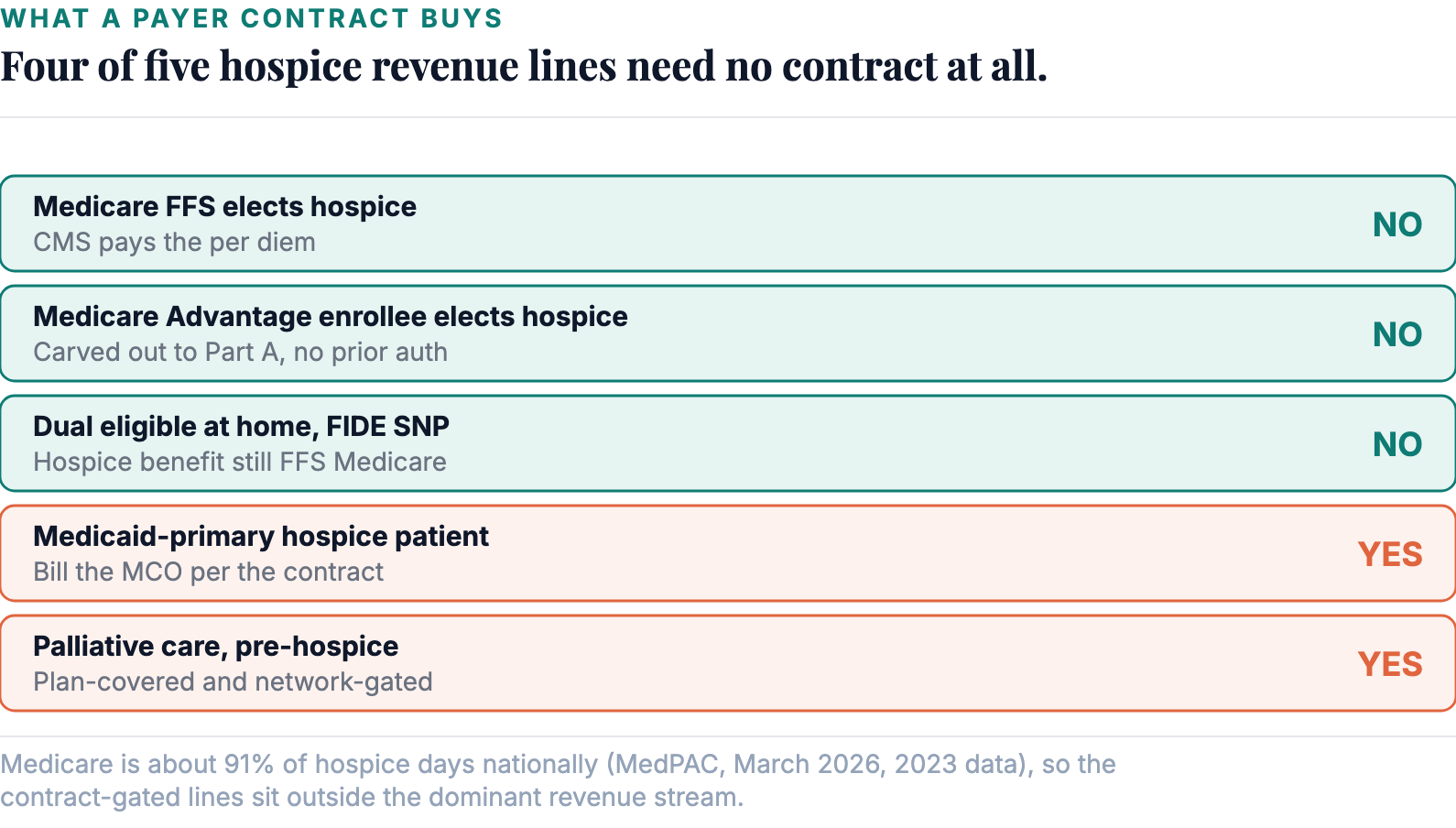
Any Medicare-certified hospice may serve any Medicare beneficiary, Medicare Advantage or not, with no plan contract. No plan prior authorization applies to the hospice benefit. And the payer is CMS, at the published per diem, wage-adjusted by county.1
There is no network to join and no network to be excluded from. Contracting with "all the insurances" is not a strategy an Illinois home hospice can execute for its main line of business, because there is nothing there to buy.
CMS did test the alternative. The hospice component of the Value-Based Insurance Design model, generally called the carve-in, ran from 2021 and ended December 31, 2024.2 CMS attributed the sunset to operational challenges: too few plans participated and too few beneficiaries were served to constitute a valid test. Hospices in the demonstration reported difficulty joining networks and delayed claims payment. The broader VBID model continues to 2030 without it.2
The demonstration is also the only real evidence we have about what a hospice network would do, and it should be read in full rather than in its first year. CMS's own findings report gives three years: 37% of beneficiaries starting hospice chose an in-network hospice in 2021 on 9,630 beneficiaries, 48% in 2022 on 19,065, and 55% in 2023 on 23,828.3
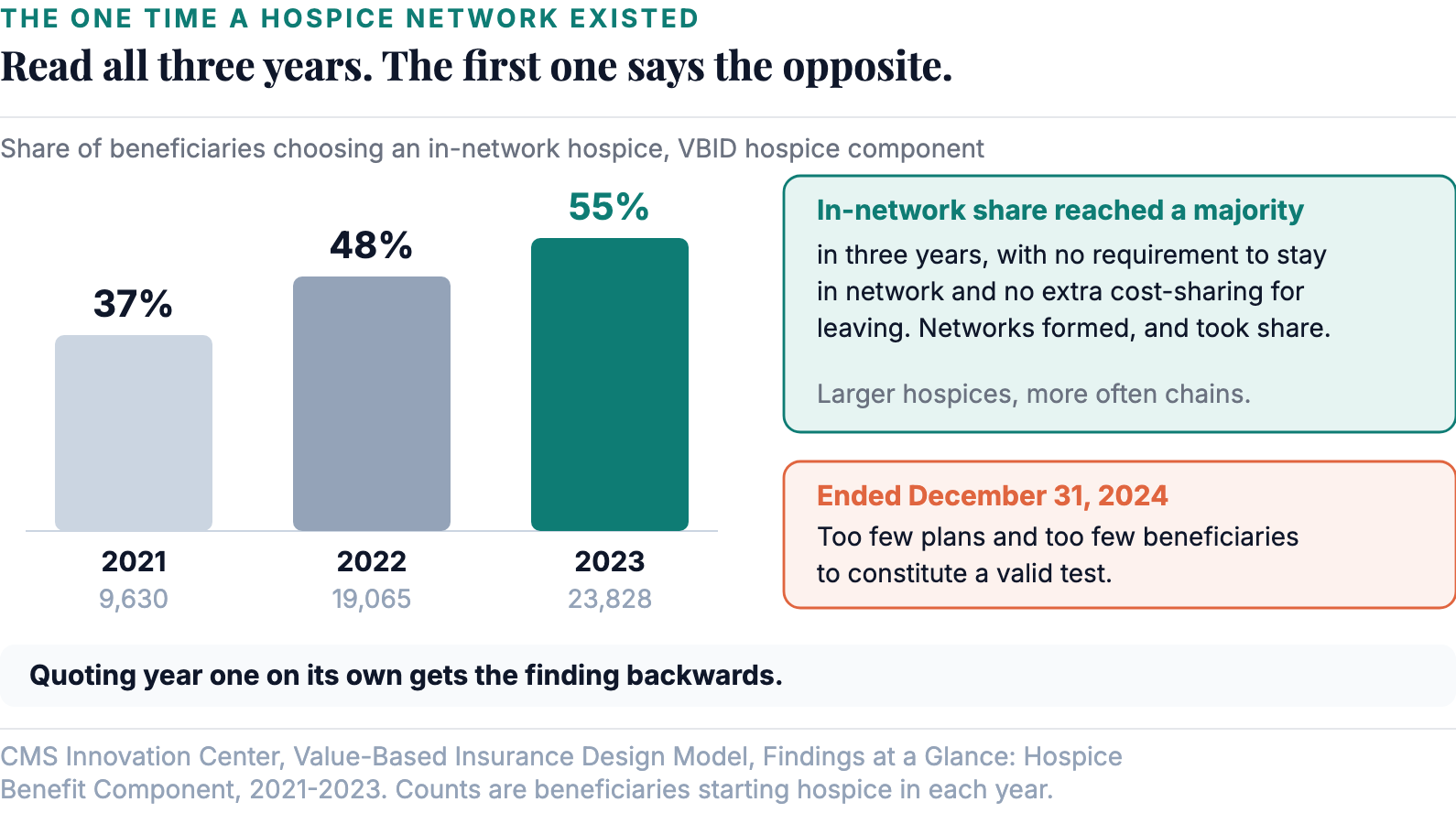
The 37% from year one gets quoted as evidence that networks do not decide who gets the patient. Read the series and it says the opposite. In-network share climbed to a majority in three years, and it did so even though beneficiaries were never required to use an in-network hospice and faced no extra cost-sharing for going outside. Networks formed, and they took share.
Two more findings from the same report land harder for a small operator. In-network hospices were larger than out-of-network ones and more likely to belong to a chain, though the two scored similarly on quality. And hospices joined networks "primarily to maintain long-term business viability, expressing concern that being left out of a network could result in hospice closure."3
That is the honest read. The carve-in is not a live threat today. If it ever returns, the demonstration says the independents are the ones who lose share, and they know it.
The policy direction is toward preserving the carve-out. A carve-in provision appeared in H.R. 3467, introduced in May 2025, with no implementation framework attached. In November, Senators Roger Marshall and Sheldon Whitehouse circulated a bipartisan letter urging Senate leadership to oppose any hospice carve-in, citing prior authorization delay and "reduced patient choice due to network limitation."4 The field's own framing, from the National Alliance for Care at Home, is that hospice "should be outside of managed care, because hospice is already managed care."
I would treat a carve-in as a real tail risk on a five-year horizon and as no part of a 2026 or 2027 operating plan. It failed once as a demonstration and it is opposed from both parties. It is also exactly the kind of provision that rides along on something larger, so it belongs on a watch list rather than in a forecast.
So where does a contract actually buy something?
Narrow places, and none of them is the core business.
Medicaid-primary hospice patients. The Illinois HFS hospice handbook is explicit that its fee-for-service billing instructions do not apply to managed care enrollees, and that charges for patients in a Managed Care Organization or Managed Care Community Network "must be billed to that entity according to the contractual agreement."8 For that slice, you need the contract. Medicare accounts for roughly 91% of hospice days nationally, so this is the remainder, not the business.11
Dual eligibles in the new FIDE SNPs. Illinois ended its Medicare-Medicaid Alignment Initiative on December 31, 2025 and moved duals into fully integrated dual eligible special needs plans on January 1, 2026. HFS has told providers they must contract with each FIDE SNP.10 That is true and worth doing, but it reaches Medicaid wrap services. The hospice benefit itself is still carved out to fee-for-service Medicare for those patients.
Nursing facility residents. Here a contract matters, and it costs you. More on that below.
Palliative care. This is the one place where being in network genuinely buys volume. Palliative care is a plan-covered, network-gated service, and it is the upstream feeder into hospice. An operator who wants to spend real effort on payer contracting should spend it here, not on the hospice line.
Illinois will let anyone in, and that is the whole problem
Most states with a certificate of need program use it to limit entry. Illinois does not, for this.
I read the definitions section of the Illinois Health Facilities Planning Act directly. The statute enumerates what counts as a "health care facility": ambulatory surgical treatment centers, entities under the Hospital Licensing Act, skilled and intermediate long term care facilities, ID/DD and MC/DD facilities, specialized mental health rehabilitation facilities, state-maintained hospitals and nursing homes, kidney disease treatment centers, out-of-state outpatient surgical facilities, rooms used for a health care category of service, and major medical equipment above the capital expenditure minimum.5
The word "hospice" appears zero times in that section. So does "home health." A home hospice in Illinois needs an IDPH license under the Hospice Program Licensing Act and 77 Ill. Adm. Code 280, at a $500 annual license fee, plus Medicare certification.6 There is no bed need determination, no review board hearing, and no standing for an incumbent to object.
One caveat that should not travel with the finding. This is the home-based analysis. A hospice residence with beds is a separate question, IDPH has its own application for it, and an inpatient facility can pull a project onto the certificate of need list through the hospital or nursing home licensing path. If an inpatient unit is ever on the table, re-run this.
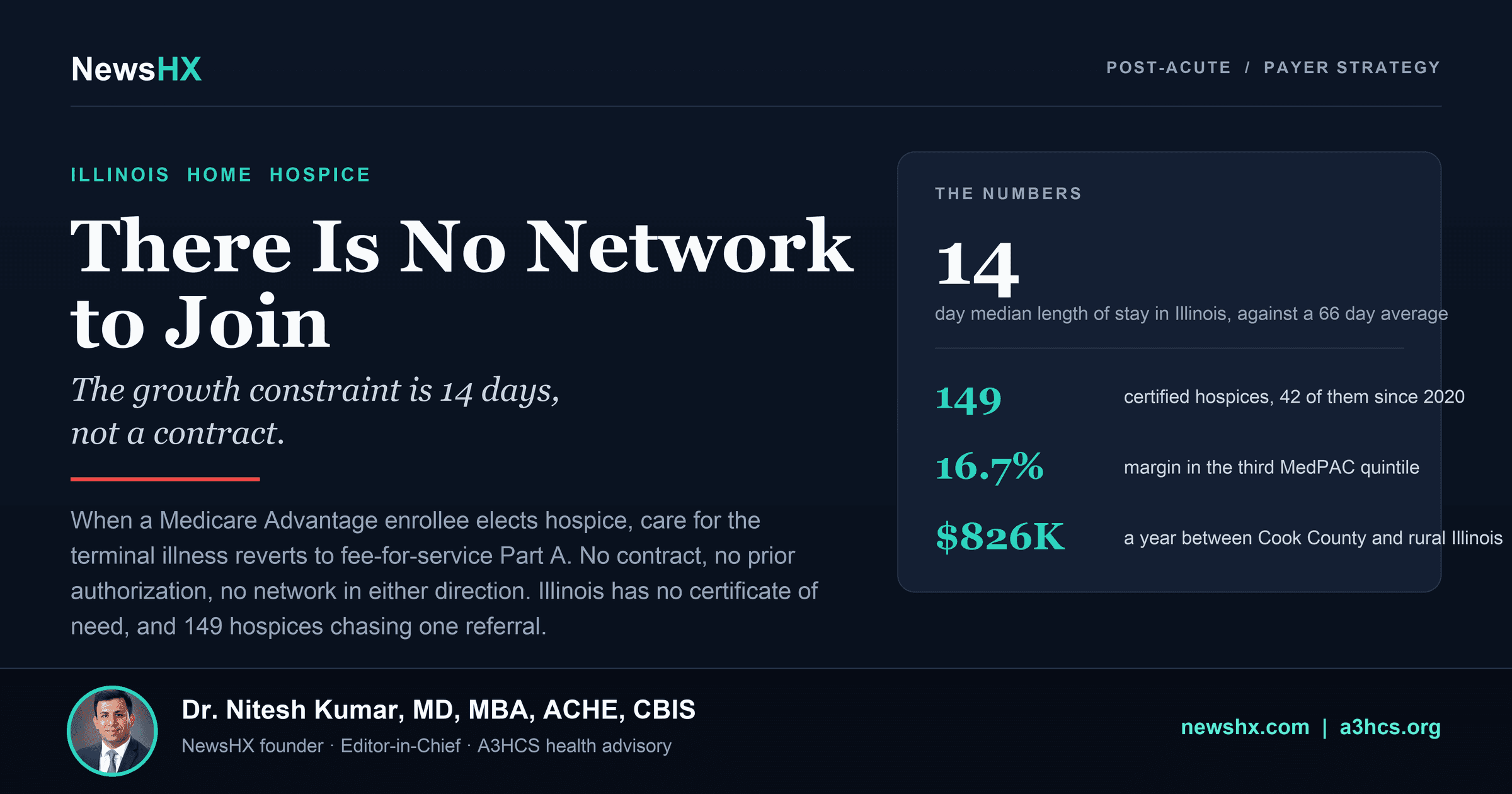
Here is what open entry has produced, from the CMS hospice provider file. Illinois has 149 Medicare-certified hospices. Seventy-eight of them, 52%, are in the nine-county Chicago metro, and 51 of those 78 are for profit. Cook County alone has 40, DuPage 25.7
New certifications by year in Illinois: nine in 2021, four in 2022, nine in 2023, eleven in 2024, seven in 2025. Forty-two Illinois hospices have been certified since 2020, and twenty-seven of those since 2023.7 Fourteen of the new entrants are in Chicago metro alone, spread across Willowbrook, Oak Brook, Rosemont, Skokie, Evergreen Park, Des Plaines, Schaumburg, Morton Grove, Addison, Orland Park, Downers Grove, Northbrook and Chicago.
Put the two halves together. There is no contract to win, and there is no barrier to keep the next entrant out. The scarce input in Illinois home hospice is neither a payer relationship nor a license. It is a referral, and every quarter there is one more agency asking for the same one.
The 14-day problem is the real margin story
Illinois hospice utilization runs around 51.9% of Medicare decedents, with 16.3% in rural areas and 28.4% among dual eligibles. Total Medicare hospice spending in the state is roughly $648M.14
The number that should govern the operating plan is this one: the median hospice length of stay in Illinois is 14 days, against an average of 66.14
That gap between median and mean is the signature of a book dominated by very late referrals with a thin tail of long ones. And length of stay, not payer mix, is what MedPAC's data says drives hospice margin. Group hospices by the share of their stays exceeding 180 days and the 2023 aggregate fee-for-service Medicare margin runs from negative 4.8% in the lowest quintile to 16.7% in the third and back to negative 1.1% in the highest.11
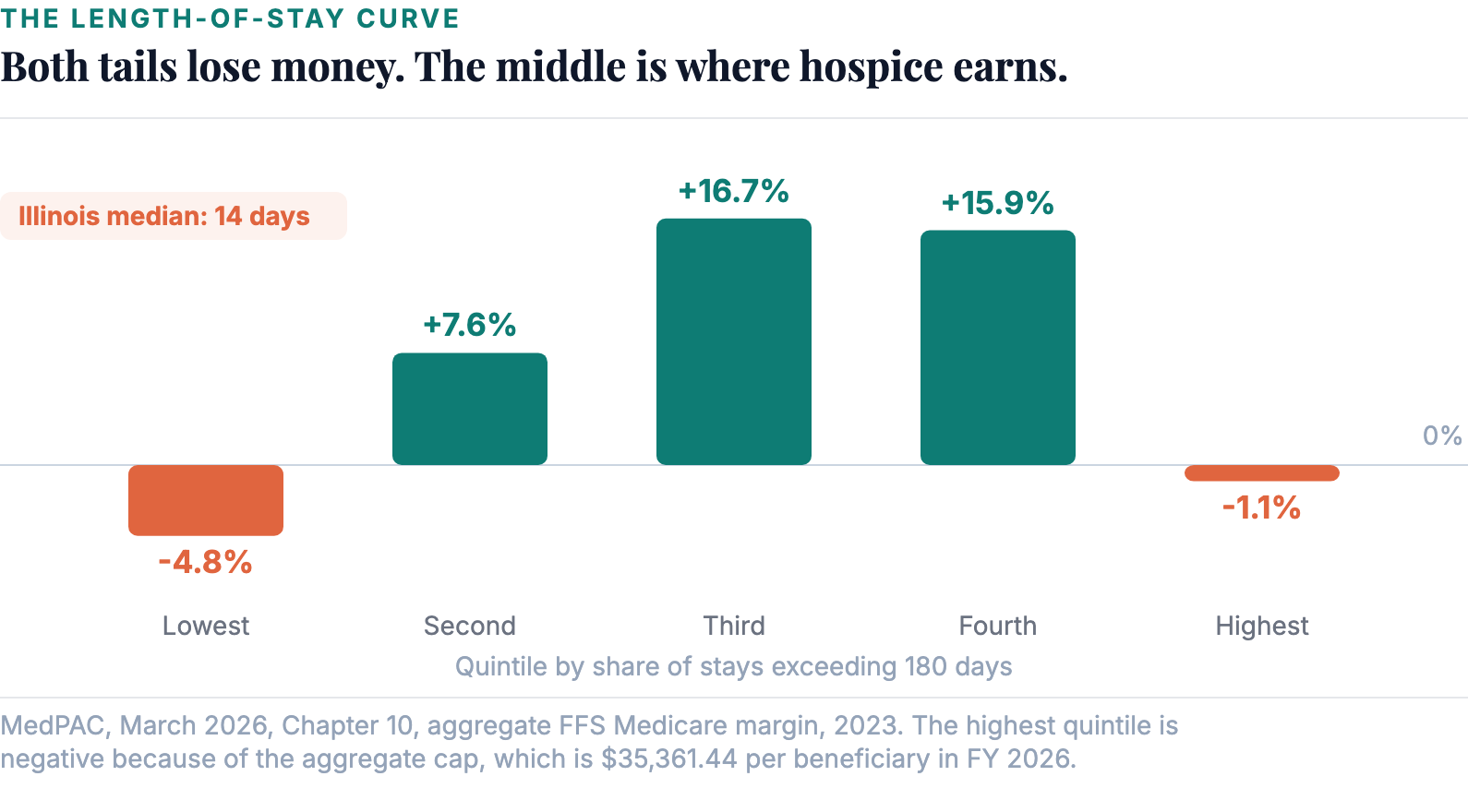
The curve is an inverted U, and both tails lose money. Short-stay-heavy hospices lose because admission and the final days are the two most staff-intensive periods in a hospice episode, and a 14-day stay is almost entirely made of those two periods. You pay for the intake, the certification, the equipment delivery, the crisis nursing and the death visit, and you collect a routine home care per diem for two weeks.
Long-stay-heavy hospices lose for the opposite reason. They hit the aggregate cap, which for FY 2026 is $35,361.44 per beneficiary.12 MedPAC put above-cap hospices at a negative 1.4% margin excluding cap overpayments, against 9.0% for below-cap hospices.11
So the operating target is not the longest possible stay. It is the third and fourth quintiles: a median that moves up meaningfully from 14 days, with cap exposure monitored on the other end. That is an earlier-referral problem and a referral-source-education problem. No payer contract touches it.
The site-of-care lever, and the Illinois version of it
MedPAC's other big finding is about where the patient lives. Group hospices by the share of patients residing in nursing facilities and assisted living, and the 2023 margins split sharply: 0.2% for the lowest half by facility share against 13.3% for the highest half. In 2019 the same split was 6.6% against 18.7%.11
Thirteen points. MedPAC names the drivers: the diagnosis profile and length of stay of facility residents, plus the fact that "treating hospice patients in a centralized location likely creates efficiencies in terms of mileage costs and staff travel time, as well as facilities serving as referral sources for new patients."11
The obvious reading is that a home hospice should go chase nursing facility census. In Illinois that reading is half right, and the wrong half is expensive.
For a dually eligible nursing facility resident, Illinois pays the hospice 95% of the facility's calculated per diem and makes the hospice pay the facility. The handbook is direct: the facility "cannot bill hospice patients' nursing home room and board charges directly to the Department. The hospice is responsible for paying the facility." And on what happens when that goes wrong: "Disputes regarding payment of the room and board charges must be resolved between the long term care facility and the hospice provider."8
No facility accepts 95%, because that is a 5% cut on every resident who elects hospice and an immediate reason to stop mentioning hospice to families. So the hospice pays 100%, collects 95, and absorbs the difference every day the patient lives.
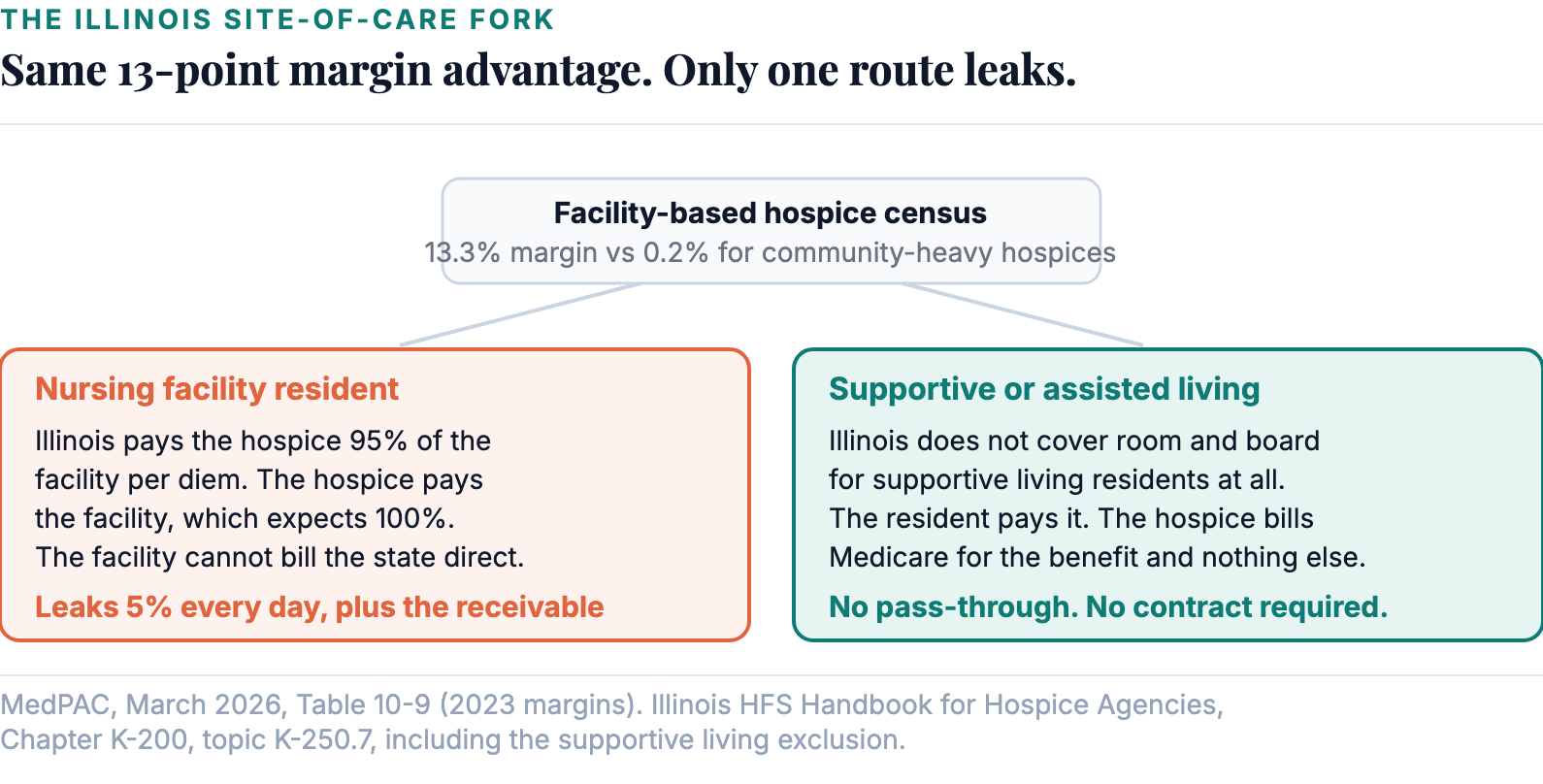
Now the part almost nobody prices correctly. From the same Illinois handbook: "The Department does not cover the room and board of patients residing in a SLF."8 Under the Illinois Supportive Living Program, the resident pays their own room and board and Medicaid pays only for personal care.9
So a hospice patient in an Illinois supportive living or assisted living facility generates no room-and-board pass-through at all. You bill Medicare for the hospice benefit and nothing else. No 95% haircut. No facility check to write. No aging receivable. No inducement exposure of the kind that surfaced in California when managed care plans stopped reimbursing hospices for pass-throughs they had already paid out.
That is the finding worth building a territory plan on. Assisted living and supportive living density delivers the centralization efficiency, the mileage and travel savings, and the built-in referral source that MedPAC quantifies at roughly 13 margin points, with none of the Medicaid leak that comes attached to the nursing facility version of the same play. And it requires no payer contract of any kind.
Geography pays more than negotiation ever will
One more number, because it dwarfs anything a contracting conversation could produce.
FY 2026 national base rates, effective October 1, 2025, reflect a 2.6% update. Routine home care pays $230.83 for days 1 through 60 and $181.94 for day 61 onward. Continuous home care is $69.76 an hour, inpatient respite $532.48, general inpatient care $1,199.86. A hospice that misses quality reporting takes the update minus four points, which is a negative 1.4% change year over year.12
Those rates are then wage-adjusted, with a 66% labor share for routine home care.12 Applied to the Illinois county wage indices, the spread inside one state is larger than most operators assume.13
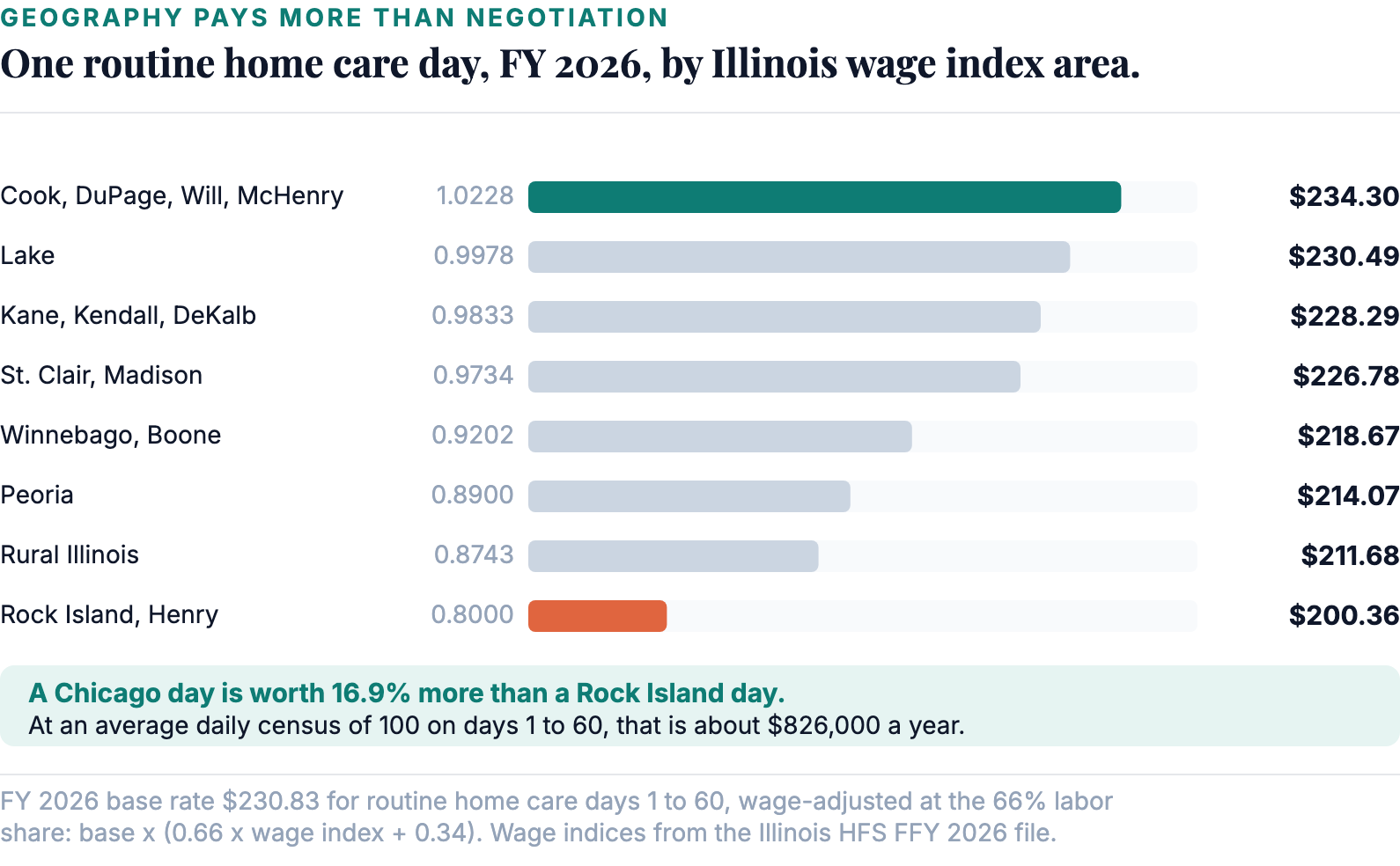
A routine home care day pays $234.30 in Cook County and $200.36 in Rock Island, 16.9% more before anybody talks to a payer. At an average daily census of 100 held on days 1 through 60, the Chicago index annualizes to roughly $8.55M against $7.73M at the rural Illinois index. That is an $826K difference produced entirely by which county the patient sleeps in.
No hospice negotiation in Illinois will ever move a number that size, because there is no negotiation to have.
What to actually do
Stop treating payer contracting as the growth plan. It cannot be, because the asset it would buy does not exist for the dominant revenue line. Watch the carve-in anyway: the one federal experiment that built hospice networks saw in-network share reach a majority in three years, and it favored large chain-affiliated hospices.
1. Build assisted living and supportive living density. Highest margin available, no room-and-board exposure in Illinois, no contract required, and a referral source that renews itself.
2. Attack the 14-day median. The margin curve punishes the shortest-stay quintile at negative 4.8% and rewards the third at 16.7%. Earlier referral is worth more than any rate concession you will ever be offered.
3. Contract for palliative care, not for hospice. It is network-gated, it is the feeder, and it is where being in network genuinely converts to volume.
4. Take the Medicaid MCO and FIDE SNP contracts as hygiene. Cheap, they remove friction on a small slice, and they position you if the carve-in ever lands.
5. Price the nursing facility channel before you chase it. It works, and the Illinois version leaks 5% a day plus a receivable you are financing.
And watch the cap on the other end. The instruction to lengthen stays is not an instruction to maximize them. Above the aggregate cap the margin goes negative, and the difference between the third quintile and the fifth is 17.8 points.
The bottom line
The in-network versus out-of-network debate is the right debate in inpatient rehabilitation, in long-term acute care, and in home health. It is a category error in hospice, because Congress deliberately built the benefit outside managed care in 1997, and CMS tested the alternative and shut it down at the end of 2024. That test is worth respecting rather than dismissing, because while it ran, networks formed and took a majority of elections in three years.
For a home hospice in Illinois, the levers that remain are unglamorous and entirely within the operator's control. Where the patients live. How early the referral comes. Which county. Those three decide the margin, and not one of them is settled at a contracting table.
One boundary on all of the above, because it is the first question a careful operator asks. This is the Medicare hospice benefit, which is roughly nine-tenths of the revenue. The commercial slice behaves in the opposite direction, and a commercial HMO without a contract is exclusion rather than leverage. That is the subject of Part 2, which maps the four Blue Cross products an Illinois hospice actually meets.
Building home hospice census in a market with no network to join?
A3HCS works the levers that actually move hospice margin: site-of-care mix and room-and-board exposure, referral timing against the length-of-stay curve, county rate geography, and which payer contracts are worth signing and which buy nothing at all.
References
- Balanced Budget Act of 1997, Public Law 105-33, Special Rule for Hospice. The provision that reverts hospice care for the terminal illness to Medicare Part A on election by a Medicare Advantage enrollee.
- Centers for Medicare & Medicaid Services, Innovation Center. Medicare Advantage Value-Based Insurance Design Model. CMS terminated the Hospice Benefit Component as of 11:59 PM, December 31, 2024. cms.gov
- Centers for Medicare & Medicaid Services, Innovation Center. Value-Based Insurance Design Model, Findings at a Glance: Hospice Benefit Component, 2021-2023. Read directly September 7, 2026. Context on the carve-in debate from "In or Out: The Hospice, Medicare Advantage Conundrum," Hospice News, January 2, 2026.
- H.R. 3467, introduced May 2025, carrying a hospice carve-in provision with no implementation framework. Senators Roger Marshall and Sheldon Whitehouse, bipartisan letter to Senate leadership opposing a hospice carve-in, November 2025.
- Illinois Health Facilities Planning Act, 20 ILCS 3960/3, definitions. The enumerated list of health care facilities contains neither hospice nor home health. ilga.gov
- Hospice Program Licensing Act, 210 ILCS 60, and 77 Ill. Adm. Code 280. Illinois Department of Public Health hospice licensure, $500 annual license fee.
- CMS Provider Data Catalog, Hospice General Information file, August 2026 release. Counts of Illinois certified hospices, metro distribution, ownership and certification dates are computed from this file.
- Illinois Department of Healthcare and Family Services, Handbook for Hospice Agencies, Chapter K-200, topics K-250.7 and K-260.1. Source of the 95% nursing facility per diem, the pass-through obligation, the dispute-resolution language, and the supportive living exclusion.
- Illinois Department of Healthcare and Family Services, Supportive Living Program. Residents pay their own room and board; Medicaid covers personal care and supportive services only.
- Illinois Department of Healthcare and Family Services. End of the Medicare-Medicaid Alignment Initiative, December 31, 2025, and transition of dual eligibles to fully integrated dual eligible special needs plans effective January 1, 2026.
- Medicare Payment Advisory Commission. Report to the Congress: Medicare Payment Policy, March 2026, Chapter 10, Hospice services, including Table 10-9. Source of the margin-by-quintile series, the facility-share margin split, the aggregate cap margins, and the 91% Medicare share of hospice days. medpac.gov
- Centers for Medicare & Medicaid Services. FY 2026 Hospice Wage Index and Payment Rate Update and Hospice Quality Reporting Program Requirements Final Rule, CMS-1835-F, 90 FR 37404, published August 5, 2025. FY 2026 aggregate cap $35,361.44; 2.6% payment update; 66% routine home care labor share. cms.gov
- Illinois Department of Healthcare and Family Services. Federal FY 2026 revised hospice rates and wage index values for all Illinois counties, October 21, 2025. County per-diem products in this article are computed from the CMS base rate and these wage indices at the 66% labor share, not quoted.
- Research Institute for Home Care, Hospice Care Chartbook, Illinois. Source of the Illinois utilization rates, the 14-day median and 66-day average length of stay, and total state Medicare hospice spending.