


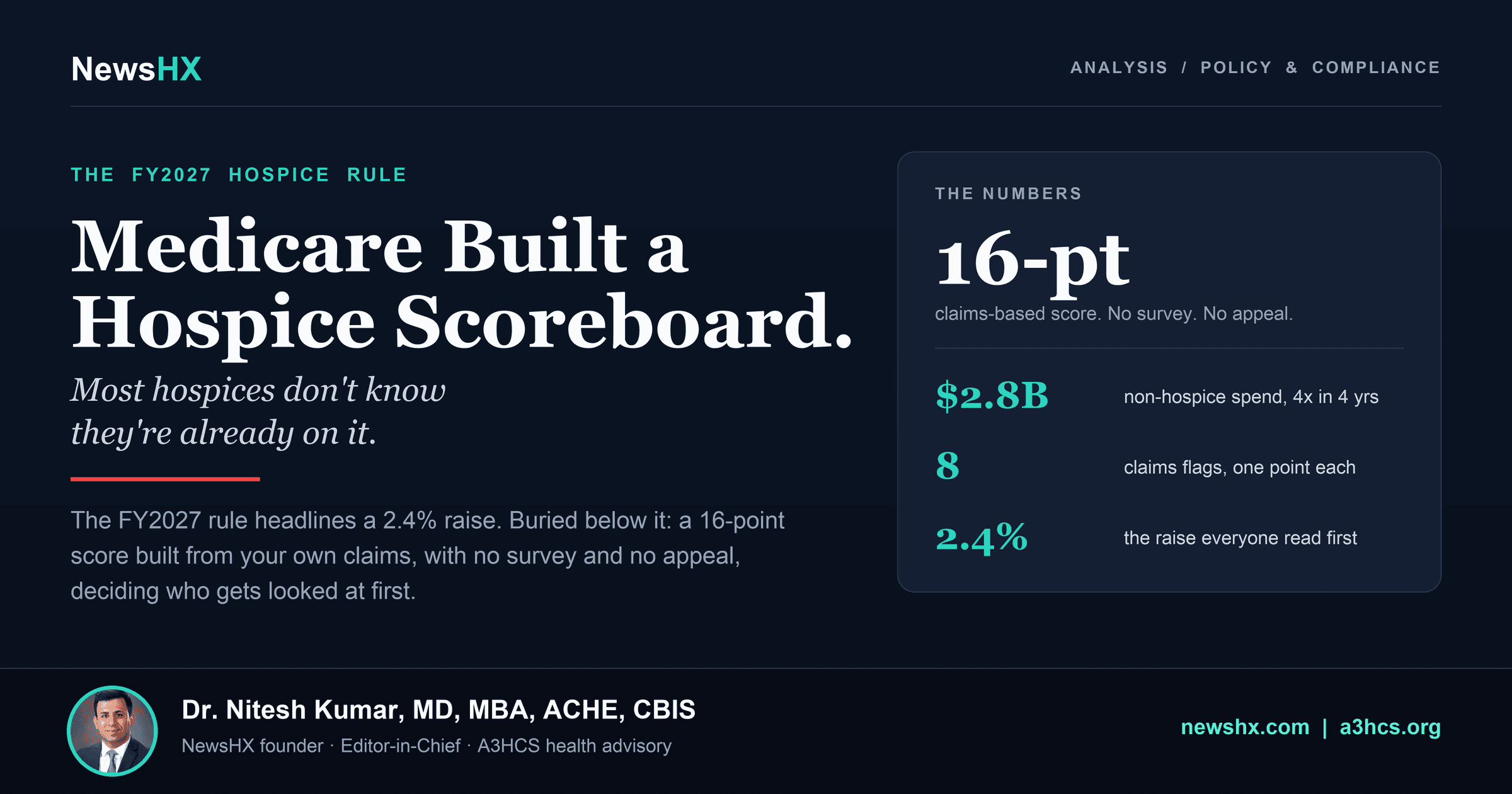
Status note, July 28, 2026. Everything below describes CMS-1851-P, a proposed rule. As of this morning the FY 2027 hospice final rule has not been published and does not appear on the Federal Register's public inspection list. The last two hospice final rules landed on July 30, 2024 and August 1, 2025, so the window is now open. This piece is published deliberately ahead of it, because the single most useful thing a hospice can do about the SSVI is calculate its own score before the rule is final and before a contractor does it first. We will update this analysis when the final rule drops.
Read the FY 2027 hospice proposed rule the way most administrators do, and you will come away with one fact: payments go up 2.4% on October 1, 2026 2. The routine home care rate for the first sixty days rises to $236.56 a day. The aggregate cap climbs to $36,210.11 3. CMS estimates hospices will collect $785 million more next year than this year 2. Good news, file it, move on.
That reading misses the actual event in this rule. Tucked into a section most operators skim, CMS has proposed building a permanent scoring system that ranks every hospice in the country on how its spending and utilization patterns compare to everyone else's. It is called the Service and Spending Variation Index, and it is the most consequential thing in the document by a wide margin 1. The 2.4% is what you get paid. The SSVI is the apparatus that decides whether a regulator, a Medicare contractor, or eventually the public looks harder at how you got paid.
The payment update is the part of the rule written to be read. The scoring index is the part written to be acted on. Most hospices are reading the wrong half.
The number that is really driving this rule
To understand why CMS is building a hospice scoreboard, look at one figure the agency keeps returning to. Spending on care delivered to hospice patients outside the hospice benefit, the services Medicare pays for separately while a patient is supposed to be receiving comprehensive hospice care, has exploded. It was about $790 million in FY 2020. By FY 2024 it had reached $2.8 billion 4. That is not gradual drift. It is a near-quadrupling in four years.
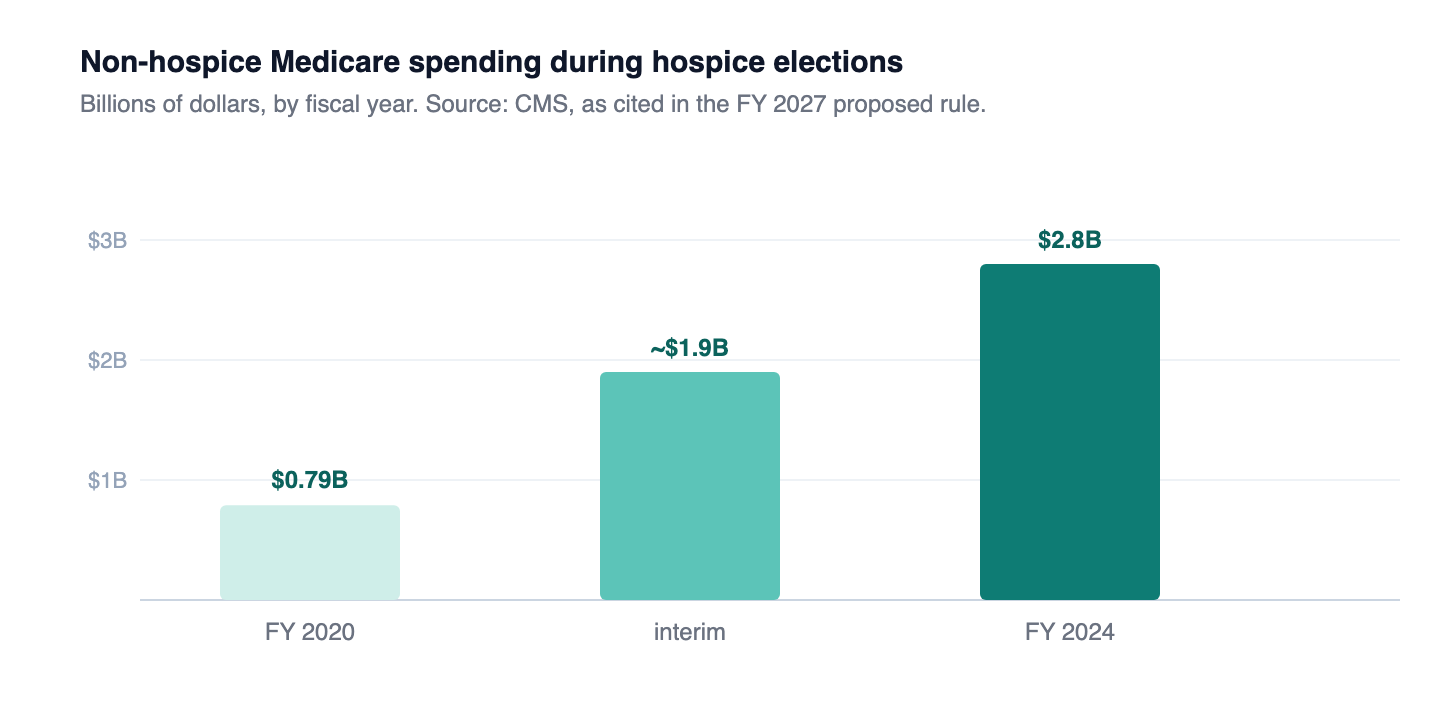
CMS reads that number as a signal that something is wrong. In a benefit designed to be all-inclusive, a patient who keeps generating large non-hospice Medicare bills is, by the program's logic, either not getting the comprehensive care the per-diem already paid for, or never belonged in hospice to begin with. Layer that on top of a decade of HHS Office of Inspector General reports on hospice fraud, the surge of newly certified and private-equity-backed hospices in states like California, Arizona, Nevada, and Texas 8, and a record $6.8 billion in False Claims Act recoveries across healthcare in FY 2025 9, and the agency's posture is clear. It no longer trusts the claims at face value. It wants a way to sort the field. The SSVI is that sorting mechanism.
How the score actually works
Here is what almost no one outside the rule's technical appendix has internalized: the index is already built, the data already exists, and your hospice already has a score, whether you have ever heard the term or not. It is calculated entirely from claims CMS already holds 4,10. Nothing about it requires your cooperation. The index runs 0 to 16, assembled from two halves.
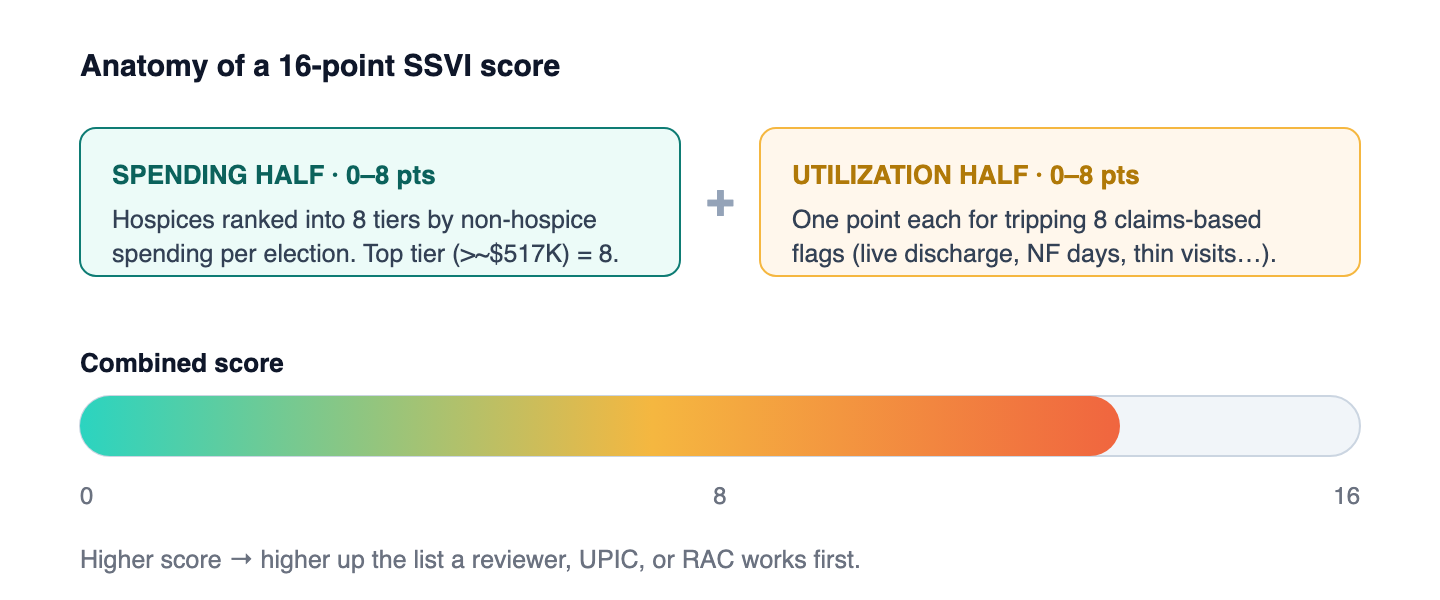
The spending half (0 to 8 points). CMS ranks every hospice into eight tiers by how much non-hospice Medicare spending its patients generate during their election. A hospice whose patients generate essentially none scores zero. A hospice at the top of the distribution, where per-election non-hospice spending crossed roughly $517,000 in FY 2025 10, scores the full eight. The more your patients cost Medicare outside your per-diem, the higher you climb.
The utilization half (0 to 8 points). One point each for tripping eight claims-based flags, the operational fingerprints CMS associates with thin or questionable care 10. They are:
1. Providing no continuous home care or general inpatient care at all.
2. Delivering 40% or more of routine home care days inside nursing facilities.
3. Low skilled-visit intensity in the last two days of life.
4. A live-discharge rate of 46.7% or higher.
5. 33.3% or more of discharges having a stay of 180 days or more.
6. An average of 9.9 or fewer skilled-nursing minutes per routine home care day.
7. 4.8% or fewer weekend routine home care days with a skilled visit.
8. 18.2% or more of live discharges returning to the same hospice within seven days.
(These are CMS's FY 2025 cutoffs. Most are set at the 25th or 75th percentile of the national distribution, so the exact numbers move each year; the no-CHC/no-GIP and 40%-nursing-facility flags are fixed.)
None of these eight flags is fraud on its own. A rural hospice with no GIP contract, a hospice serving a heavily nursing-home population, a program with a sicker book of business, can each light up the board honestly. That is the risk in the design. The index does not know why your number is high. It only knows that it is, and so will everyone who reads it.
Add the two halves and you have a single number that travels. CMS frames the SSVI as a tool to signal potential utilization, quality of care, or compliance concerns. Translated: it is a triage list. A high score does not prove anything. It puts you near the top of the pile a medical reviewer, a UPIC, or a RAC works first.
The index is not theoretical. Look at what else happened on April 2.
CMS announced the SSVI proposal on April 2, 2026. That same day, in the Central District of California, the Justice Department announced the arrest of eight defendants in a hospice fraud takedown covering more than $50 million in fraudulent Medicare billing 11. The timing was not a coincidence. It is the enforcement half of the same strategy.
Read the charging documents next to the SSVI methodology and the design intent becomes obvious. One charged operator, Topanga Hospice Care, allegedly ran a non-death discharge rate of roughly 85%, against a national average of 17.2% 11. The SSVI's live-discharge flag trips at 46.7%. A hospice discharging 85% of its patients alive does not just trip that flag. It clears it by nearly forty points, and it would have been visible in claims data years before anyone was arrested.
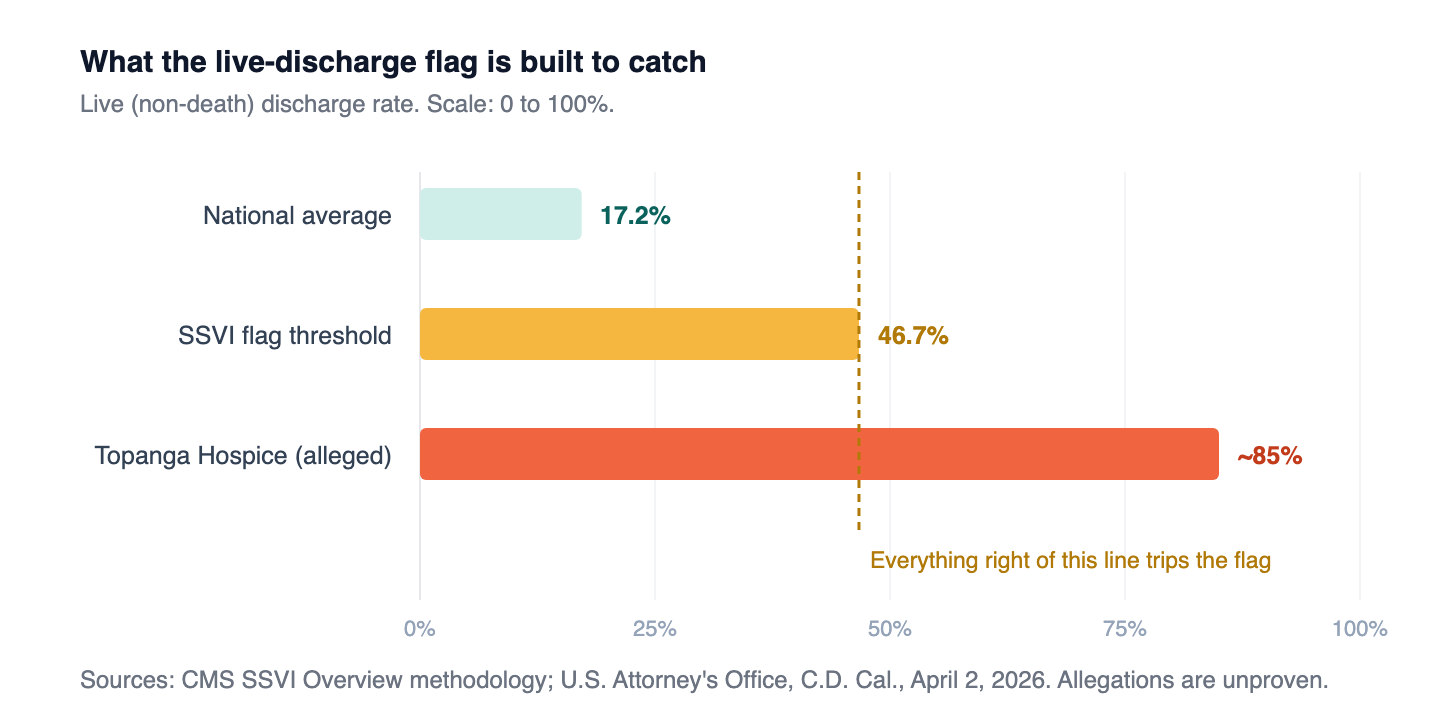
That is what CMS is buying with the index: the ability to see that pattern without waiting for a whistleblower.
The enforcement record around it is already substantial. Enhanced oversight in the four highest-risk states, Arizona, California, Nevada, and Texas, has produced more than 200 hospice Medicare enrollment revocations for non-compliance 12. CMS has run unannounced hospice site visits nationwide and has since extended the focused-oversight approach to additional states including Georgia and Ohio 12. And on May 13, 2026, CMS imposed a six-month nationwide moratorium on new Medicare enrollment for hospices and home health agencies, a blunt instrument the agency reaches for only when it believes the front door is the problem 13.
A hospice discharging 85% of its patients alive does not just trip the SSVI's live-discharge flag. It clears it by forty points. That pattern sat in claims data for years before anyone was arrested. The index is CMS buying the ability to see it without waiting for a whistleblower.
Set the pieces side by side and the proposed rule stops looking like a payment document. Site visits, a nationwide enrollment freeze, 200-plus revocations, coordinated criminal takedowns, and now a permanent claims-based score assigned to every hospice in the country. The SSVI is the targeting layer for machinery that is already running. That is the reason it deserves more attention than the 2.4%, and the reason it will survive the comment period in some form whatever the final rule says about the details.
The addendum mandate: small print, real burden
The rule's second operational change is quieter and has drawn the loudest objection from the field. Today, hospices must furnish the election statement addendum, the document listing conditions and services the hospice has determined are unrelated to the terminal diagnosis and therefore not covered, only when a patient or representative asks for it. CMS proposes to make it mandatory for every election, handed to every patient at the moment they enroll 2,6.
CMS's theory is that the addendum, in everyone's hands, will help patients and other providers understand what hospice does and does not cover, and thereby curb some of that $2.8 billion in non-hospice spending. The major trade groups, the National Alliance for Care at Home and LeadingAge, pushed back hard in their June comments 5. Their argument: handing a legalistic coverage-exclusion document to a family at the most fragile moment of enrollment is duplicative, confusing, and a fresh administrative load, and it does nothing about the real driver. As LeadingAge put it, the problem is unsupported non-hospice claims and the lack of meaningful reviews and enforcement against those billing providers, not a paperwork gap at admission.
Whether or not CMS softens this in the final rule, the direction is the tell. The addendum mandate and the SSVI are the same instinct pointed at the same target: close the gap between what the hospice per-diem is supposed to cover and what Medicare is actually paying for on top of it.
Transparency is becoming public, not just internal
The third piece extends the logic to patients and referral sources. CMS proposes adding an icon to the Medicare.gov hospice Compare tool flagging programs that fail to submit the required quality data, those that report on fewer than 90% of their patients, no earlier than FY 2028 6. Public reporting of the new HOPE assessment-based measures, the tool that replaced the old HIS this year, is slated to begin around November 2027 2.
Taken together, the trajectory is unmistakable. An internal score for regulators (SSVI). A mandatory disclosure at the bedside (the addendum). A public mark on the Compare tool (the data-completeness icon). CMS is building visibility into hospice performance at every level at once: what the regulator sees, what the family sees, what the referring hospital and the next clinician see. For two decades hospice was one of the least-scrutinized corners of Medicare. That era is closing on a defined schedule.
An internal score for regulators, a mandatory disclosure at the bedside, a public mark on the Compare tool. CMS is lighting up hospice performance at every level at once. The least-watched benefit in Medicare is becoming one of the most.
Why the 2.4% is thinner than it looks
Return, briefly, to the headline. A 2.4% update sounds like a raise. Against the wage growth, nursing shortages, and cost inflation hospices have absorbed since 2023, it is closer to flat, and the trade groups said so in their comments, calling the update inadequate to current conditions 5. Rural hospices fare slightly better at roughly 3.0% and urban ones slightly worse at about 2.3%, a function of wage-index mechanics 3,7, but no one in the field is calling this generous.
The strategic read is that the margin environment and the oversight environment are tightening at the same time. CMS is raising the rate just enough to stay defensible while building the machinery to claw back the dollars it believes are being misspent. A hospice that treats the 2.4% as the whole story, and ignores where it sits on a 16-point index it never agreed to be scored on, is optimizing the small variable and ignoring the large one.
What hospice leaders actually do now
Pull your own numbers against the eight SSVI flags now. Every input is in your claims. Run your live-discharge rate, your nursing-facility RHC percentage, your GIP and CHC utilization, your end-of-life visit intensity, your weekend coverage. You can calculate your own SSVI before CMS publishes it back to you. Do it this quarter, not after a contractor calls.
Treat a high score as a documentation question, not a guilt verdict. If you legitimately serve a nursing-home-heavy or higher-acuity population, the flags will light up for honest reasons. The work is making sure the chart explains why, so the story holds when a reviewer reads it cold.
Audit your non-hospice spending directly. Pull the Medicare claims your patients generate outside your per-diem. Some of it is appropriate unrelated care. Some of it is care you should be furnishing under the benefit and are not. Know which is which before the index forces the question.
Build the addendum workflow before it is mandatory. If CMS finalizes the universal-addendum requirement, you will need a clean, consistent, documented process for furnishing and explaining it at every election. The hospices that scramble in October will make errors; the ones that build it now will not.
Fix your HOPE data completeness today. The Compare-tool icon is binary and public. Falling under the 90% submission threshold is an unforced error that will sit next to your name where every referral source can see it.
Read the whole rule, not the press release. The payment update is the headline precisely because it is the least demanding part. The compliance architecture is where the next three years of risk lives.
The bottom line
The FY 2027 hospice rule will be remembered by most operators as the year payments went up 2.4%. It should be remembered as the year Medicare stopped trusting the claims and started scoring them. The Service and Spending Variation Index is not a proposal to debate in the abstract. It is a number already attached to your hospice, calculated from data already in CMS's hands, that will increasingly determine who gets reviewed, who gets flagged, and who gets left alone.
The hospices that come through the next three years intact will not be the ones that lobbied the update higher. They will be the ones that found their own score first, understood why it reads the way it does, and made the documentation tell a true story before anyone else came looking. The scoreboard is already on. The only question is whether you have looked up at it yet.
General information for clinicians and healthcare leaders, not legal advice. CMS-1851-P is a proposed rule. As of publication on July 28, 2026, the FY 2027 hospice final rule has not been published. Figures and provisions, including the SSVI methodology, its thresholds, and the addendum mandate, may change in the final rule, which on the last two years' timing is expected within days. Criminal allegations described here are allegations; defendants are presumed innocent unless and until proven guilty. Confirm specifics against the final rule and consult your compliance office or qualified healthcare counsel for your situation.
Do you know your hospice's SSVI score, and can your documentation defend it?
A3HCS helps hospices and health systems get ahead of CMS's new oversight architecture: SSVI self-scoring and benchmarking, non-hospice spending audits, election and addendum workflow design, HOPE data-completeness readiness, and False Claims Act exposure review before a contractor or whistleblower runs the numbers for you. The index is calculated from claims you already hold. There is no reason CMS should see your score before you do.
References
- Federal Register. Medicare Program; FY 2027 Hospice Wage Index and Payment Rate Update and Hospice Quality Reporting Program Requirements (CMS-1851-P). Published April 6, 2026. https://www.federalregister.gov/documents/2026/04/06/2026-06604/medicare-program-fy-2027-hospice-wage-index-and-payment-rate-update-and-hospice-quality-reporting
- CMS. Fact Sheet: FY 2027 Hospice Wage Index and Payment Rate Update and Hospice Quality Reporting Program Proposed Rule (CMS-1851-P). April 2, 2026. https://www.cms.gov/newsroom/fact-sheets/fiscal-year-fy-2027-hospice-wage-index-payment-rate-update-hospice-quality-reporting-program
- Applied Policy. CMS Proposes FY 2027 Payment Updates for Hospices (per-diem rates, aggregate cap, SSVI summary). https://www.appliedpolicy.com/cms-proposes-fy-2027-payment-updates-for-hospices/
- Hospiceworks. Understanding CMS's Proposed New Hospice Transparency Measures (SSVI scoring detail; non-hospice spending figures). https://hospiceworks.com/cms-hospice-transparency-measures/
- Hospice News. National Alliance, LeadingAge Submit Comments on 2027 Proposed Hospice Rule. June 2, 2026. https://hospicenews.com/2026/06/02/national-alliance-leadingage-submit-comments-on-2027-proposed-hospice-rule/
- American Hospital Association. CMS proposes hospice payments for FY 2027; increased oversight and reporting. April 3, 2026. https://www.aha.org/news/headline/2026-04-03-cms-proposes-hospice-payments-fy-2027-increased-oversight-and-reporting
- HFMA. FY 2027 Hospice Payment Rate Update Proposed Rule Summary. https://www.hfma.org/payment-reimbursement-and-managed-care/fy-2027-hospice-payment-rate-update-proposed-rule-summary/
- Medbridge. CMS Releases 2027 Proposed Hospice Rule Amid Anti-Fraud Enforcement Actions. https://www.medbridge.com/blog/cms-releases-2027-proposed-hospice-rule-amid-anti-fraud-enforcement-actions
- White & Case LLP. DOJ's Record-Breaking 2025 False Claims Act Recoveries and Key Healthcare Fraud Enforcement Trends (>$6.8B; majority healthcare). https://www.whitecase.com/insight-alert/dojs-record-breaking-2025-false-claims-act-recoveries-and-key-healthcare-fraud
- CMS. Service and Spending Variation Index (SSVI) Overview — methodology document covering score construction, tier thresholds, and the eight utilization measures. https://www.cms.gov/files/document/ssvi-overview.pdf
- U.S. Attorney's Office, Central District of California. 8 Arrested in Health Care Fraud Takedown, Including Owners of Hospices That Billed Taxpayers Millions of Dollars to Serve the "Dying." April 2, 2026. https://www.justice.gov/usao-cdca/pr/8-arrested-health-care-fraud-takedown-including-owners-hospices-billed-taxpayers
- CMS Newsroom. CMS Proposes New Transparency Measures to Strengthen Oversight of Hospice Providers. April 2, 2026. https://www.cms.gov/newsroom/press-releases/cms-proposes-new-transparency-measures-strengthen-oversight-hospice-providers
- Healthcare Dive. CMS suspends new Medicare enrollment of hospice, home health providers (six-month nationwide moratorium). May 13, 2026. https://www.healthcaredive.com/news/cms-suspends-new-medicare-enrollment-hospice-home-health-six-months/820137/