


Part 1 of this series made an argument that surprises most operators the first time they hear it. For the Medicare hospice benefit, there is no network. The carve-out from the Balanced Budget Act of 1997 survived the one federal attempt to change it, so any Medicare-certified hospice can serve any Medicare beneficiary with no plan contract and no prior authorization.
That covers roughly nine-tenths of hospice days.9 It does not cover the card that shows up on the tenth.
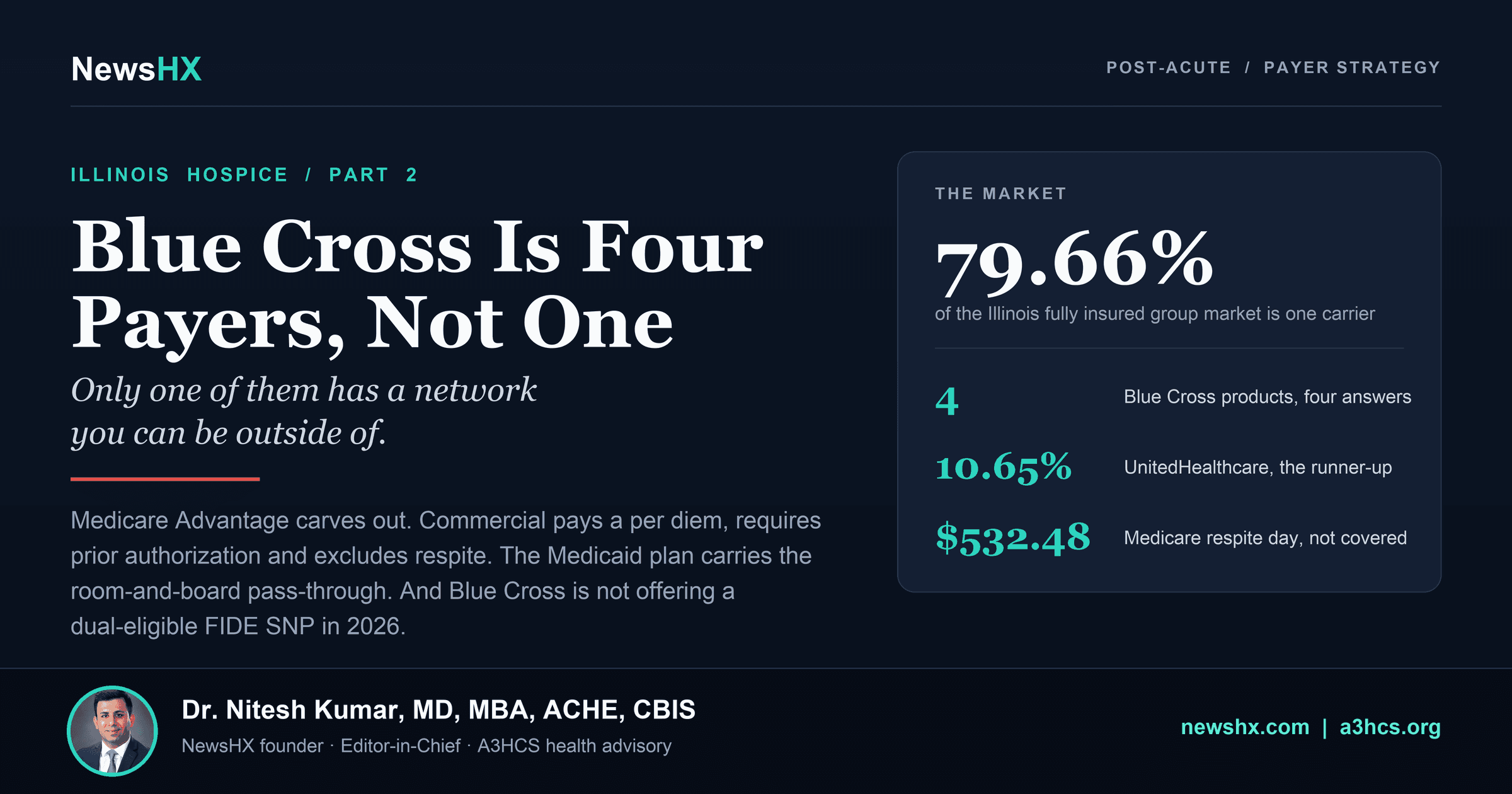
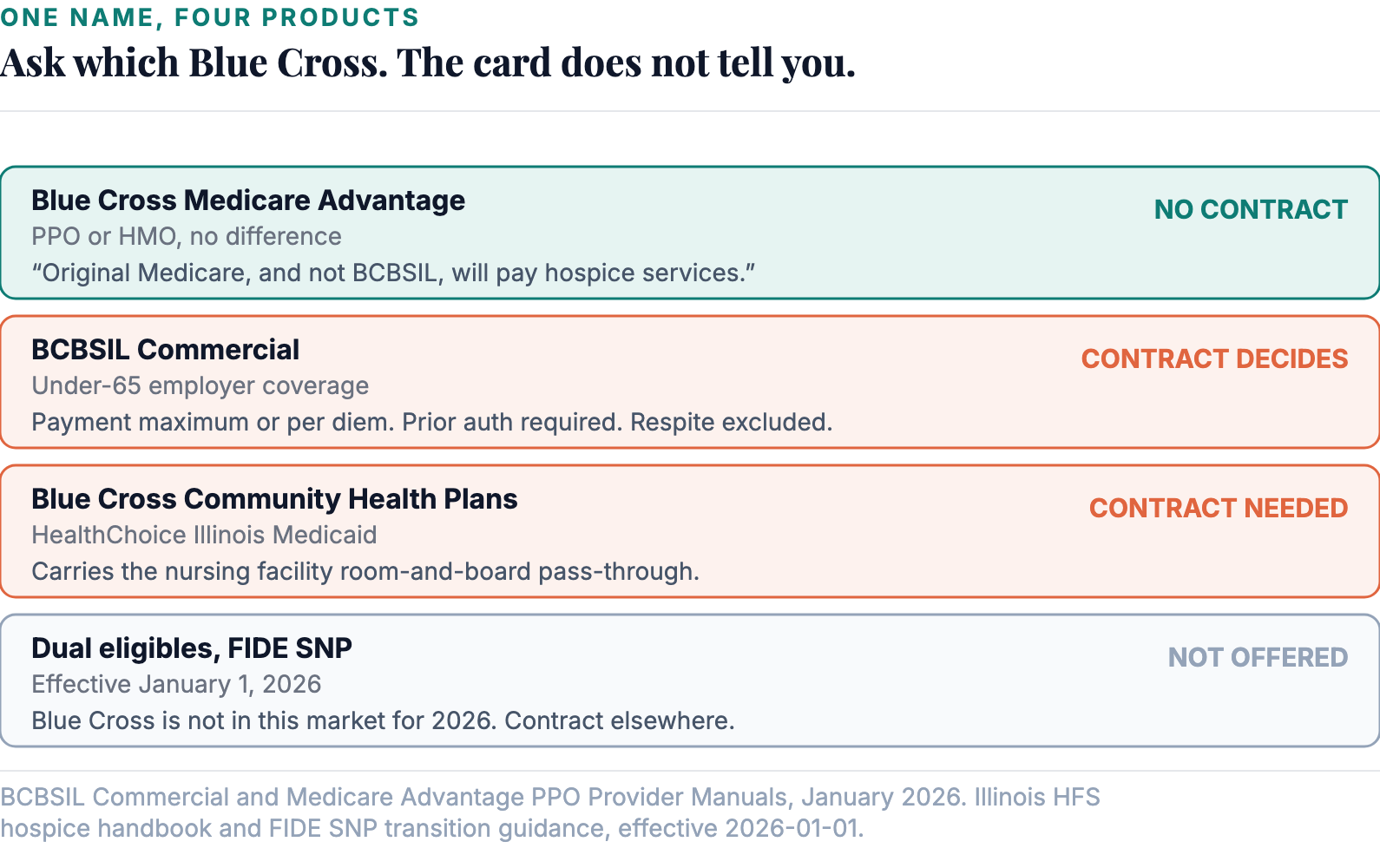
And in Illinois that card has an overwhelming likelihood of saying Blue Cross. What almost nobody does is ask which Blue Cross, because the name sits on four different products that behave in four different ways. One of them is the only place in your entire book where the in-network versus out-of-network question is real.
Illinois is a Blue Cross state, and it is not close
The Illinois Department of Insurance publishes carrier-level market share from the companies' own annual statements. For 2024 group comprehensive, the fully insured employer market, Health Care Service Corp, the BCBSIL parent, wrote $10.31 billion in Illinois direct premiums, 79.66% of the market.1 UnitedHealthcare's three Illinois entities together hold 10.65%, and Health Alliance Medical Plans 7.73%.
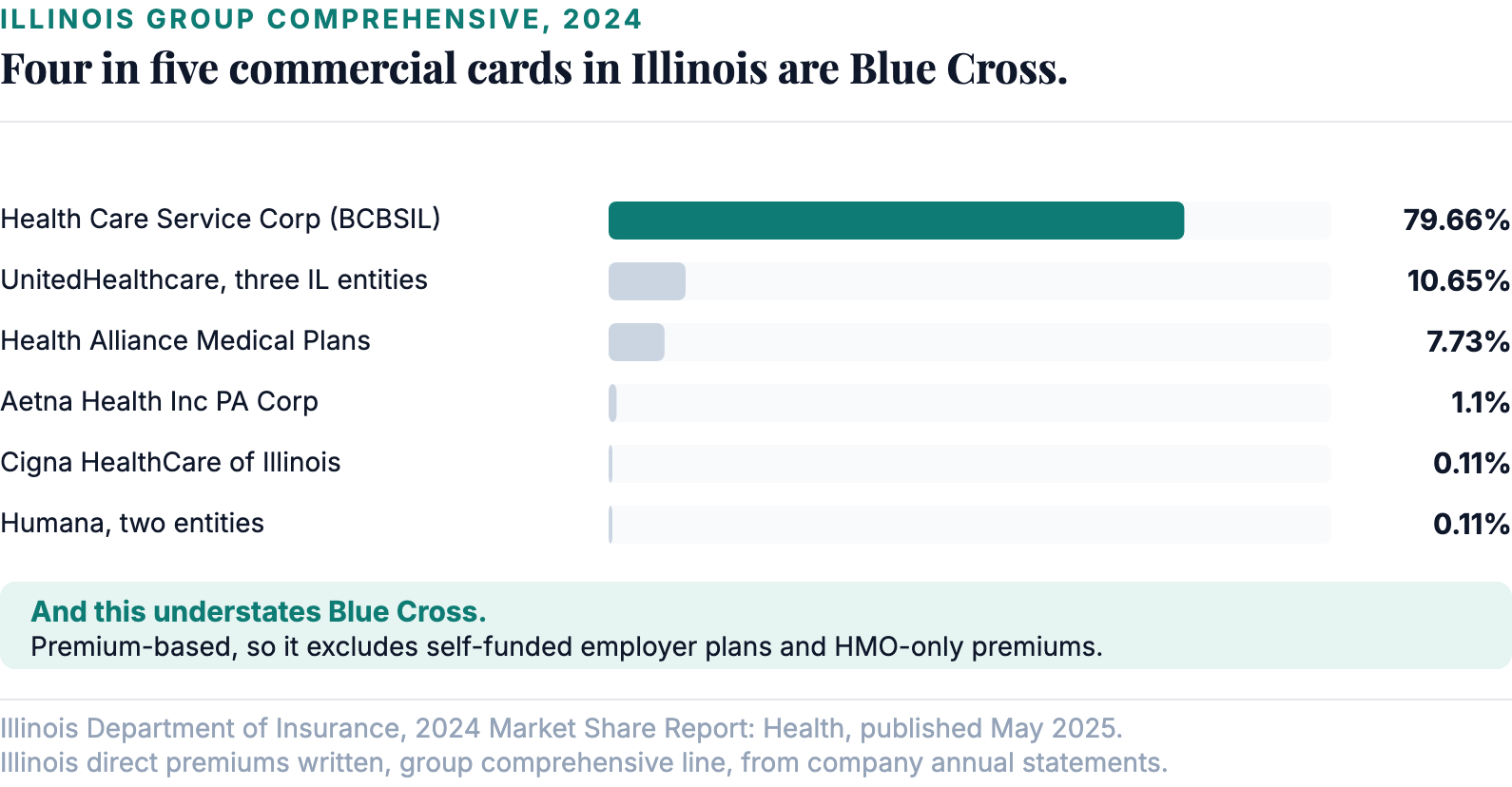
Roughly four in five commercial cards in Illinois are Blue Cross. UnitedHealthcare is the only other carrier worth a phone call. Health Alliance matters downstate, around Champaign and Urbana, where it is the Carle-affiliated plan. Aetna, Cigna and Humana together are under 1.5% of the market, and Humana's sliver is a remnant: it announced its exit from employer group commercial medical products in 2023.11
Two limits on that figure, and both push the same direction. It is premium-based, so it counts fully insured business only and excludes self-funded employer plans, which Health Care Service Corp administers in volume and which run on Blue Cross networks and Blue Cross cards. And the report states it does not break out HMO-only premiums, which are published separately.1 Blue Cross is larger than 79.66%, not smaller.
So the commercial contracting question in Illinois is not a portfolio decision. It is one negotiation and one fallback.
Blue Cross Medicare Advantage: no contract, and they say so
This is the largest slice of Blue Cross cards a hospice will see, because hospice patients are overwhelmingly 65 and older. It is also the one that requires nothing from you.
The BCBSIL Medicare Advantage PPO Provider Manual lists hospice among the exceptions to the rule that MA plans cover what Original Medicare covers:
Hospice – Original Medicare, and not BCBSIL, will pay hospice services received by a MA PPO plan member.
That is the carve-out in the plan's own words.3 No contract, no network, no prior authorization on the hospice benefit, and PPO versus HMO is irrelevant because both revert to Part A on election.
Worth noting for scale: Humana is actually the largest Medicare carrier in Illinois at roughly 29% across two entities, with UnitedHealth entities close behind and Health Care Service Corp at 12.85%.1 For hospice, none of that concentration matters. It all carves out.
Blue Cross commercial: the only one where the question is real
This is the under-65 employer population, and it is where every commercial contracting decision actually lives. On payment, the BCBSIL Commercial Provider Manual is specific:
Illinois Ancillary facilities such as Coordinated Home Care, Hospice, Skilled Nursing Facilities, Renal Facilities, Surgi-Centers, and Substance Abuse Facilities, may also have a contract with BCBSIL. Payment structure is typically a payment maximum or per diem.
A payment maximum or a per diem. Not billed charges.2 Charges appear in that section only to define the contractual allowance, which is the amount you write off, not the amount you collect.
I want to be direct about this because the assumption runs the other way in a lot of hospice finance conversations. There is no percent-of-charges arbitrage in hospice, and the reason is structural rather than a negotiating failure. Hospice is already a per diem benefit by construction. You bill a day of care at a level of care under revenue codes for routine home care, continuous home care, inpatient respite and general inpatient. There is no line-item chargemaster to mark up. That mechanism, which makes percent-of-charges genuinely lucrative in an inpatient rehabilitation hospital or a long-term acute care hospital, does not exist here.
Blue Cross Community Health Plans: the Medicaid one carries the pass-through
Health Care Service Corp runs Blue Cross Community Health Plans, one of the statewide HealthChoice Illinois managed care plans, and it continues serving Medicaid members in 2026.6
This product matters for a reason unrelated to the hospice per diem. It is where the nursing facility room-and-board pass-through lives. The Illinois HFS hospice handbook is explicit that its fee-for-service billing instructions do not apply to managed care enrollees, and that charges for members of a Managed Care Organization "must be billed to that entity according to the contractual agreement."4 For a hospice with nursing facility census, a Medicaid managed care contract is not optional.
The one that left: duals, and Blue Cross is not in it
Illinois ended its Medicare-Medicaid Alignment Initiative on December 31, 2025 and moved dual eligibles into fully integrated dual eligible special needs plans on January 1, 2026.
Blue Cross is not offering a FIDE SNP for 2026. Its MMAI coverage ended with the program, and it wrote to members in October 2025 that they would need to select other Medicare coverage.5
If you were building a contracting list for the dual-eligible transition, Blue Cross is not on it for 2026. Those patients moved to other carriers, and that is where the FIDE SNP contracting question now sits. A carrier can enter in a later plan year, so check again when 2027 plans post.
PPO versus HMO, and why the intuition is backwards
Here is the part that inverts what most operators expect, and it applies only to the commercial product.
Commercial HMO. Without a contract there is generally no out-of-network benefit outside emergencies. The claim is not underpaid. It is not covered. This is exclusion, not leverage.
Commercial PPO. Without a contract you are paid the plan's out-of-network allowed amount and the member owes a higher cost share. This is the only place in hospice where a commercial out-of-network premium can exist.
Medicare Advantage, either type. Irrelevant. The benefit carves out to Part A, and there is no network in either direction.
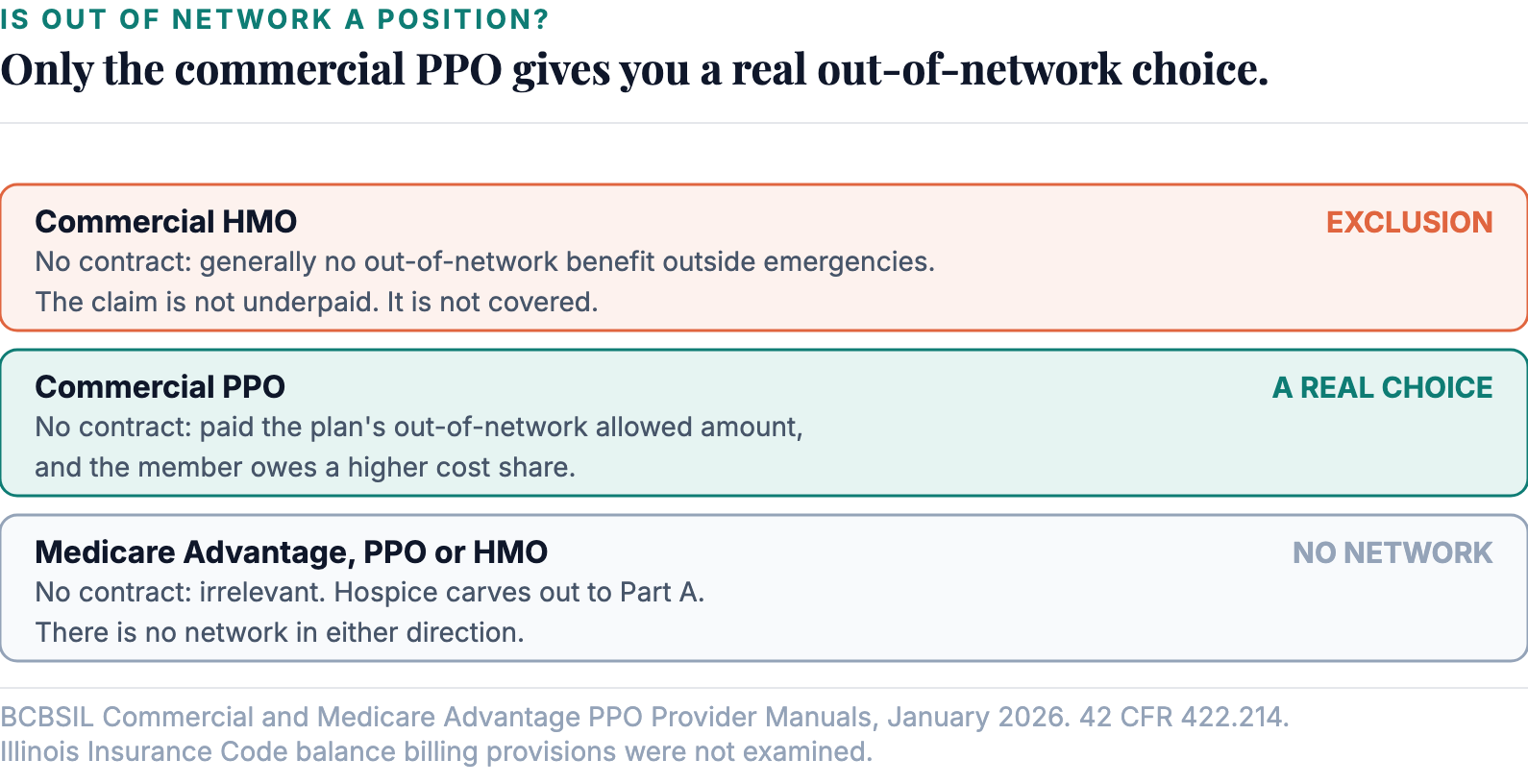
In Medicare Advantage generally, going out of network is not a pricing strategy, because 42 CFR 422.214 caps what a non-contracted provider collects at the Original Medicare amount and bars the balance bill.7 That reasoning does not transfer to commercial. There is no equivalent federal cap on a commercial out-of-network payment, and the No Surprises Act does not reach a planned admission to a nonparticipating hospice, because its protections attach to emergency services, to out-of-network providers working inside in-network facilities, and to air ambulance.8
So the honest ranking is the opposite of the Medicare Advantage conclusion. Sign the commercial HMOs, because without a contract those patients cannot be served against a benefit at all. The PPO is where you have a genuine choice, and it turns on whether the out-of-network allowed amount beats the contracted per diem, which is arithmetic only your own remittances can do.
One caution before anyone acts on the balance-billing half of that. Illinois has its own managed care and balance billing provisions in the state Insurance Code that I have not examined. The federal rule leaves the door open. State law may not.
Two coverage rules that will cost you money
These are the most likely reasons a Blue Cross commercial hospice case goes sideways, and both come from assuming Medicare rules apply.
Prior authorization is required. The BCBSIL commercial manual states that "Prior Authorization is required by most member benefit plans," and lists inpatient hospice as separately requiring authorization for some employer groups.2 The Medicare hospice benefit requires none. A hospice team that has only ever worked Medicare has no muscle memory for authorizing an admission, and the workflow gap shows up as a denial weeks later.
Respite care is not covered. BCBSIL lists respite care under services not typically considered eligible as hospice.2 Medicare pays inpatient respite at $532.48 per day in FY 2026.10 Deliver respite to a Blue Cross commercial member on the assumption that Medicare coverage carries over, and you have donated it. The manual is the general rule; an executed contract can differ, so check yours.
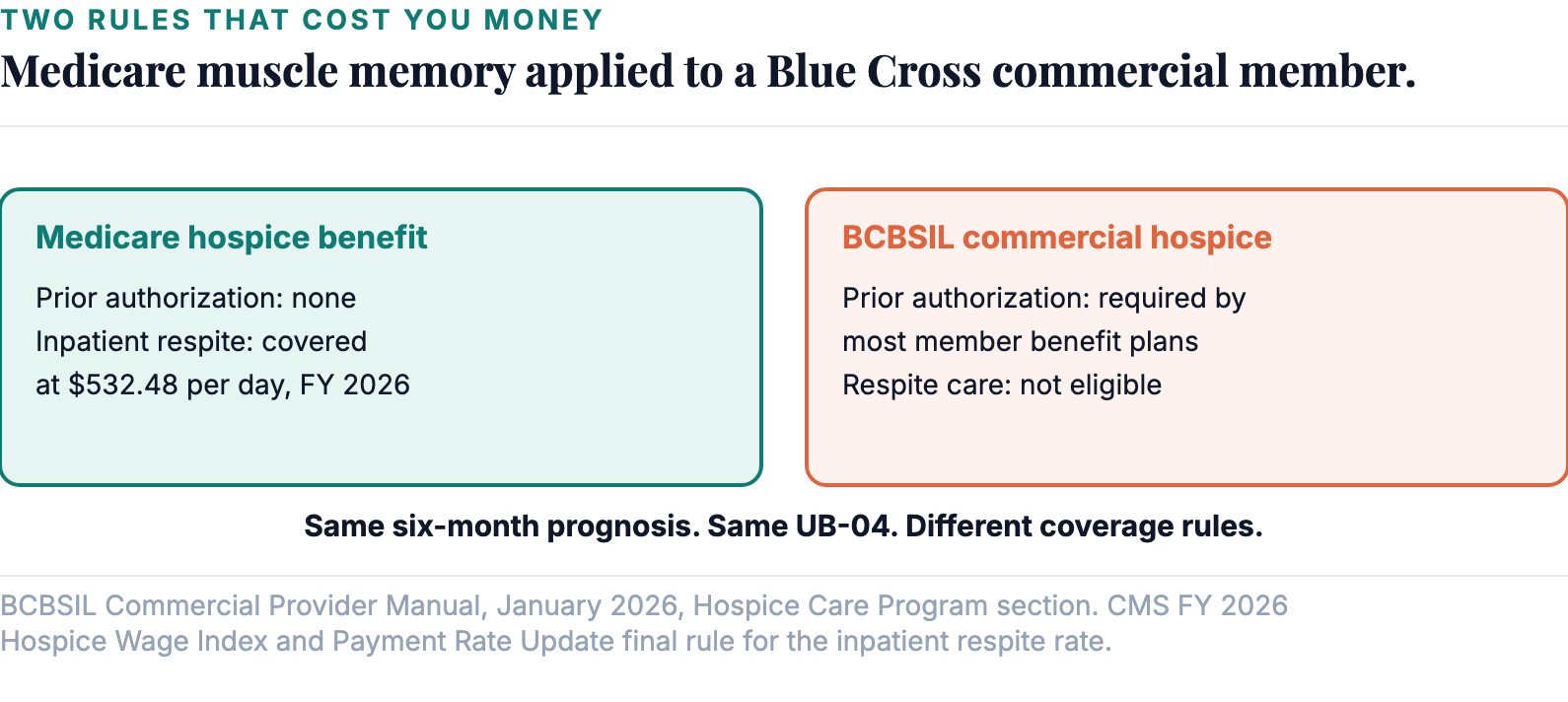
The prognosis standard is the same six months, and claims go on a UB-04 or an 837I, so the billing mechanics feel familiar. It is the coverage and authorization rules that diverge, not the claim form, which is exactly what makes the divergence easy to miss.
What actually decides this
Everything above tells you who you will meet and what the rules are. None of it tells you whether the meeting is worth taking.
Medicare was about 91% of hospice days nationally.9 Commercial hospice is an under-65 population, and under 65 does not mean commercial, because many terminally ill patients under 65 reach Medicare through disability or end-stage renal disease, and others are on Medicaid. The commercial slice is thinner than the age distribution suggests.
And no current public figure exists for it. CMS's hospice public use file excludes commercial and Medicaid claims by design, and the national reporting is built on Medicare data. The number that decides your contracting priorities is not published anywhere. It is in your accounts receivable.
Pull days and revenue by payer for the last twelve months before doing anything else. If commercial is a low single-digit share of days, this entire article is a reference document rather than a work plan, and the levers from Part 1 are where the effort belongs: assisted living and supportive living density, and moving the 14-day median length of stay.
The short version
1. Ask which Blue Cross. Four products, four answers, and the name on the card does not tell you which one you have.
2. Medicare Advantage needs nothing from you. Blue Cross says so in its own manual.
3. Commercial pays a per diem or a payment maximum, not charges. There is no chargemaster arbitrage in a per diem benefit.
4. Sign the commercial HMOs. No contract there means no coverage, not a better rate.
5. The commercial PPO is the only real decision, and your remittances decide it.
6. Blue Cross Community carries the Medicaid room-and-board pass-through, which matters the moment you have nursing facility census.
7. Blue Cross is not in the dual-eligible market for 2026. Do not build a FIDE SNP list around it.
8. Authorize the admission and do not assume respite is covered. Those two rules are where Medicare habits cost commercial dollars.
Deciding which Illinois payer contracts are worth signing?
A3HCS maps the payer mix behind a hospice's census, separates the contracts that buy coverage from the ones that buy nothing, and builds the authorization workflow that keeps commercial admissions from turning into denials.
References
- Illinois Department of Insurance. 2024 Market Share Report: Health, published May 2025. Group Comprehensive and Title XVIII Medicare tables. Figures are Illinois direct premiums written from company annual statements; the report excludes HMO-only premiums, which are published separately. insurance.illinois.gov
- Blue Cross and Blue Shield of Illinois. Commercial Provider Manual, January 2026. Facility payment structure, Hospice Care Program section (services typically and not typically considered eligible), prior authorization lists. bcbsil.com
- Blue Cross and Blue Shield of Illinois. Blue Cross Medicare Advantage PPO Provider Manual, 2026. Exceptions to MA coverage of Original Medicare benefits. bcbsil.com
- Illinois Department of Healthcare and Family Services. Handbook for Hospice Agencies, Chapter K-200, topics K-250.7 and K-260.1.
- Blue Cross and Blue Shield of Illinois. MMAI coverage ending December 31, 2025; Blue Cross is not offering a FIDE SNP for 2026; member letters mailed October 2, 2025. bcbsil.com. Illinois HFS, Medicare-Medicaid Alignment Initiative end date and FIDE SNP transition. hfs.illinois.gov
- Blue Cross and Blue Shield of Illinois. Medicaid Plans to Continue in 2026 for Members with BCCHP and MLTSS, December 4, 2025. bcbsil.com
- 42 CFR 422.214, Special rules for services furnished by noncontract providers. ecfr.gov
- 45 CFR Part 149, Subpart B, and the No Surprises Act balance billing provisions. ecfr.gov
- Medicare Payment Advisory Commission. Report to the Congress: Medicare Payment Policy, March 2026, Chapter 10, Hospice services. Source of the Medicare share of hospice days. medpac.gov
- Centers for Medicare & Medicaid Services. FY 2026 Hospice Wage Index and Payment Rate Update final rule, CMS-1835-F, 90 FR 37404, August 5, 2025. Inpatient respite care rate. cms.gov
- Humana Inc. "Humana to Exit Employer Group Commercial Medical Products Business," February 23, 2023.