

Every summer, health systems open applications for the following year's administrative fellowship class. It is the closest thing American healthcare has to a designed entrance into executive leadership: one to two years of rotations through operations, finance, and strategy, sitting close enough to the C-suite to be seen by it. Systems recruit for these seats publicly and enthusiastically, and their chief executives often do the recruiting personally.
It is a good program. That is worth saying at the start, because the argument here is not that fellowships are broken. They work extremely well for the people they were built for, and they were built for someone specific: a newly minted graduate of a health administration master's program, roughly 26 years old, with no prior career to interrupt.
The question is what happens when a practicing physician, ten or fifteen years into a career, decides to move toward operational leadership and goes looking for the door.
There is essentially one door. It is priced for the 26-year-old, and in most cases it is also written for them, in a single clause most people never read.
The arithmetic, which is most of the story
Start with what the seats actually pay, using only what programs themselves publish rather than salary-aggregator estimates, which for this job title are worthless. Three of the 15 programs reviewed state a number.
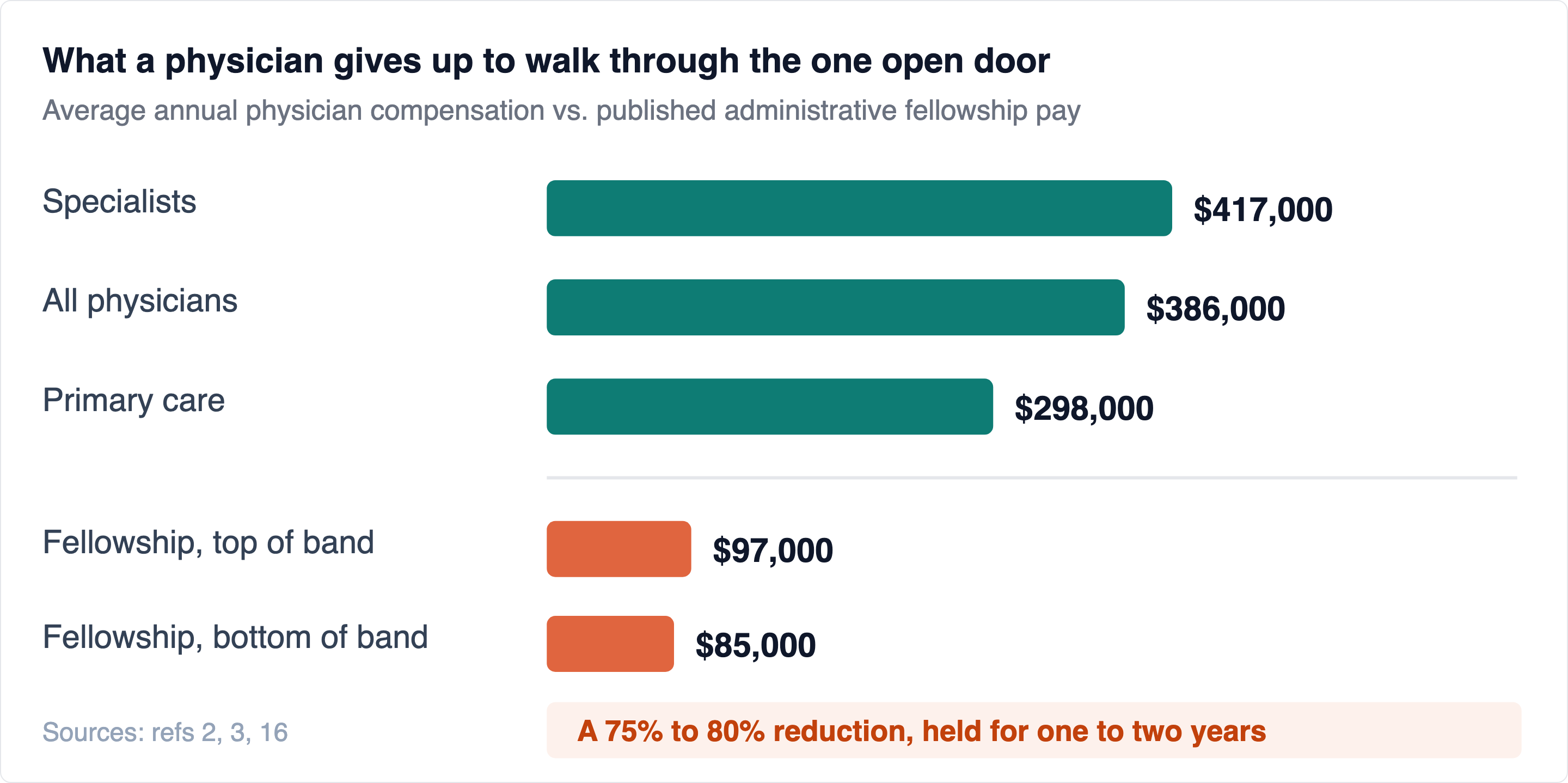
Cedars-Sinai's Thomas M. Priselac Administrative Fellowship posts a salary range of $85,000 to $90,000 2. Kaiser Permanente posts $97,000 for its Northern California cohort and $96,000 for Southern California 3. Stanford Medicine Children's Health posts an hourly range of $43.56 to $56.63, which annualizes to roughly $90,600 to $117,800 8.
Against that, the Medscape Physician Compensation Report 2026, drawn from a survey of about 6,000 physicians, puts average physician compensation for the 2025 pay year at $386,000, up 3 percent. Primary care averages $298,000 and specialists average $417,000 16.
The subtraction is the article. A physician earning the national average who takes the best-paying fellowship seat in this sample gives up roughly 75 percent of their income. At the bottom of the observed band, it is 78 percent. A specialist taking an $85,000 seat gives up 80 percent. For one to two years, depending on the program.
That is the number, and it is worth sitting with before the usual objections arrive.
Three things the percentage understates
A 78 percent pay cut sounds survivable if you picture a resident. It is a different proposition here, for three reasons that compound.
It lands at the wrong point on the earnings curve. A resident forgoes income they have never earned and have no obligations against. A physician fifteen years into practice is carrying the heaviest fixed costs of their life: a mortgage sized to an attending salary, children approaching college, often education debt still amortizing, and in many cases aging parents. The cut is not deferred gratification. It is a default risk.
There is no placement guarantee at the end. Fellowships are hiring funnels, not hiring commitments. Many fellows convert to permanent roles and programs say so proudly, but the offer is an expectation rather than a term. The clinician is being asked to price an option nobody will price for them, and to do it against a known, certain, immediate loss.
Going back is not free. Clinical re-entry after a two-year absence means re-credentialing, re-enrolling with payers, and rebuilding a referral base and a patient panel that moved elsewhere. In procedural specialties it can also mean volume and currency requirements. The exit door out of the fellowship, if the leadership move does not take, has its own toll booth. A 26-year-old MHA graduate has no equivalent cost, because there is no practice to return to.
Put together, the fellowship asks a mid-career physician to accept a near-total income loss, against an unguaranteed outcome, with an expensive path back. Framed that way, the surprising thing is not that few physicians take it. It is that the industry treats their absence as a preference.
What the postings actually say
Pay is the barrier that gets named. It is not the one that does most of the work.
Public materials for 15 administrative fellowship programs at large US health systems were pulled on August 11, 2026, and coded on three questions: does the program state what it pays, does it name MD or DO among qualifying degrees, and does it require the degree to have been earned inside a recent window. The programs were Sutter Health, Cedars-Sinai, Kaiser Permanente, Mayo Clinic, Cleveland Clinic, Duke University Hospital, MD Anderson, Stanford Medicine Children's Health, Intermountain Health, UChicago Medicine, UC San Diego Health, Rush, Vanderbilt, Northwestern Medicine, and MU Health Care.
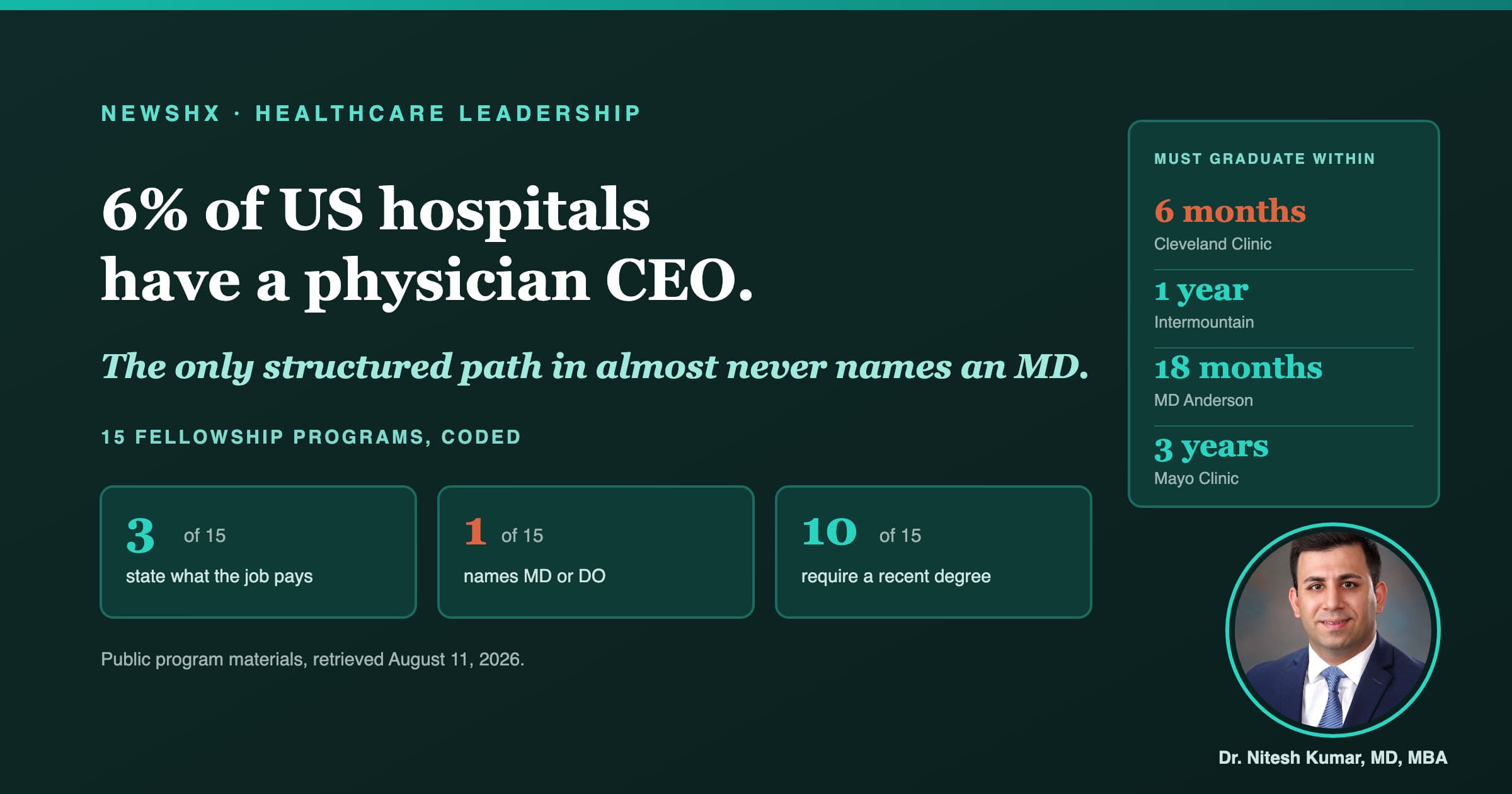
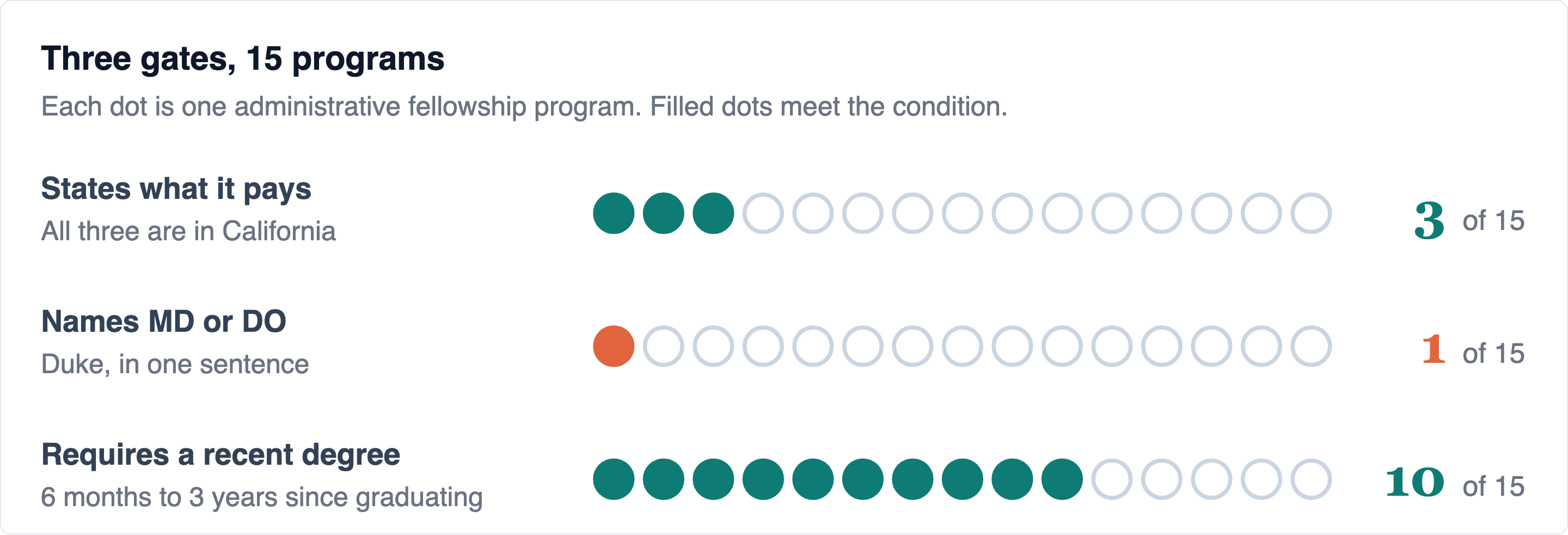
Three of the fifteen state a stipend. One names MD or DO as a qualifying degree. Ten impose a graduation-recency window.
Take the second finding first, because it is the one that sounds implausible until you read the language.
Programs do not exclude physicians. They simply enumerate the degrees they want, and the enumeration is a list of management master's degrees. Cedars-Sinai asks for an “MHA, MHS, MHSA, MPA, MPH, MPP, or MBA with a healthcare emphasis” 2. MD Anderson asks for “an M.H.A., M.B.A. (with an emphasis in health care management), M.P.H., or equivalent degree from a CAHME, CEPH or AACSB accredited school” 7. Sutter lists MHA, MBA with healthcare emphasis, MPH, MSN paired with a dual management degree, and JD 1. Cleveland Clinic asks for a master's “in health administration (MHA/MHSA), Public Health (MPH), Business Administration (MBA) or other related master's degree program” 5. Vanderbilt wants “masters-level graduates from programs in Health Care Administration, Business Administration or Public Health” 13. Northwestern wants “a master's degree in health services or business administration or the equivalent” 14. UC San Diego lists “MHA, MHSA, MBA, MPH, MSN, MS or equivalent” 11. Rush lists “MBA, MHA, MHSA, MS, MPH” 12. Intermountain lists MHA, MBA with a healthcare emphasis, and MPH 9. UChicago Medicine asks for “an accredited MHA, MPH, MBA or a related program” 10. MU Health Care asks for health care administration, public health, public administration, health informatics, or business administration 15. Mayo Clinic asks for an “M.B.A., M.H.A., M.H.S.A. or related field” 4.
Not one of those lists contains MD or DO. A medical degree is not disqualified anywhere. It is simply not mentioned, and an applicant reading the list has to decide whether “or equivalent” was written with them in mind. Most will conclude it was not, which is a reasonable reading of a list that names eleven degrees and skips theirs.
Two programs are different, and they are the more interesting cases.
Duke University Hospital states it plainly: after describing accredited master's-level requirements, its materials add that “Graduate level clinical degree holders are also accepted (Ex. MD, MSN)” 6. One sentence. It costs nothing and it resolves the ambiguity completely. Kaiser Permanente takes a different route to a similar place, stating that the program “welcomes candidates from all graduate-level academic backgrounds” 3, which does not name the MD but does not build a fence around it either.
That is the whole intervention. One sentence, in one program out of fifteen.
The clause that closes the door before pay is even a question
The recency window is the finding that matters most, because it operates before a physician has a chance to weigh the money.
Ten of the fifteen programs require the qualifying degree to have been conferred inside a defined window, usually one to two years wide, tied to the fellowship start date.
Cleveland Clinic's is the tightest: the fellowship is “intended for post-graduate students who have graduated within 6 months of their intended fellowship start date” 5. Intermountain says it will “only consider candidates within one year of graduation at the time of the program's start” 9. Kaiser requires conferral between July 1, 2026 and June 30, 2027, and adds that “Exceptions cannot be granted for this requirement” 3. Cedars-Sinai sets a window of May 1, 2025 to June 30, 2027 and states that degrees conferred before that date “are not eligible for consideration” 2. Sutter requires candidates to “confer graduation between December 2025 and July 2027” 1. Stanford Medicine Children's Health requires conferral between December 1, 2025 and June 30, 2027 8. UChicago Medicine requires coursework completed between November 2026 and June 2027 10. UC San Diego requires graduation between July 1, 2026 and July 1, 2027 11. MD Anderson requires the degree “granted within 18 months of the start of the fellowship” and describes itself as “a new graduate program” 7. Mayo requires a master's “received within three years of the application cycle” 4.
Now apply that to the physician the industry says it wants. A hospitalist who finished an MBA six years ago while practicing is time-barred from ten of these fifteen programs. Not rejected. Not outcompeted. Ineligible at the filter, before anyone reads a word about their operational experience, their service-line work, or the fact that they have spent a decade inside the building the fellowship exists to explain.
The clause is not aimed at physicians. It exists to keep fellowships functioning as entry-level pipelines rather than mid-career hiring channels, which is a legitimate design goal. But a rule does not have to intend an exclusion to produce one. The recency window is the most consequential sentence in these postings, and it is almost certainly the least discussed.
The five programs with no stated window are Duke, Rush, Vanderbilt, Northwestern Medicine, and MU Health Care 612131415. Those five are where a mid-career physician's application is at least legible.
One more thing the scan turned up
Twelve of the fifteen programs do not say what they pay. Most substitute a phrase: “a competitive salary,” “compensation competitive with other fellowship programs,” “a competitive salary along with a comprehensive benefits package” 91215.
The three that do disclose a number are all in California 238, which requires employers to include pay scales in job postings. Nothing in the sample outside a pay-transparency jurisdiction volunteers a figure.
This is not a scandal, and fellowship stipends are not a secret to anyone inside the MHA world, where students compare offers freely. But it matters specifically for the mid-career candidate, who has no cohort to compare notes with and who needs a number to run the only calculation that decides whether they can apply at all. A physician weighing a 78 percent pay cut cannot even begin that arithmetic against “competitive.”
6%, and the explanation that gets it backwards
Here is the outcome all of this feeds.
In a cross-sectional analysis of the American Hospital Association's 2019 annual survey covering 6,162 US hospitals, 383 were led by a physician CEO 17. That is 6.2 percent.
The standard reading of that number is a preference story. Physicians want to practice medicine. Leadership is a different calling. Most doctors have no appetite for budgets and board meetings, and the ones who do are rare.
Some of that is true. It is also doing a great deal of work to explain a number that has a much more boring explanation available. An industry that built exactly one structured entrance, priced it at a level a practicing physician cannot absorb, and then wrote eligibility rules keyed to recent graduation does not get to treat the resulting scarcity as evidence about what physicians want. You cannot read preference off a pipeline that filters before it asks.
The evidence, in both directions
It would be convenient to close the argument by showing that physician-led hospitals perform better, making the pipeline gap a quality problem. The literature does not support that cleanly, and overstating it is the fastest way to lose the readers this matters most to.
The strongest finding on one side is Amanda Goodall's 2011 study in Social Science & Medicine, which traced the personal histories of the CEOs of the top-100 US hospitals in cancer, digestive disorders, and heart surgery. Quality scores ran roughly 25 percent higher in physician-led hospitals 18. The sampling frame deserves to be stated as plainly as the result: top-100 hospitals only, cross-sectional, association rather than causation. Goodall said as much herself.
The strongest finding on the other side is more recent and broader. The 2022 JAMA Network Open analysis of 6,162 hospitals found a positive univariate correlation between physician CEOs and patients' willingness to recommend, but reported that “the multivariable model found no significant association between hospitals led by a physician CEO and higher HCAHPS ratings or Leapfrog grades” 17. Once the confounders were controlled, the effect did not survive.
An industry cannot learn whether physician executives produce better outcomes while the pipeline into those roles pre-selects against physicians.
So the honest position is that the question is unresolved. That is precisely the argument, rather than a weakness in it. That 6 percent is not a large enough, or randomly enough assembled, sample to answer the question. The structure is generating the missing evidence and then citing the absence of evidence as though it settled something.
What an on-ramp would actually look like
The fix is not to convert administrative fellowships into mid-career programs. They are good at what they do, and repurposing them would break the thing that works.
The fix is that the fellowship should stop being the only designed path, and the alternatives are neither expensive nor hypothetical.
From the field · Dr. Kumar
Four on-ramps that do not require a new program. Protected operational time inside an existing appointment. Twenty percent of a physician's time, formally carved out and backfilled, pointed at a real operational portfolio with a budget attached. The clinician keeps their income and their license current. The system gets a leader in training who already knows its people. This is the single highest-leverage move available and it requires no new program. A named ladder with real P&L exposure. Medical director to service-line leadership to associate COO, with each rung carrying accountability for a margin rather than a committee. Many systems have this ladder informally. Almost none have named it, published it, or told their medical staff it exists. Executive education that does not require exiting income. ACHE and AAPL credentials, executive MBA formats, and system-run internal programs already exist. What is usually missing is the system paying for them and treating completion as a qualification rather than a hobby. And one sentence in the fellowship postings. For the systems that do want mid-career clinical applicants, Duke has already written the line: graduate-level clinical degree holders are also accepted 6. Adding it costs nothing. Leaving it out costs a candidate pool.
None of this is novel. Versions of all four run somewhere today. What does not exist is a name for it, a standard shape, or any expectation that a system should have one, which is exactly the status the administrative fellowship achieved decades ago and has held since.
The close
Every health system chief executive recruiting for a fellowship class is doing something genuinely useful. The programs are strong, the fellows are talented, and the systems that run them are better for it.
But when a chief executive posts publicly asking their network to send promising people toward the fellowship, a large share of the people reading that post are physicians on their own medical staff who cannot apply. Not because they lack interest, and in most cases not because anyone decided to exclude them. Because the stipend assumes they have no career to interrupt, and the eligibility clause assumes they graduated last spring.
The systems that solve this will end up with a leadership bench their competitors cannot recruit against, for a reason that ought to be obvious. The candidates are already on the medical staff, already know the operation, and are not going to show up in anybody's fellowship applicant pool.
6% is not a statement about what physicians want. It is a statement about what was built.
Your next operating executive is already on your medical staff.
Health systems that want a physician leadership bench usually do not need a new program. They need the ladder named, the operational time protected, and the P&L exposure made real. A3HCS builds physician leadership pathways inside existing structures, so the clinicians who already know your operation can move toward running it without leaving their income or their license behind.
References
- Sutter Health. Administrative Fellowship Program. https://jobs.sutterhealth.org/us/en/administrative-fellowship. Degree eligibility list and conferral window (must confer graduation between December 2025 and July 2027). Retrieved August 11, 2026.
- Cedars-Sinai. Thomas M. Priselac Administrative Fellowship Program. https://careers.cshs.org/administrative-fellowship-program. Salary range $85,000-$90,000; eligibility MHA, MHS, MHSA, MPA, MPH, MPP, or MBA with a healthcare emphasis; conferral window May 1, 2025 to June 30, 2027; 24-month program. Retrieved August 11, 2026.
- Kaiser Permanente. Administrative Fellowship Program. https://adminfellowship.kp.org/program/. Base pay $97,000 (Northern California) and $96,000 (Southern California); welcomes candidates from all graduate-level academic backgrounds; conferral July 1, 2026 to June 30, 2027 with Exceptions cannot be granted for this requirement. Retrieved August 11, 2026.
- Mayo Clinic. Administrative Fellowship Program. https://jobs.mayoclinic.org/afp. Eligibility M.B.A., M.H.A., M.H.S.A. or related field received within three years of the application cycle; two-year program. Retrieved August 11, 2026.
- Cleveland Clinic. Administrative Fellowship Program, Application Process. https://my.clevelandclinic.org/departments/education/health-management-education/administrative-fellowship-program/application-process. Eligibility language and the six-month post-graduation window. Retrieved August 11, 2026.
- Duke University Hospital. Administrative Fellowship. https://adminfellowship.duhs.duke.edu/duh. Graduate level clinical degree holders are also accepted (Ex. MD, MSN); no stated recency window; two-year program. Retrieved August 11, 2026.
- UT MD Anderson Cancer Center. Administrative Fellowship Program, How to Apply. https://www.mdanderson.org/education-training/continuing-education-professional-development/administrative-internships-fellowships/administrative-fellowship-program/how-to-apply.html. Eligibility list; degree must be granted within 18 months of the start of the fellowship. Retrieved August 11, 2026.
- Stanford Medicine Children's Health. Administrative Fellow: 2027-2029 posting. https://jobs.smartrecruiters.com/StanfordMedicineChildrensHealth/3743990013986406-administrative-fellow-2027-2029-smch-administrative-fellowship-program. Hourly range $43.56 to $56.63; conferral December 1, 2025 to June 30, 2027; 24-month term. Retrieved August 11, 2026.
- Intermountain Health. Administrative Fellowship. https://intermountainhealthcare.org/careers/professional-training-programs/administrative-fellowship. Competitive salary; MHA/MBA/MPH eligibility; only consider candidates within one year of graduation at the time of the program's start in July 2027; one-year program. Retrieved August 11, 2026.
- UChicago Medicine. Administrative Fellowship Application. https://www.uchicagomedicine.org/about-us/careers/career-development/administrative-fellowship/administrative-fellowship-application. Accredited MHA, MPH, MBA or a related program; coursework completed between November 2026 and June 2027. Retrieved August 11, 2026.
- UC San Diego Health. Administrative Fellowship FAQ. https://prod.health.ucsd.edu/for-health-care-professionals/education-training/administrative-fellowship/faq/. Competitive salary unspecified; MHA, MHSA, MBA, MPH, MSN, MS or equivalent; graduation between July 1, 2026 and July 1, 2027. Retrieved August 11, 2026.
- Rush University Medical Center. Administrative Fellowship. https://www.rush.edu/education-and-training/administrative-fellowship. Compensation package that is competitive with other fellowship programs; master's degree (MBA, MHA, MHSA, MS, MPH) or equivalent; no stated recency window; 12-month program. Retrieved August 11, 2026.
- Vanderbilt Health Hospital & Clinics. Administrative Fellowship Program, Application Information. https://www.vumc.org/administrative-fellowship/application-information. Masters-level graduates from programs in Health Care Administration, Business Administration or Public Health; no stated recency window; two-year program July 1, 2027 to June 30, 2029. Retrieved August 11, 2026.
- Northwestern Medicine. Harrison Administrative Fellowship Program, How to Apply. https://www.nm.org/for-medical-professionals/administrative-fellowship-program/application-process. Master's degree in health services or business administration or the equivalent; salary unstated; no recency window. Retrieved August 11, 2026.
- MU Health Care. Administrative Fellowship Program. https://careers.muhealth.org/us/en/residencies-fellowships-and-externships/administrative-fellowship-program. Competitive salary; health care administration, public health, public administration, health informatics or business administration; no stated recency window; two-year program. Retrieved August 11, 2026.
- Medscape. Physician Compensation Report 2026. https://www.medscape.com/p11/return-normalization-medscape-physician-compensation-report-2026a10009um. Average physician compensation $386,000 for the 2025 pay year, up 3%; primary care $298,000; specialists $417,000; approximately 6,000 physicians surveyed. Retrieved August 11, 2026.
- See H, Shreve L, Hartzell S, Daniel S, Slonim AD. Comparison of Quality Measures From US Hospitals With Physician vs Nonphysician Chief Executive Officers. JAMA Network Open. 2022;5(10). Published October 13, 2022. https://pmc.ncbi.nlm.nih.gov/articles/PMC9561952/. 6,162 hospitals in the 2019 AHA Annual Survey, 383 with physician CEOs; multivariable model found no significant association with HCAHPS ratings or Leapfrog grades.
- Goodall AH. Physician-leaders and hospital performance: is there an association? Social Science & Medicine. 2011;73(4). https://www.sciencedirect.com/science/article/abs/pii/S0277953611003819. Top-100 US hospitals in cancer, digestive disorders, and heart and heart surgery, 2009; 300 CEO histories traced by hand; quality scores approximately 25% higher in physician-led hospitals; association, not causation.