

A patient "failed rehab." That is the phrase that goes in the chart, and it closes the question. Ask what actually happened often enough and a pattern shows up instead of a failure: discharge instructions written above the family's reading level, a follow-up call that never got made, a caregiver nobody coached on what to watch for. Ten days later the patient is back in a bed. That is not a patient who failed. That is a system that never communicated. And in nearly every budget, curriculum, and org chart in American healthcare, the skill that would have prevented it is filed under a single dismissive word: soft.
That word does something quiet and expensive. It tells a CFO the training is optional. It tells a curriculum committee to schedule it after the "real" content. It tells a clinician running on empty that the part of the job that connects them to another human being is the part that does not count. So we protect the procedures and the throughput, and we treat relationships and communication as the nice-to-have around the edges. The evidence does not support that hierarchy. The relationship is not the wrapper around the treatment. It is part of the treatment.
Communication is not a personality trait some clinicians are born with. It is a clinical procedure with a dose-response curve, and it is trainable.
Communication is a procedure, not a personality
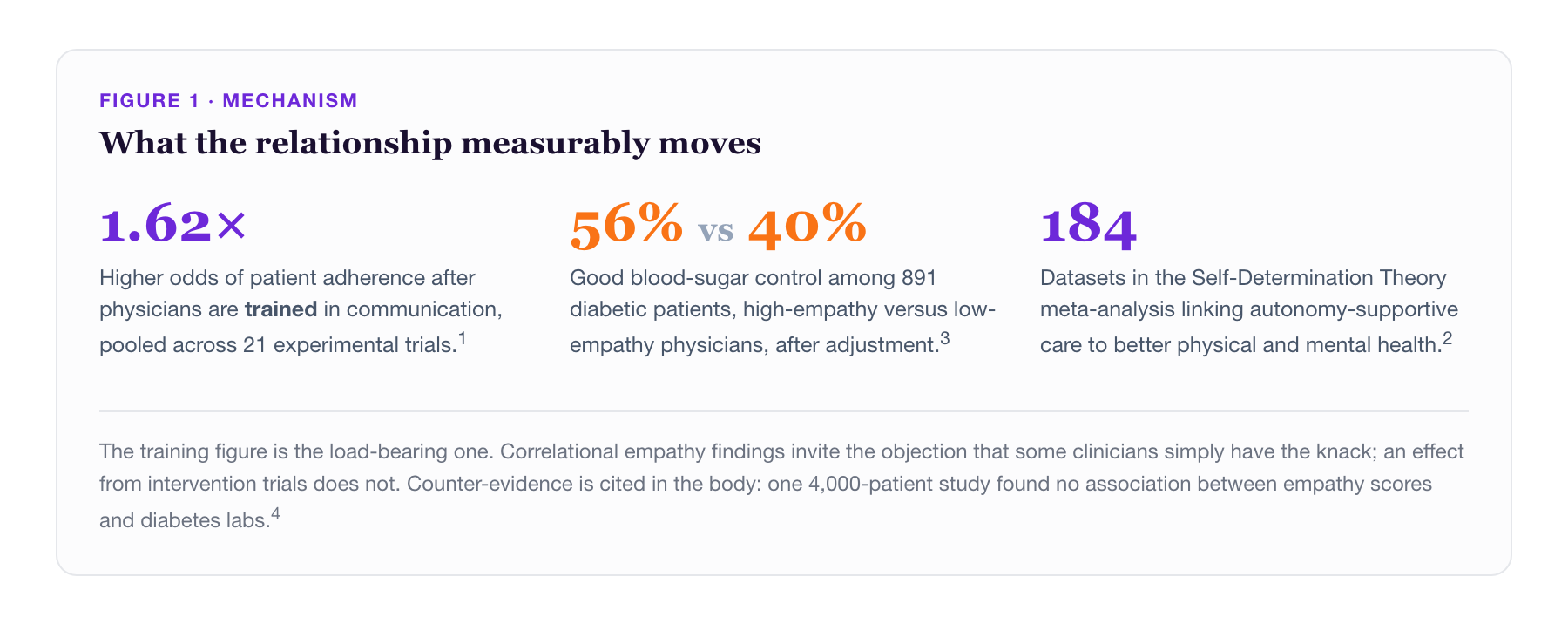
Start where the skeptics live, with behavior. In a meta-analysis of 45,093 patients across 106 correlational studies, those whose physician communicated poorly had a 19% higher risk of not following the treatment plan. Put the other way round, good communication carried 2.16 times better odds of adherence.1 That much is correlation. Here is the part that is not: across 21 experimental trials covering a further 10,190 patients, training physicians in communication raised the odds of adherence 1.62-fold.1 Because that figure comes from intervention studies, it settles the "some people just have it" objection. This is a modifiable skill, and moving it moves what patients actually do.
Behavioral science explains why. Self-Determination Theory, tested across 184 datasets, shows that when clinicians support a patient's autonomy rather than command it, and patients experience competence and genuine connection, their mental and physical health measurably improve.2 People do not follow a plan because we are right. They follow it because they trust the person in front of them and feel like a partner in the plan rather than a subject of it. That is the engine under adherence, and the relationship is what turns it.
The relationship shows up in the body
It is not only behavior. In a study of 891 diabetic patients, those treated by physicians who scored high on a validated empathy scale were far more likely to have their disease controlled: good blood-sugar control in 56% versus 40%, and good cholesterol control in 59% versus 44%, with empathy independently predicting the result after adjustment.3 In a secondary analysis inside a randomized trial of 719 patients, those who rated their clinician's empathy as perfect had colds resolve more than a full day faster, 5.89 days against 7.00, alongside a significantly stronger interleukin-8 response measured in the lab rather than on a survey.5 And in a review of 28 randomized trials, the 13 that reported pain found empathic, expectation-setting communication cut it by one to two points on a ten-point scale, roughly the margin of a common analgesic.6 Be precise about which half did the work: the significant effect came from the expectation-setting arm, and empathy on its own did not reach significance. Even so, the relationship performed like a drug.
Now the honest counterweight, because the case only holds if it can survive one. The empathy-outcomes literature is genuinely mixed. A rigorous study of more than 4,000 diabetes patients found physician empathy scores were not associated with lab outcomes at all.4 A Cochrane review found communication-skills training did not, on its own, fix clinician burnout or every patient outcome.16 So the defensible claim is not that empathy is magic. It is this: relationships and communication reliably move behavior, experience, adherence, safety, and retention, and often, though not always, move the biomarkers. Doing this badly is exactly what shows up as a null result.
The sharpest counter-evidence is worth sitting with, because it is not the one skeptics usually reach for. In a cluster randomized trial of 91 oncology clinicians and 278 patients with advanced cancer, the Serious Illness Care Program did what implementation research almost never manages: it actually changed clinician behavior. Of the clinicians who received a prompt, 87.2% held a structured goals-and-values conversation, median length 19 minutes.19 And the two coprimary outcomes, goal-concordant care and peacefulness, did not differ from control. Patient anxiety did improve, at both 14 and 24 weeks. Depression improved at 14 weeks and not after.
So a well-designed communication program succeeded at the thing it was built to do and still missed the endpoint its own investigators had picked. The lesson is not that the conversation was worthless. It is that we remain bad at choosing what to measure, and a program can be worth funding on uptake, anxiety, and documented goals while a composite outcome stays flat. Any leader who funds this work should design the measurement before the rollout, not after.
The honest synthesis: relationships reliably move adherence, experience, safety, and whether clinicians stay, and often move the hard biomarkers too. That is not the profile of a soft skill you can defer. It is the profile of a core competency you have been under-resourcing.
The safety issue, and the balance sheet
If the mechanism does not move you, the profit-and-loss statement should. Communication failure is not a feelings problem. It is a body count and a cost line. An analysis of nearly 24,000 U.S. malpractice cases found communication breakdowns contributed to 30% of them, linked to 1,744 deaths and $1.7 billion in cost over five years.8 The Joint Commission names inadequate hand-off communication as a contributing factor to adverse events including its most serious sentinel events, wrong-site surgery among them.7
It is also written directly into how hospitals get paid, and the arithmetic just got starker. Medicare's Hospital Value-Based Purchasing program is funded by withholding 2% of participating hospitals' base operating DRG payments, roughly $1.7 billion a year, then redistributing all of it on performance.21 One of its four scoring domains, Person and Community Engagement, is built entirely from HCAHPS. For fiscal 2026 that domain scored eight HCAHPS dimensions, three of them explicitly about communication: with nurses, with doctors, and about medications.9 Beginning with the FY2027 program year, CMS scores only six dimensions, having dropped Responsiveness of Hospital Staff and Care Transition.20 The three communication dimensions all stayed.
Do that arithmetic. The share of a hospital's patient-experience score that is purely about how well its people talk to patients rose from three of eight to three of six. CMS priced the "soft skill," put it on the invoice, and then, effective with the program year now under way, quietly made it a larger fraction of the bill.20 And it is the difference between a patient who stays well and one who bounces back: a systematic review found post-discharge teach-back and follow-up communication reduced readmissions in five of six teach-back studies examined.10
The strongest evidence is a protocol, not a personality
If you want the single cleanest refutation of the word "soft," it is not a study of empathy. It is a study of a handoff.
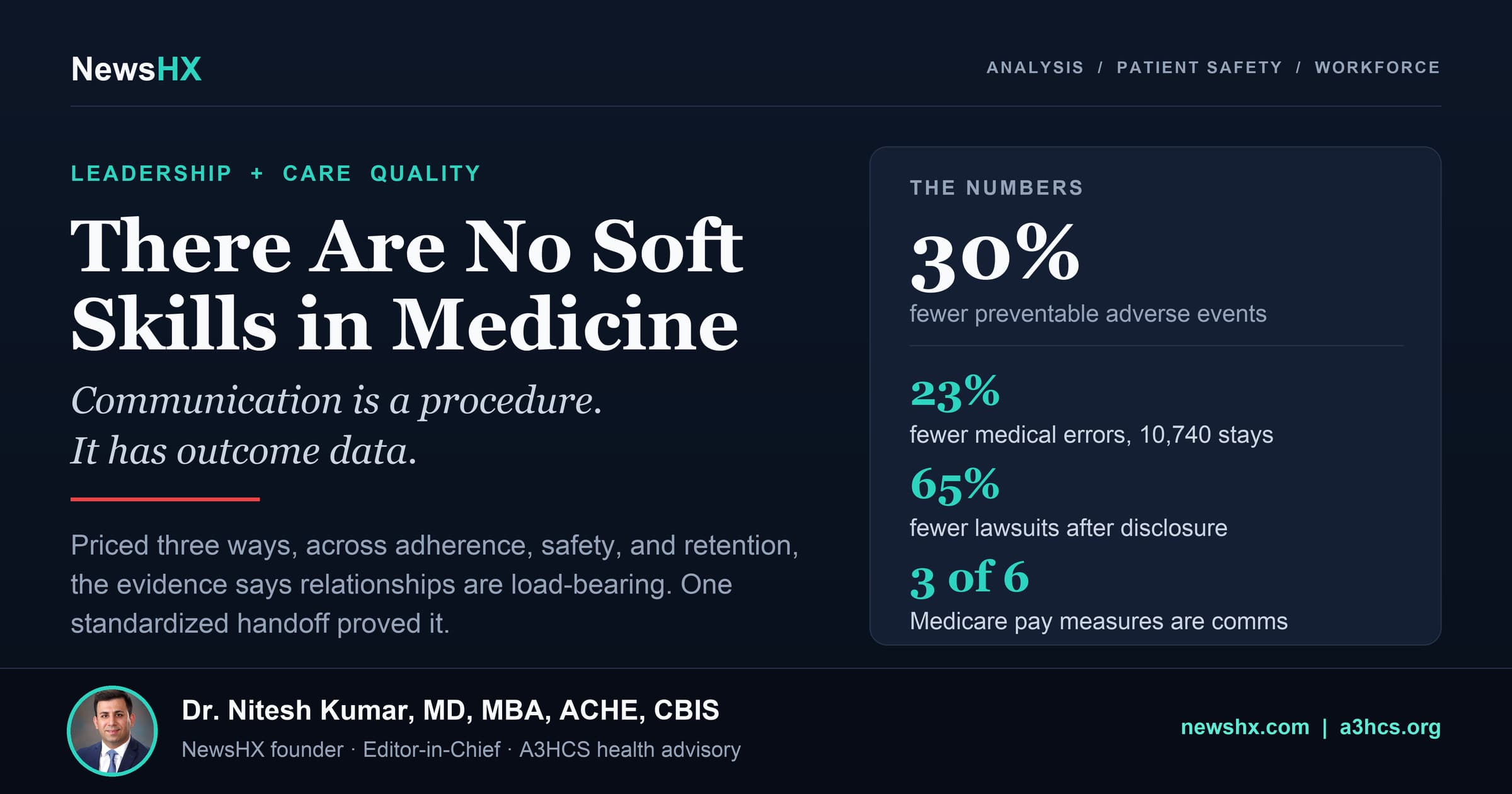
In 2014 the I-PASS Study Group published a prospective intervention across nine hospitals and 10,740 patient admissions.17 The intervention was not a values seminar. It was a standardized verbal and written handoff structure: a mnemonic, a printed template, a faculty development module, and direct observation with feedback. After implementation, medical errors fell 23%, from 24.5 to 18.8 per 100 admissions. Preventable adverse events, the subset where a patient was actually harmed and it did not have to happen, fell 30%, from 4.7 to 3.3 per 100 admissions. Both at P less than 0.001.
Two details in that paper matter more than the headline. First, nonpreventable adverse events did not budge, 3.0 versus 2.8, which is exactly the control you want to see. The intervention moved the harm that communication causes and left alone the harm it cannot touch. Second, and every CFO should read this number twice: the handoff took 2.4 minutes per patient before and 2.5 minutes after. There was no time cost. The gain did not come from spending longer with people. It came from structuring what got said.
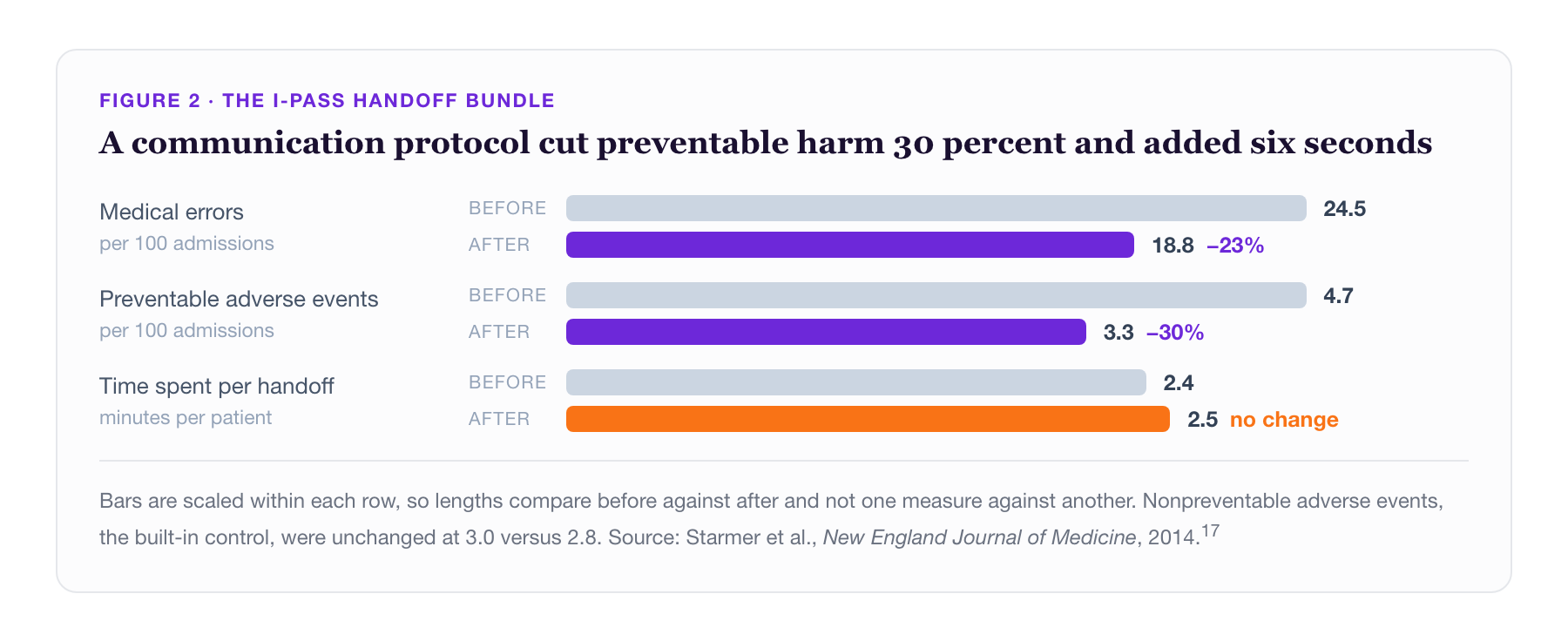
That is what a clinical procedure looks like. It has a defined technique, it is teachable to an entire department, it produces a measurable reduction in harm, and it survives audit. Nobody calls central-line insertion a soft skill because it involves a checklist and touching a person. The structured handoff has better outcome data than a good deal of what we do call hard.
The most expensive conversation is the one after the error
There is one more place the mislabel costs real money, and it is the conversation nobody wants to have.
The default posture after an adverse event is deny and defend. In 2001 the University of Michigan Health System replaced it with the opposite: full disclosure, an internal review that told the patient what actually happened, and a proactive offer of compensation when the care was wrong. A retrospective before-and-after analysis in Annals of Internal Medicine tracked what followed.18 New claims fell from 7.03 to 4.52 per 100,000 patient encounters. Lawsuits fell from 2.13 to 0.75 per 100,000, roughly 65%. Median time to resolve a claim dropped from 1.36 years to 0.95. Total liability costs fell to 41% of their prior level, and non-compensation legal costs, the money that buys lawyers rather than patients, to 39%.
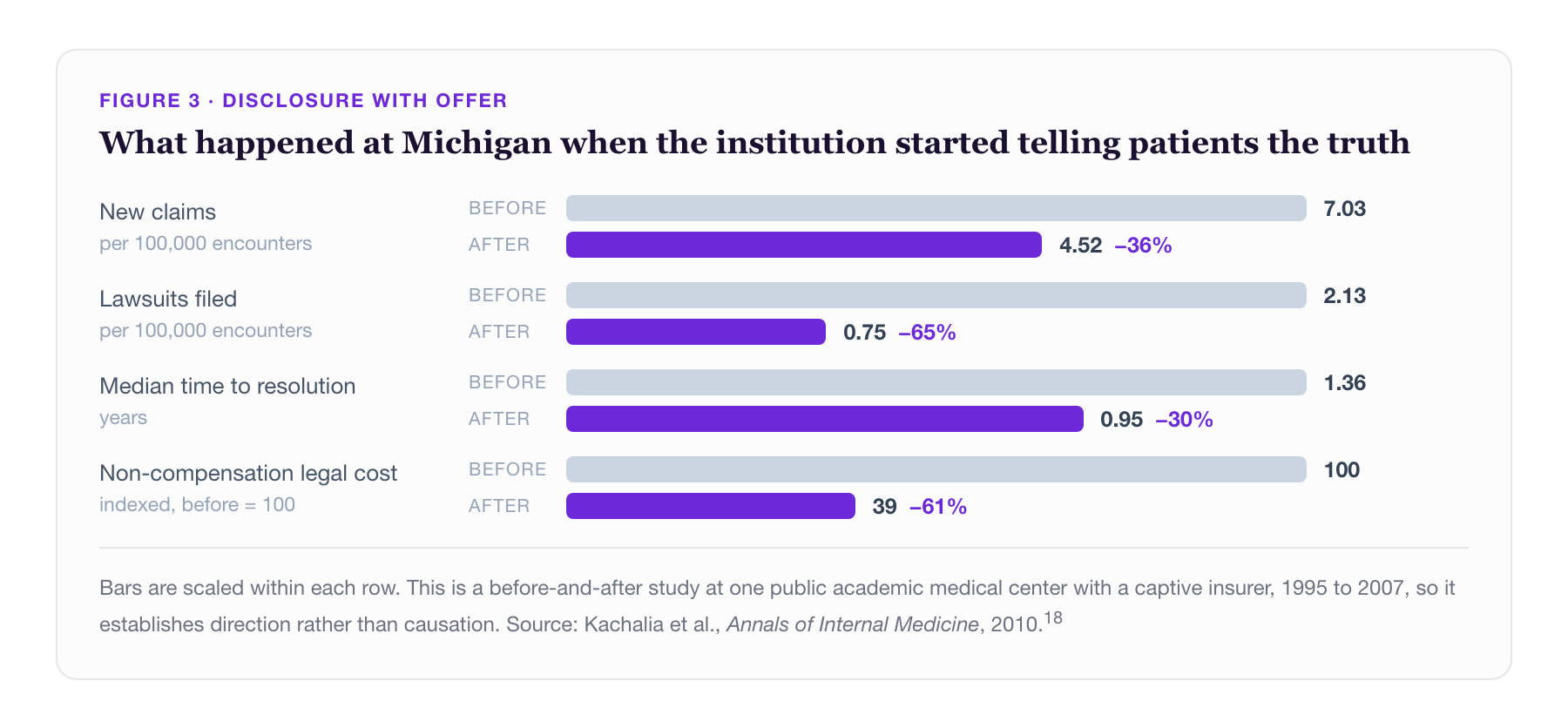
Read the honest limits, because they are real. This is a before-and-after design at a single public academic medical center with its own captive insurer, so it cannot prove causation and may not transfer cleanly to a community hospital in a harsher liability environment. The authors say as much themselves. But the direction is not ambiguous and the mechanism is not mysterious. Patients sue, in large part, because nobody told them the truth. AHRQ built the approach into a national toolkit, CANDOR, precisely because the pattern held up elsewhere.22
Notice what Michigan did not buy. No new technology. No new service line. It changed who said what, and when, after something went wrong. That is a communication intervention with a nine-figure logic sitting behind it.
The recovery gap is a communication gap
This is the terrain I write about most, and it is where the mislabel does its worst damage. The recovery gap, the space after a brain injury or a hospitalization where patients get lost, is not primarily a gap in medicine. It is a gap in communication. The discharge instruction nobody understood. The follow-up call that never came. The caregiver who was never coached. The two landmark programs that moved this needle did not invent a new drug. Project RED, a re-engineered discharge with a nurse advocate and pharmacist follow-up, cut hospital utilization within 30 days by about 30% in a randomized trial of 749 patients, 0.314 against 0.451 visits per person per month.11 The Care Transitions Intervention, a coaching-and-communication model, cut 30-day rehospitalization to 8.3% from 11.9%, and 90-day to 16.7% from 22.5%, across 750 patients aged 65 and over.12 Both rebuilt the relationship and the handoff. The readmissions fell.
The largest remaining gains in recovery are not hiding in a new molecule. They are sitting in the instruction nobody understood and the call that never came.
The workforce runs on it too
There is a third strand, and leaders cannot afford to miss it. We are losing clinicians, and disconnection is a line item. Physician burnout costs the United States an estimated $4.6 billion a year, roughly $7,600 per physician, in turnover and lost clinical hours.13 Primary-care turnover alone drives close to $1 billion in excess spending, about a quarter of it attributable to burnout.14 What buffers against it is not another wellness app. It is psychological safety, the shared belief that a team is safe for honest, interpersonal risk. Amy Edmondson developed the construct studying hospital nursing units, where the units with better team climate reported more medication errors, not fewer, because people were willing to name them.23 She then tested it formally outside healthcare, across 51 work teams in a manufacturing company, where it predicted team learning behavior and performance.15 Neither study measured retention directly, so here is the honest chain rather than the flattering one: psychological safety governs whether problems surface, and problems that never surface are what the burnout costs above are measuring.
Stop calling it soft
Line the three strands up and the conclusion is hard to avoid. There are no soft skills in medicine. There are load-bearing skills we have been underfunding because we called them soft. The relationship is the operating system the clinical work runs on. Underinvest in it and you pay in nonadherence, in readmissions, in claims, and in the people who walk out the door.
What to fund on Monday
"Fund it" is not an action item, so here is what the evidence above actually authorizes a leader to do. Five moves, each one tied to a number in this article rather than to a sentiment.
Protocolize one handoff, and measure harm rather than satisfaction. I-PASS worked because it was a technique with a template, an observation loop, and a feedback cycle, and because it cost no extra minutes.17 Pick the highest-risk transition you own, ICU to floor, emergency department to inpatient, or hospital to skilled nursing, and instrument it. The metric you carry upstairs is preventable adverse events per 100 admissions, not a survey score. A safety number survives a budget meeting that a satisfaction number does not.
Move the three HCAHPS communication dimensions onto the finance dashboard. They now hold three of six slots in the Person and Community Engagement domain,20 scored against a 2% withhold.21 Put them where the CFO already looks, next to the readmission penalty, and not in a patient-experience deck reviewed quarterly by people with no budget authority. The measure moved in your favor this summer and most organizations have not noticed.
Make the post-discharge contact an order, not an intention. Project RED and the Care Transitions Intervention both cut rehospitalization by rebuilding the handoff and the follow-up, not by adding a drug,11,12 and teach-back reduced readmissions in five of six studies reviewed.10 Anything that depends on somebody remembering to call will not happen at volume. Put the call, the teach-back, and the caregiver coaching into the discharge order set with a name attached to each.
Adopt a communication-and-resolution program before you need one. Michigan's disclosure-with-offer model cut lawsuits roughly 65% and non-compensation legal spend to 39% of baseline,18 and AHRQ has already published the toolkit.22 You cannot stand this up during a crisis. It needs policy, insurer alignment, and trained disclosure coaches in place beforehand.
Treat psychological safety as a retention line item. Burnout runs roughly $7,600 per physician per year,13 and primary-care turnover close to $1 billion.14 Psychological safety is measurable, and it predicts whether people surface problems before those problems compound.15,23 Retention is the downstream inference rather than a measured outcome in those papers, so track both. Measure safety by unit, report it beside vacancy rate, and hold managers accountable for it the way you would for any other operating number.
And two things not to do. Do not buy a one-off workshop. The Cochrane evidence is clear that training alone, unreinforced, does not reliably move burnout or every patient outcome.16 And do not stake the program on a composite endpoint you have no power to move, which is exactly how a successful intervention gets defunded on a technicality.19
Fund communication and relational skill like the clinical competency it is. Measure it. Reinforce it past the workshop. Reward it. Protect the time it takes. Not because it is nice, but because the evidence says this is where the outcomes, the safety, and the margin actually live. Stop calling it soft. Start funding it like the core of the work, because it is.
General information for clinicians and healthcare leaders, not clinical, financial, legal, or coding advice. Study limitations are stated inline where each claim is made, including the null empathy-outcomes study, the null Cochrane review, and the trial whose coprimary outcomes did not differ. HCAHPS dimension counts are program-year-specific: eight for FY2026, six for FY2027 through FY2029, and nine announced for FY2030, so confirm the current program year before citing the ratio. Burnout-cost figures are modeled, pre-pandemic, and likely conservative. Confirm all figures against the primary sources before making clinical, operational, or investment decisions.
Stop calling it soft. Start funding it like the core of the work.
The "soft skill" on your org chart is doing hard, load-bearing work. Fund it like it. A3HCS works with hospitals and health systems on the operational half of this story: care-transition and discharge communication, readmission reduction, HCAHPS communication-domain performance, and the team culture and psychological safety that hold clinicians in place. If your recovery gap is really a communication gap, that is a solvable, measurable problem.
References
- Haskard Zolnierek KB, DiMatteo MR. Physician Communication and Patient Adherence to Treatment: A Meta-analysis. Med Care. 2009;47(8):826-834. DOI: 10.1097/MLR.0b013e31819a5acc.
- Ng JYY, Ntoumanis N, Thogersen-Ntoumani C, Deci EL, Ryan RM, Duda JL, Williams GC. Self-Determination Theory Applied to Health Contexts: A Meta-Analysis. Perspect Psychol Sci. 2012;7(4):325-340. DOI: 10.1177/1745691612447309.
- Hojat M, Louis DZ, Markham FW, Wender R, Rabinowitz C, Gonnella JS. Physicians' Empathy and Clinical Outcomes for Diabetic Patients. Acad Med. 2011;86(3):359-364. Replicated in Del Canale S et al., Acad Med. 2012;87(9):1243-1249 (20,961 patients).
- Chaitoff A, Rothberg MB, Windover AK, Calabrese L, Misra-Hebert AD, Martinez KA. Physician Empathy Is Not Associated with Laboratory Outcomes in Diabetes: A Cross-sectional Study. J Gen Intern Med. 2019;34(1):75-81. DOI: 10.1007/s11606-018-4731-0. 4,176 patients, 51 primary care physicians, Cleveland Clinic. (Counter-evidence; cited for balance.)
- Rakel D, et al. Perception of Empathy in the Therapeutic Encounter: Effects on the Common Cold. Patient Educ Couns. 2011;85(3):390-397.
- Howick J, Moscrop A, Mebius A, et al. Effects of Empathic and Positive Communication in Healthcare Consultations: A Systematic Review and Meta-Analysis. J R Soc Med. 2018;111(7):240-252.
- The Joint Commission. Inadequate Hand-off Communication. Sentinel Event Alert 58; September 12, 2017. jointcommission.org
- The Joint Commission. Inadequate Hand-off Communication. Sentinel Event Alert 58; September 12, 2017, which reports the CRICO Strategies finding verbatim: communication failures contributed to 30% of 23,658 malpractice cases filed 2009-2013, linked to 1,744 deaths and $1.7 billion in costs. jointcommission.org. Original analysis: CRICO Strategies, Malpractice Risks in Communication Failures: 2015 Annual Benchmarking Report, Harvard Risk Management Foundation, 2016. rmf.harvard.edu. *Re-pointed 2026-08-04* from the CRICO benchmarking report to the Joint Commission alert, which carries the same figures inside a peer-reviewed standards body's publication rather than an industry benchmarking release.
- Centers for Medicare & Medicaid Services. HCAHPS and the Hospital Value-Based Purchasing Program, FY2026 Person and Community Engagement domain (eight HCAHPS dimensions). hcahpsonline.org/en/hcahps-and-hospital-vbp
- Mashhadi SF, et al. Post Discharge mHealth and Teach-Back Communication Effectiveness on Hospital Readmissions: A Systematic Review. Int J Environ Res Public Health. 2021;18(19):10442.
- Jack BW, Chetty VK, Anthony D, et al. A Reengineered Hospital Discharge Program to Decrease Rehospitalization: A Randomized Trial (Project RED). Ann Intern Med. 2009;150(3):178-187.
- Coleman EA, Parry C, Chalmers S, Min SJ. The Care Transitions Intervention: Results of a Randomized Controlled Trial. Arch Intern Med. 2006;166(17):1822-1828. caretransitions.health
- Han S, Shanafelt TD, Sinsky CA, et al. Estimating the Attributable Cost of Physician Burnout in the United States. Ann Intern Med. 2019;170(11):784-790.
- Sinsky CA, Shanafelt TD, Dyrbye LN, et al. Health Care Expenditures Attributable to Primary Care Physician Overall and Burnout-Related Turnover. Mayo Clin Proc. 2022;97(4):693-702.
- Edmondson AC. Psychological Safety and Learning Behavior in Work Teams. Adm Sci Q. 1999;44(2):350-383. DOI: 10.2307/2666999. Sample was 51 work teams in a manufacturing company; outcomes were team learning behavior and performance, not retention.
- Moore PM, Rivera S, Bravo-Soto GA, Olivares C, Lawrie TA. Communication Skills Training for Healthcare Professionals Working with People Who Have Cancer. Cochrane Database Syst Rev. 2018;7:CD003751. (Counter-evidence; cited for balance.)
- Starmer AJ, Spector ND, Srivastava R, et al; I-PASS Study Group. Changes in Medical Errors after Implementation of a Handoff Program. N Engl J Med. 2014;371(19):1803-1812. DOI: 10.1056/NEJMsa1405556. Nine hospitals, 10,740 patient admissions.
- Kachalia A, Kaufman SR, Boothman R, et al. Liability Claims and Costs Before and After Implementation of a Medical Error Disclosure Program. Ann Intern Med. 2010;153(4):213-221. DOI: 10.7326/0003-4819-153-4-201008170-00002. Retrospective before-after, University of Michigan Health System, 1995-2007.
- Bernacki R, Paladino J, Neville BA, et al. Effect of the Serious Illness Care Program in Outpatient Oncology: A Cluster Randomized Clinical Trial. JAMA Intern Med. 2019;179(6):751-759. DOI: 10.1001/jamainternmed.2019.0077. (Coprimary outcomes null; cited for balance.)
- Centers for Medicare & Medicaid Services. FY 2025 Hospital Inpatient Prospective Payment System and LTCH PPS Final Rule (CMS-1808-F), which finalized scoring of the Person and Community Engagement domain on only the six unchanged HCAHPS dimensions for the FY2027 through FY2029 program years, pending public reporting of the updated survey in the Hospital IQR Program. The six are Communication with Nurses, Communication with Doctors, Communication about Medicines, Discharge Information, a combined Cleanliness and Quietness dimension, and Overall Hospital Rating; Responsiveness of Hospital Staff and Care Transition were dropped. Confirmed against HCAHPS and Hospital VBP, hcahpsonline.org. cms.gov; hcahpsonline.org/en/hcahps-and-hospital-vbp/
- Centers for Medicare & Medicaid Services. Hospital Value-Based Purchasing Program. Budget-neutral program funded by a 2% reduction in participating hospitals' base operating DRG payments, estimated at approximately $1.7 billion for FY2026 and redistributed in full as incentive payments. cms.gov/medicare/quality/value-based-programs/hospital-purchasing
- Agency for Healthcare Research and Quality. Communication and Optimal Resolution (CANDOR) Toolkit. Published 2017. ahrq.gov
- Edmondson AC. Learning from Mistakes Is Easier Said Than Done: Group and Organizational Influences on the Detection and Correction of Human Error. J Appl Behav Sci. 1996;32(1):5-28. The hospital nursing-unit study in which better team climate was associated with more reported medication errors, because reporting was safer.