


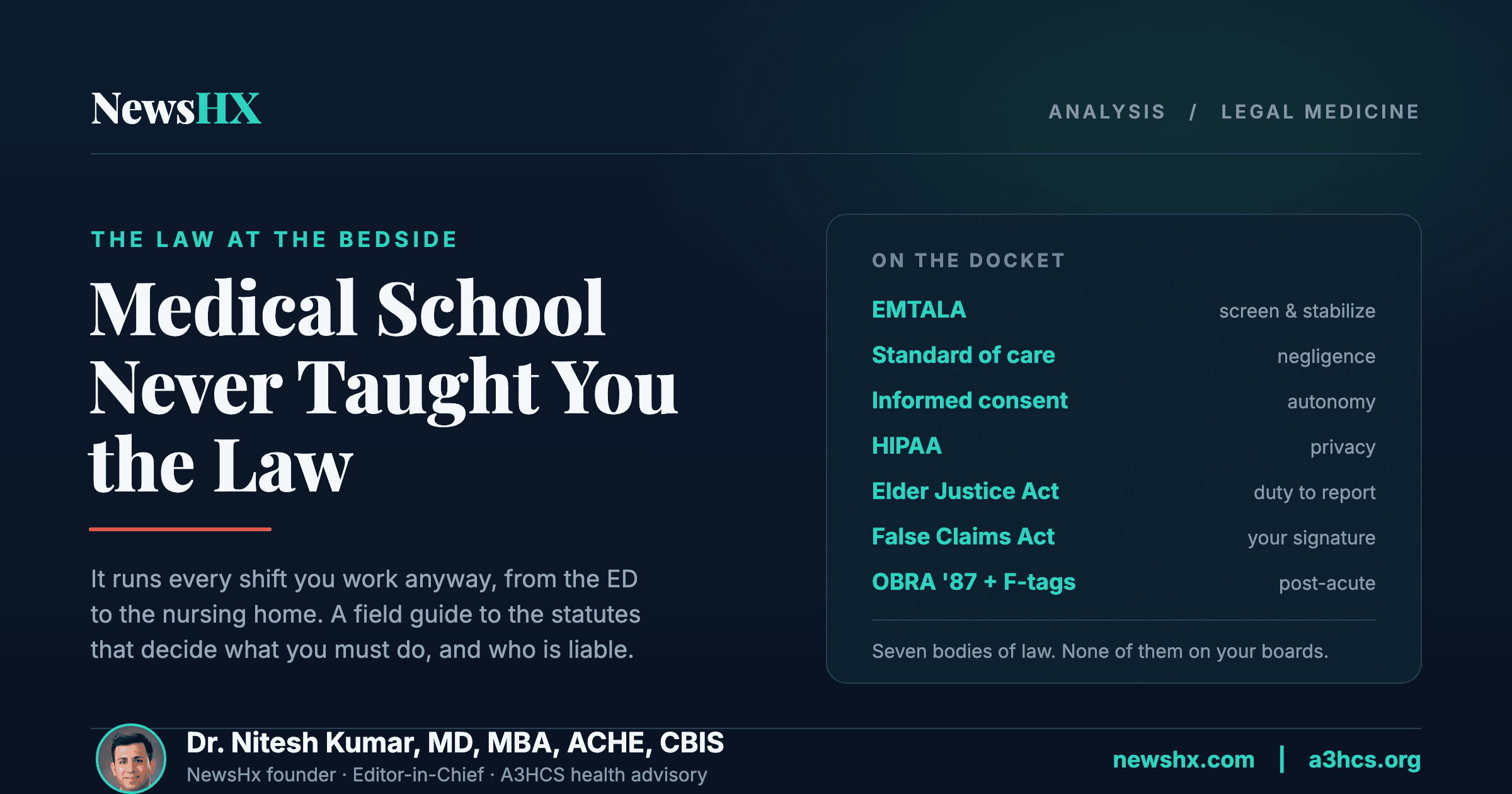
We train physicians for years on the biology of disease and almost not at all on the body of law that decides what we are allowed, and required, to do about it. Legal medicine is the class medical school skipped. You learned pharmacology to three decimal places and never read a page of the statute that says you must screen the patient who walks into your emergency department regardless of whether they can pay. That gap does not make the law optional. It just means most clinicians meet it for the first time in a deposition.
A study published in June makes the stakes concrete. Writing in JAMA Health Forum, Horwitz and colleagues looked at the wave of COVID-era laws that shielded nursing homes from lawsuits, roughly 43 states granted some form of immunity, and asked a simple question: when you remove the threat of being sued, what happens to care? 1 The answer was that staffing fell. Facilities granted immunity cut overall staffing by about 2.5 percentage points relative to facilities in states without it, on the order of 7.9 fewer staff hours per day, or roughly 5.2 fewer minutes of direct care per resident per day. 1 The cut landed hardest on certified nursing assistants, the hands that actually turn, feed, and toilet residents.
Read that finding slowly, because it inverts how most clinicians think about the law. We treat liability as a threat that hangs over good care. This study says liability was also holding the floor up. Take it away and the floor drops. The law is not background noise to the clinical work. It is one of the variables that determines how much care a vulnerable person actually receives. If a statute can move staffing, it can move outcomes, and that means every front-line worker should understand the legal scaffolding they stand on.
We are taught to see the law as the thing that punishes us when care goes wrong. The data says the law is also one of the things quietly keeping care from going wrong in the first place.
So consider this a working clinician's field guide to the laws that actually govern a shift, in the hospital and across the post-acute network that patients move into after discharge. Not the version a malpractice carrier emails you once a year. The version you can hold in your head at 3 a.m. None of this is legal advice, and the details vary by state. But every front-line worker should know these exist, what they demand, and where the personal exposure lives.
EMTALA: the one duty you cannot opt out of
The Emergency Medical Treatment and Labor Act is the closest thing American medicine has to a universal right to care, and it is the law most likely to be violated by accident. Passed in 1986 to stop hospitals from “dumping” uninsured patients, it binds every hospital that participates in Medicare and runs an emergency department. 2 It imposes three duties, and they are not subtle.
EMTALA, 42 U.S.C. § 1395dd. Any person who “comes to the emergency department” must get (1) a medical screening examination to determine whether an emergency condition exists; (2) stabilizing treatment if it does; and (3) an appropriate transfer if the hospital cannot stabilize them. You may not delay screening to ask about insurance or ability to pay, and a hospital with the capacity and specialty cannot refuse an appropriate transfer in. 2
The traps are practical. Triage is not a medical screening exam. Telling a walk-in to go register with their primary care doctor before they are screened can be a violation. “Stable” has a legal definition, not just a clinical feel. And the obligation reaches anywhere on hospital property, not only the four walls of the ED. Enforcement is real money: as of 2024, the civil penalty runs to $133,420 per violation for hospitals with 100 or more beds and $66,712 for smaller ones, and physicians can be penalized and excluded from Medicare independently of the hospital. 3
The law is also moving under our feet. In May 2025, CMS rescinded its 2022 guidance that had specifically reinforced EMTALA obligations in pregnancy and pregnancy-loss emergencies, while stating it would continue to enforce the statute generally. 4 Around the same time, CMS opened a channel for patients to file EMTALA complaints directly with the agency. 4 The duty did not change. The political weather around it did, which is exactly why clinicians should know the black-letter rule rather than the headline.
The standard of care: how negligence is actually decided
Most clinicians carry a vague dread of “getting sued” without knowing what a plaintiff actually has to prove. Medical malpractice is a negligence claim, and it has four elements. All four must be present, which is more protective than the dread suggests.
Medical negligence, state common law. Duty (a clinician-patient relationship existed), breach (care fell below the standard a reasonably prudent practitioner would provide), causation (the breach actually and proximately caused the harm), and damages (a real injury resulted). The “standard of care” is not a statute. It is what your peers, through expert testimony and increasingly through written guidelines, would have done in the same situation. 5
Two things follow that every front-line worker should internalize. First, the record is the case. Causation and breach are litigated years later, almost entirely through the chart. Contemporaneous, honest documentation is not defensive paperwork; it is the primary evidence of what the standard required and whether you met it. Second, the standard of care is a moving line set by the profession, which is why the JAMA tort-immunity finding matters here too. When the threat of having to defend that line disappears, the data suggests institutions let the line drop. Liability and the standard of care are two ends of the same lever.
Consent, capacity, and the law of the body
Touching a competent adult without valid consent is, legally, a battery, even if the care was excellent. Informed consent is not a signature on a form; it is a process, and it is a legal duty owned by the clinician performing the procedure, not the nurse who hands over the clipboard.
Informed consent and self-determination, Patient Self-Determination Act, 1990. Valid consent requires capacity, disclosure of the diagnosis, the proposed treatment, its risks and benefits, and the reasonable alternatives, and a voluntary choice. The Patient Self-Determination Act requires Medicare and Medicaid facilities to tell patients about their right to accept or refuse treatment and to make advance directives. 6 Refusal by a patient with capacity is their right, even when it is the wrong clinical call.
The post-acute network adds wrinkles the hospital often hides. Capacity is decision-specific and can fluctuate, as it does in the dementia and delirium that fill skilled nursing and long-term care. When a patient lacks capacity, the law supplies a decision-maker through a hierarchy: a healthcare proxy or power of attorney if one exists, then a state surrogate-consent ladder, then guardianship. Knowing who is legally allowed to say yes is a daily question in post-acute care, and getting it wrong is both a clinical and a legal error.
HIPAA: less than you fear, more than you think
HIPAA is the most misunderstood law in the building. It is invoked constantly to refuse things it plainly permits. The Privacy Rule allows you to use and share protected health information for treatment, payment, and health care operations without separate patient authorization. 7 Calling the receiving facility to give report, curbside-consulting a colleague about your own patient, coordinating a transfer: all permitted. “HIPAA” is not a reason to withhold information from the next clinician in the chain of care.
HIPAA Privacy and Security Rules, 42 U.S.C. § 1320d; 45 C.F.R. Parts 160, 164. Sharing for treatment, payment, and operations is permitted. The operative limit is minimum necessary: access and disclose only what the task requires. The real violations are mundane, looking up a record you are not treating, discussing a patient in an elevator, a lost unencrypted device, texting PHI on an unsecured app. Penalties scale with culpability and reach into criminal liability for knowing misuse. 7
The practical rule is the inverse of the myth. HIPAA rarely stops you from sharing information for care. It governs snooping, gossip, and sloppy handling of data. Know which one you are actually doing.
The duty to report: the post-acute law almost nobody mentions
Here is the statute that most surprises hospital clinicians when they rotate into or refer into post-acute care. Under the Elder Justice Act, anyone who works in a long-term care facility that receives at least $10,000 a year in federal funds is a mandated reporter of suspected crimes against residents, on a clock measured in hours.
Elder Justice Act crime-reporting duty, Social Security Act § 1150B. A “covered individual,” meaning owners, operators, managers, employees, agents, and contractors, must report a reasonable suspicion of a crime against a resident. If the suspected crime caused serious bodily injury, the report must go to law enforcement and the state survey agency within 2 hours. Otherwise, within 24 hours. Failure to report carries civil penalties up to $200,000, rising to $300,000 where the failure worsens harm, plus possible exclusion from federal programs. 8
This sits on top of state mandatory-reporting laws that already require clinicians to report suspected child abuse, elder and dependent-adult abuse, and certain injuries such as gunshot and some burn or assault wounds. The throughline is that “I assumed someone else would report it” is not a defense. In the settings where the JAMA study found staffing being quietly cut, the front-line worker is often the only person positioned to notice the bruise, the unexplained fracture, the financial exploitation, and the law puts the duty squarely on them.
In post-acute care, the law frequently treats the aide and the nurse, not the administrator, as the legally responsible eyes in the room. The reporting clock starts when you form the suspicion, not when it is convenient.
Where the money meets the law: fraud and abuse
Clinicians tend to file billing and referrals under “administration.” The government files them under “fraud and abuse,” backed by three of the most powerful enforcement statutes in healthcare. You do not need to be the biller to be exposed; your signature, your documentation, and your referrals are the raw material these laws act on.
False Claims Act, 31 U.S.C. §§ 3729-3733. Submitting, or causing the submission of, a claim to Medicare or Medicaid that is false makes you liable for treble damages and per-claim penalties. A note that does not support the level of service billed can become a false claim. The Act's qui tam provision lets whistleblowers, often employees, sue on the government's behalf and share in the recovery, which is why so many cases start on the inside. 9
Anti-Kickback Statute, 42 U.S.C. § 1320a-7b(b). A criminal law: knowingly paying or receiving anything of value to induce or reward referrals for items or services payable by a federal program. Intent matters, and there are safe harbors, but the speaking fees, the “medical director” arrangement, the lab's free supplies, all live here. 9
Physician Self-Referral Law (Stark), 42 U.S.C. § 1395nn. A strict-liability civil law: a physician generally may not refer Medicare patients for certain “designated health services” to an entity the physician or an immediate family member has a financial relationship with, unless a specific exception is met. No bad intent is required to violate it, which is what makes it dangerous. 9
The clinician's takeaway is narrow and important: document the service you actually performed, refer based on the patient's need, and treat any arrangement that pays you in proximity to your referrals as a question for compliance, not a perk. The federal Office of Inspector General publishes a plain-language roadmap to these laws for physicians; it is worth the hour. 9
The post-acute rulebook: OBRA '87, F-tags, and the staffing rule that came and went
When your patient leaves the hospital for a skilled nursing facility, they cross into a different and denser legal regime. The Nursing Home Reform Act, part of OBRA '87, created an enforceable set of residents' rights and care standards, freedom from unnecessary restraints, the right to participate in care planning, the right to be free from abuse and neglect, that surveyors enforce through the deficiency citations known as F-tags. 10 A facility's survey history is a public legal record, and front-line documentation is what survives a complaint survey.
The most instructive recent story in this regime is the federal minimum-staffing rule, because it shows how unsettled even the “hard” rules are. CMS finalized a rule in May 2024 requiring a registered nurse on site 24/7 and minimum nurse hours per resident day. 11 Within a year, two federal district courts vacated the core provisions as exceeding CMS's authority. Then Congress imposed a moratorium barring enforcement through September 30, 2034, and in December 2025 CMS issued an interim final rule formally rescinding the standards, effective February 2, 2026. 12 The federal staffing floor was announced, litigated, frozen, and repealed inside two years.
Put the two findings side by side and the picture is sharp. The federal government just removed the prospective staffing floor, and the JAMA study shows that where the retrospective deterrent, the lawsuit, was also removed, staffing fell. Front-line workers in post-acute care are now operating in a setting where two of the major external pressures to staff adequately have been loosened at once. That makes the internal record, the documentation of what care was needed and whether it was delivered, more consequential, not less.
Scope of practice and the law of who may do what
Every license comes with a legal fence around it. Nurse Practice Acts, and the parallel acts for therapists, aides, and advanced-practice clinicians, define what each role may legally do and under what supervision. 13 Practicing outside your scope, or directing someone to practice outside theirs, is both a board-discipline matter and a negligence theory. In a stretched post-acute facility, the pressure to let people work above their license is constant, and it is exactly where liability concentrates.
There is also a duty that belongs to the institution itself, not just the individual. Under doctrines of corporate negligence and negligent credentialing, a hospital or facility can be liable for failing to vet, train, supervise, or adequately staff. That is the legal name for what the JAMA study measured: when the institution quietly thinned the staff, it was thinning the very thing these doctrines say it has a duty to maintain. The front-line worker who documents unsafe staffing is not being difficult. They are creating the record that locates the duty where it belongs.
The laws that protect you
The legal scaffolding is not only a set of obligations pointed at the clinician. Several of these statutes protect the worker who raises concerns. The False Claims Act's qui tam provisions include anti-retaliation protection for employees who report in good faith. 9 Many states layer on whistleblower and safe-staffing protections, and the same honest, contemporaneous documentation that defends you in a malpractice case is what substantiates a good-faith report of unsafe conditions. The record protects the patient and the clinician at the same time.
The clinician's legal operating system. Screen first, ask about payment later: EMTALA attaches the moment a patient reaches your property. The chart is the case: document contemporaneously and honestly; it is the primary evidence of the standard of care. Consent is a conversation and capacity is decision-specific: know who is legally allowed to say yes when the patient cannot. HIPAA permits sharing for care: its real limit is minimum necessary, and snooping is the actual violation. The reporting clock is in hours: under the Elder Justice Act, serious-injury suspicions go out in 2 hours, others in 24. Your signature is a legal instrument: bill and refer based on what you did and what the patient needed. Document unsafe staffing: it is the record that places the duty on the institution, where the law puts it.
The bottom line
The reason to learn this is not fear. It is that the law is a clinical variable, as real as a lab value, and we are the only profession expected to operate inside it without ever being taught it. The JAMA study is a clean demonstration: change one statute and the amount of care a frail resident receives changes with it. The law was holding part of the floor up the whole time.
You do not need a second degree to practice safely inside this system. You need to know that EMTALA does not wait for the insurance question, that the chart is what gets read in court, that the consent is yours and the reporting clock is in hours, that your signature carries the weight of a federal statute, and that the front-line record is what locates responsibility where the law intends it. Learn the legal scaffolding the way you learned pharmacology. It governs every shift you work, whether or not anyone ever taught it to you.
Does your hospital or post-acute network actually operate inside the law, or just hope it does?
A3HCS helps health systems and post-acute operators turn legal and regulatory exposure into operational discipline: EMTALA readiness, survey and F-tag preparedness, fraud-and-abuse compliance, and the documentation and staffing practices that hold up when a surveyor, or a plaintiff, comes looking. The deterrents are loosening. The duty is not.
References
- Horwitz JR, Wenger NS, Powell DP, Escarce JJ, Jennings LA, Liang LJ, Parikh P, Zingmond DS. Tort Immunity and Nursing Home Staffing. JAMA Health Forum. Published online June 1, 2026;7(6). doi:10.1001/jamahealthforum.2026.1534. Accessed June 20, 2026. jamanetwork.com/journals/jama-health-forum/fullarticle/2849728
- Emergency Medical Treatment & Labor Act (EMTALA), 42 U.S.C. § 1395dd. Centers for Medicare & Medicaid Services. Accessed June 20, 2026. cms.gov/medicare/regulations-guidance/legislation/emergency-medical-treatment-labor-act. See also EMTALA fact sheet, American College of Emergency Physicians. acep.org/life-as-a-physician/ethics--legal/emtala/emtala-fact-sheet
- The Emergency Medical Treatment and Labor Act (EMTALA). HHS Office of Inspector General. Penalty amounts updated August 2024. Accessed June 20, 2026. oig.hhs.gov/reports/featured/emtala/
- CMS Rescinds Post-Dobbs EMTALA Guidance, Raising New Questions for Emergency Departments. Foley Hoag LLP. June 2025. Accessed June 20, 2026. foleyhoag.com/news-and-insights/publications/alerts-and-updates/2025/june/cms-rescinds-post-dobbs-emtala-guidance-raising-new-questions-for-emergency-departments/
- Medical malpractice and the standard of care: duty, breach, causation, damages. StatPearls, NCBI Bookshelf. Accessed June 20, 2026. ncbi.nlm.nih.gov/books/NBK470573/
- Informed consent and the Patient Self-Determination Act of 1990. StatPearls, NCBI Bookshelf. Accessed June 20, 2026. ncbi.nlm.nih.gov/books/NBK430827/
- HIPAA Privacy Rule: permitted uses and disclosures; minimum necessary standard, 45 C.F.R. Parts 160 and 164. U.S. Department of Health & Human Services. Accessed June 20, 2026. hhs.gov/hipaa/for-professionals/privacy/index.html
- Reporting of reasonable suspicion of a crime in a long-term care facility. Social Security Act § 1150B. Accessed June 20, 2026. ssa.gov/OP_Home/ssact/title11/1150B.htm. See also Elder Justice Act reporting requirements, FindLaw. findlaw.com/elder/elder-abuse/elder-justice-act-reporting-requirements.html
- A Roadmap for New Physicians: Fraud & Abuse Laws (False Claims Act, 31 U.S.C. §§ 3729–3733; Anti-Kickback Statute, 42 U.S.C. § 1320a-7b(b); Physician Self-Referral / Stark Law, 42 U.S.C. § 1395nn). HHS Office of Inspector General. Accessed June 20, 2026. oig.hhs.gov/compliance/physician-education/fraud-abuse-laws/
- Nursing Home Reform Act (OBRA '87); requirements for states and long-term care facilities, 42 C.F.R. Part 483. eCFR. Accessed June 20, 2026. ecfr.gov/current/title-42/chapter-IV/subchapter-G/part-483. Residents' rights and F-tag survey guidance: State Operations Manual, Appendix PP. Centers for Medicare & Medicaid Services.
- Medicare and Medicaid Programs; Minimum Staffing Standards for Long-Term Care Facilities. Final rule, Federal Register, May 2024. Accessed June 20, 2026. federalregister.gov/documents/2024/05/10/2024-08861/
- Medicare and Medicaid Programs; Repeal of Minimum Staffing Standards for Long-Term Care Facilities. Interim final rule, Federal Register, Dec. 3, 2025 (effective Feb. 2, 2026); enforcement moratorium under Pub. L. 119-21 § 71111 (July 4, 2025). Accessed June 20, 2026. federalregister.gov/documents/2025/12/03/2025-21792/
- Scope of practice and the Nurse Practice Act. National Council of State Boards of Nursing. Accessed July 8, 2026. ncsbn.org/nursing-regulation/practice.page