


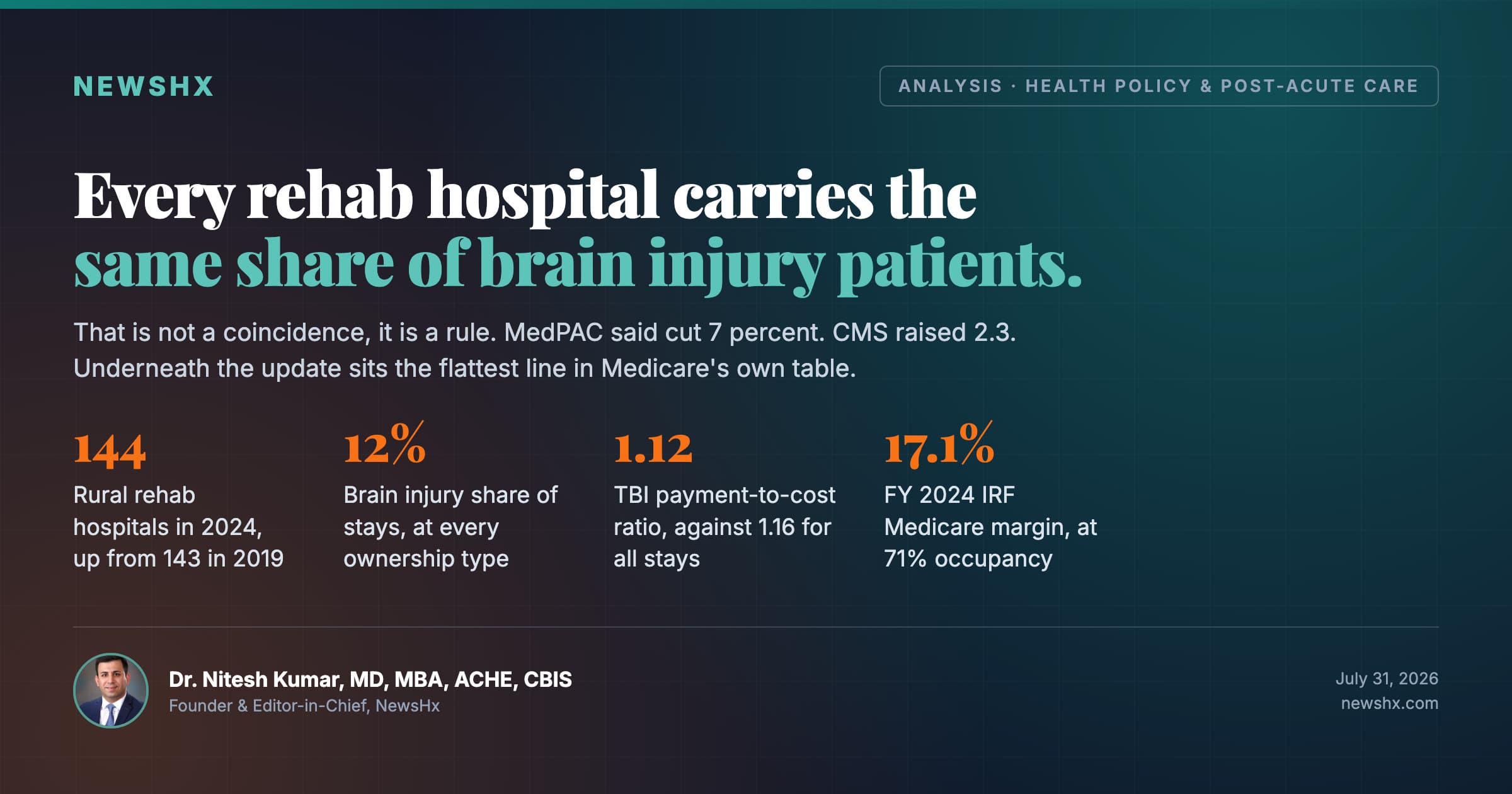
There is a table in MedPAC's March report that takes about ten seconds to read and then does not let go of you 3.
It counts the inpatient rehabilitation facilities in the United States, by year, by type. IRFs are the intensive end of post-acute care, the places that take a person after a stroke, a spinal cord injury, a major trauma, or a serious brain injury, and run three hours of therapy a day under direct physician supervision. They are the difference, for a lot of people, between going home and not.
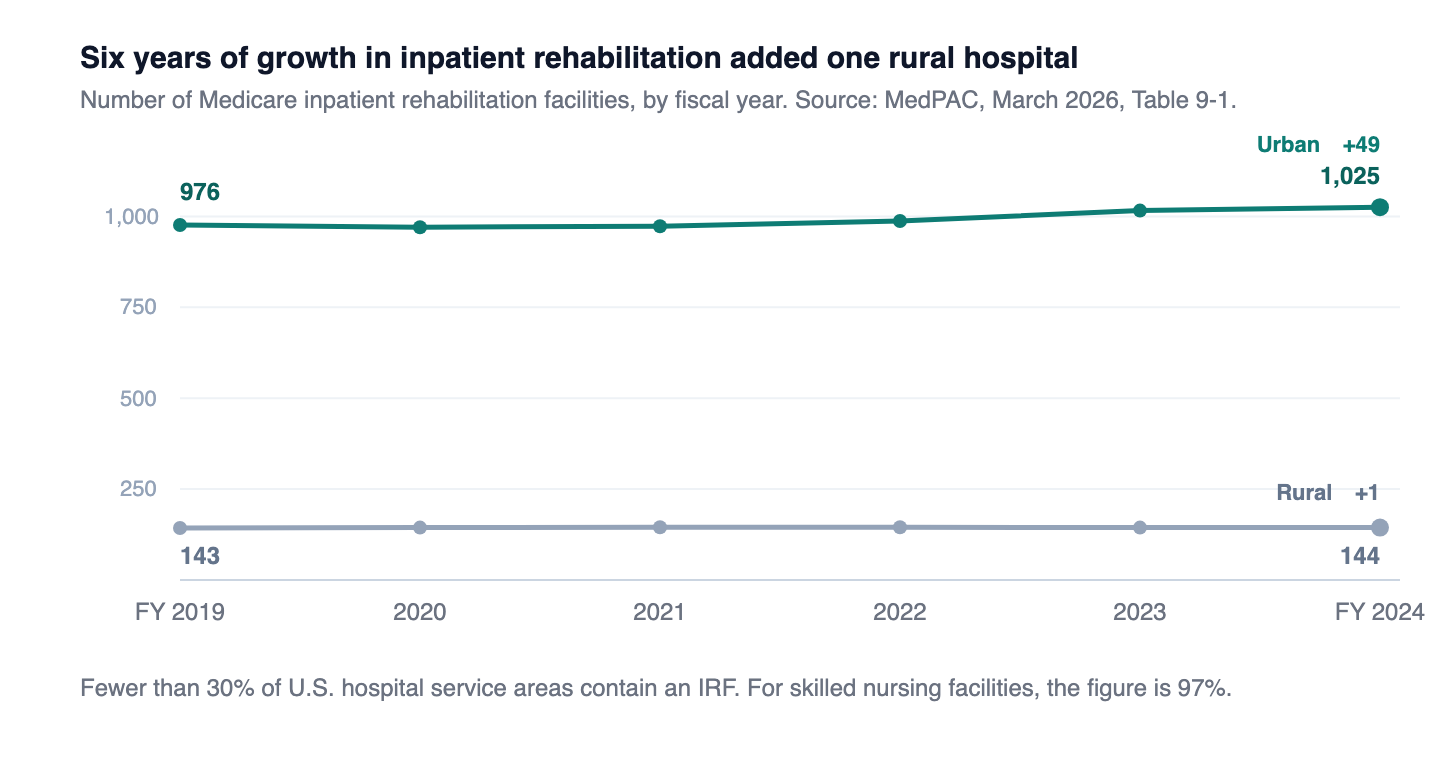
In fiscal 2019 there were 1,119 of them. By fiscal 2024 there were 1,169. Fifty more rehabilitation hospitals, a healthy 0.9 percent a year in a sector everyone describes as under pressure.
Now split that by geography. Urban IRFs went from 976 to 1,025. Rural IRFs went from 143 to 144 3.
One. In six years, across fifty states, the entire growth of American inpatient rehabilitation delivered a net of one rural facility.
That is the context for what CMS did yesterday.
What the rule did
On July 30, 2026, CMS issued the FY 2027 IRF prospective payment system final rule, CMS-1845-F 1. Payments rise 2.3 percent on October 1, built from a 3.2 percent market basket increase less a 0.9 percentage point productivity adjustment. CMS estimates the technical rate setting changes will increase IRF payments by $340 million 1.
In April, the proposed version of the same rule carried a 2.4 percent update and a $355 million estimate, using the identical phrase, "technical rate setting changes" 2. The productivity adjustment moved from 0.8 to 0.9 on newer data. So the final rule is modestly smaller than the proposal. Fifteen million dollars smaller.
Set that beside what Medicare's own advisory commission asked for.
MedPAC recommended cutting the inpatient rehabilitation payment rate by 7 percent. CMS raised it 2.3 percent. The gap between the advice and the decision is more than nine points, and every dollar of it landed in a market that already had a rehabilitation hospital.
In its April 30 comment letter to Administrator Oz, MedPAC wrote that it "recommended reducing the IRF payment rate by 7 percent for FY 2027" after reviewing beneficiary access, provider supply, and margins, "the totality of which suggests that Medicare's current payment rates for IRFs are more than adequate" 4.
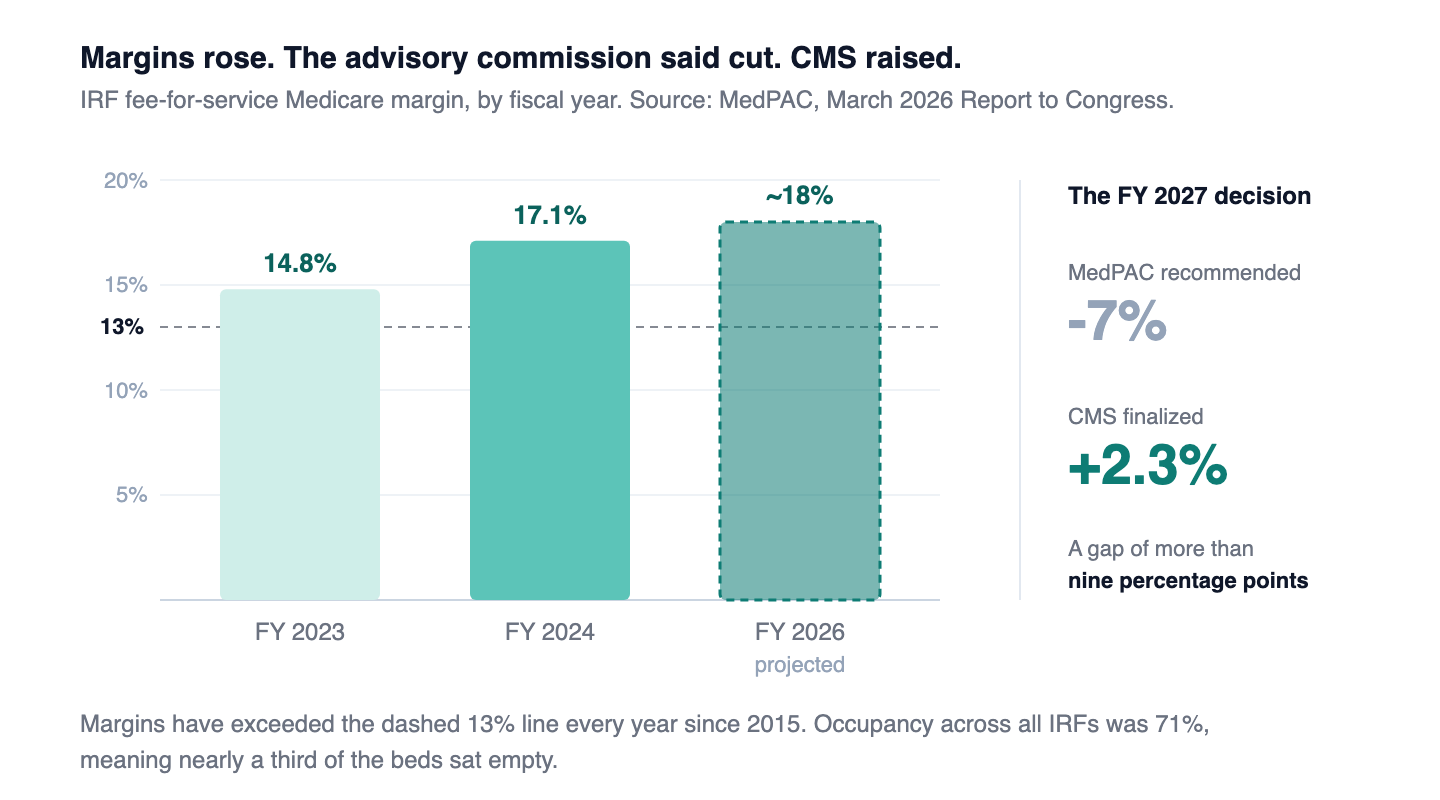
The margin figures behind that sentence are not close. Aggregate IRF Medicare margins have been above 13 percent since 2015 4. In FY 2024 the fee-for-service Medicare margin reached 17.1 percent, up from 14.8 percent the year before, and MedPAC projects roughly 18 percent for FY 2026 3. Payments per stay grew faster than costs per stay. Freestanding IRFs' all-payer total margin rose two points to 12 percent 3.
Meanwhile occupancy sat at 71 percent 3. Nearly a third of the beds were empty.
This is not a sector starved of capital. It is a sector with capital and a distribution problem, and the FY 2027 rule sends more capital into the same distribution.
Where the growth actually went
Look at how those fifty new facilities arrived.
Between FY 2023 and FY 2024, freestanding IRFs grew 4.3 percent and for-profit IRFs grew 4.3 percent. Over the same year, hospital-based IRFs fell 0.9 percent and nonprofit IRFs fell 2.8 percent 3. Bed growth of 3.5 percent came entirely from freestanding for-profit facilities. Beds in hospital-based nonprofit IRFs were flat 3.
Then MedPAC says the quiet part directly:
The majority of new IRFs were freestanding for-profit facilities and opened in markets in which another IRF was already serving beneficiaries. And: Half of the closures were nonprofit hospital-based facilities in areas with another IRF. [3]
Read those two sentences together and you have the shape of the whole system. The map is not expanding. It is thickening where it is already thick, and thinning where a hospital-based unit inside a struggling nonprofit finally gives up the beds.
How thick and how thin? In 2022, fewer than 30 percent of hospital service areas in the United States had a single IRF. For skilled nursing facilities the figure was 97 percent 3. Seventy percent of Medicare beneficiaries lived in a hospital service area with an IRF, which means about 30 percent of fee-for-service beneficiaries lived in one without 3. Those patients travel, or they get their rehabilitation somewhere less intensive, or they do not get it.
MedPAC does not read this as an access crisis, and the piece would be dishonest not to say so. The Commission's position is that capacity is adequate: occupancy is below capacity, volume is rising, and IRFs are not the only post-acute providers in any given area. Home health, outpatient departments, comprehensive outpatient rehabilitation facilities, and SNFs all furnish rehabilitative care 3. That is a fair reading of the aggregate. The argument in this piece is not about the aggregate. It is about one population inside it, for whom the substitutes are meaningfully worse and for whom the aggregate has never been the right unit of analysis.
From the field · Dr. Kumar
That occupancy figure has a denominator, and the denominator is softer than it looks. A unit is certified for a bed count that assumes its rooms hold the number of patients they were drawn to hold. I have worked in a unit certified for thirty inpatient rehabilitation beds that had fifteen rooms, each built as a double. Then you stand in one of those rooms with a brain injury patient, a wheelchair, a walker, a lift, and a family member who needs to be at the bedside, and you understand that the second bed is never going in. The certificate said thirty. The unit ran fifteen. No cost report and no occupancy table has a field for a room that is technically a double and functionally a single, so the gap is invisible in every dataset built on certified beds. This is an observation, not a finding, and I would not put it in a table. But if certified capacity overstates usable capacity, then 71 percent overstates how empty these units run, and the third of the system we are told sits idle is smaller than the number suggests.
Now the table that matters
Here is where the brain injury story stops being an inference and becomes arithmetic.
MedPAC breaks down the mix of Medicare IRF stays by facility type and ownership. Six impairment categories plus an "all other." Watch what moves and what does not 3:
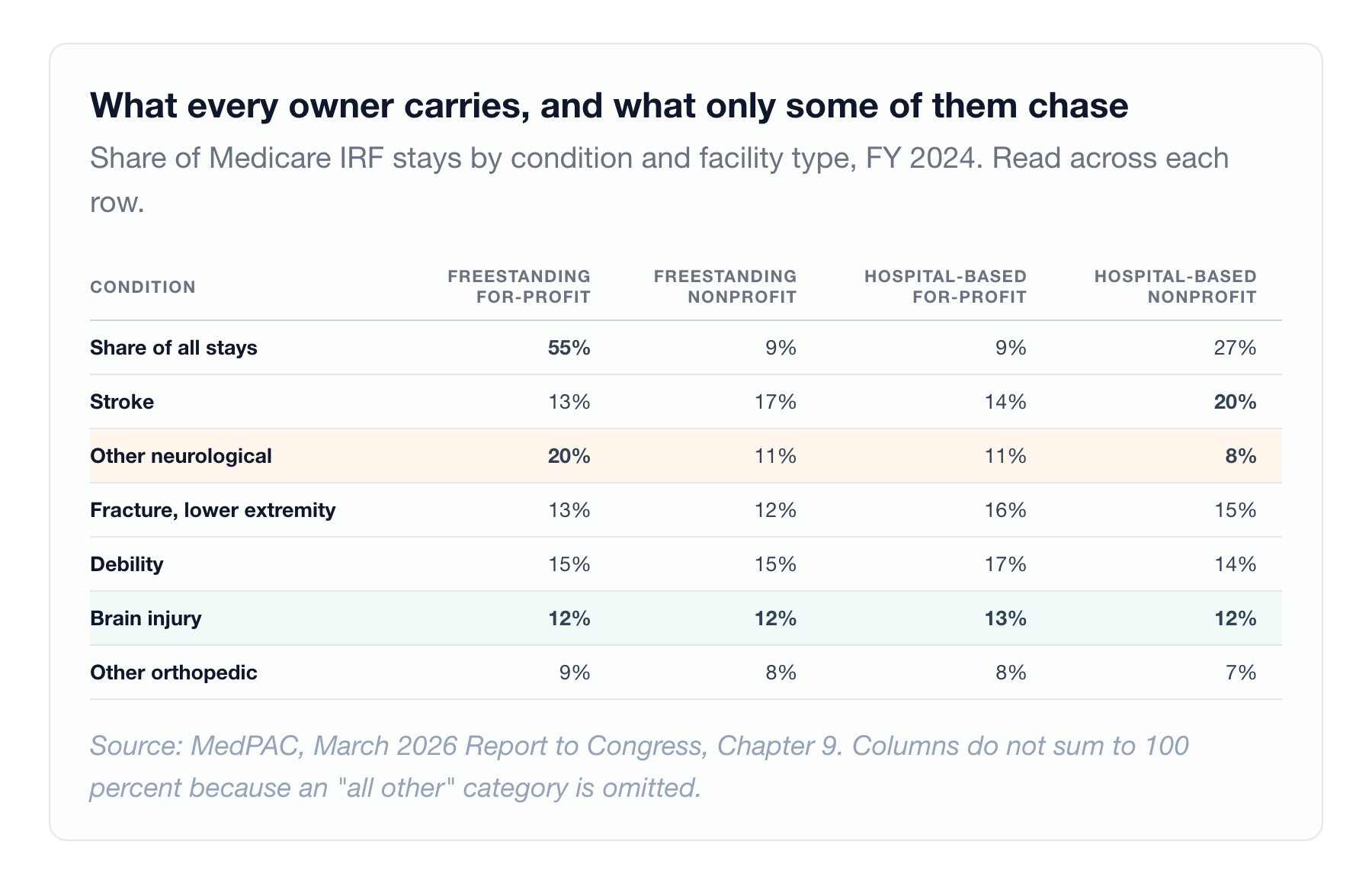
Stroke swings seven points across ownership types. "Other neurological conditions" swings twelve, from 8 percent at hospital-based nonprofits to 20 percent at freestanding for-profits, more than double.
Brain injury moves one point. Twelve, twelve, thirteen, twelve. It is the flattest line in the table.
Now add the fact that makes it legible.
MedPAC commissioned the Urban Institute to calculate payment-to-cost ratios for every rehabilitation impairment category with at least 10,000 stays. A ratio of 1.16 means payments exceeded costs by 16 percent. Here is the ranking, FY 2019 11:
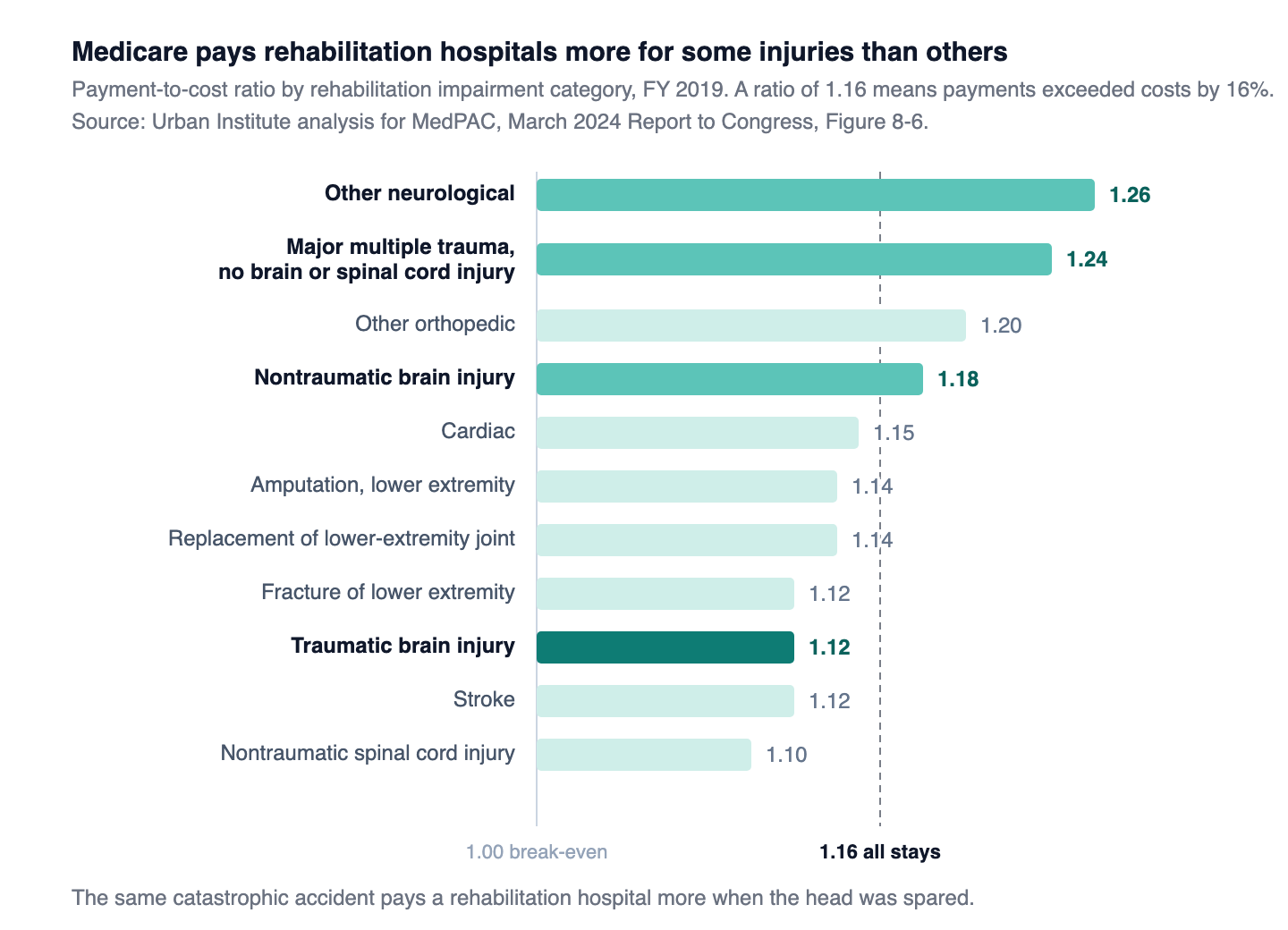
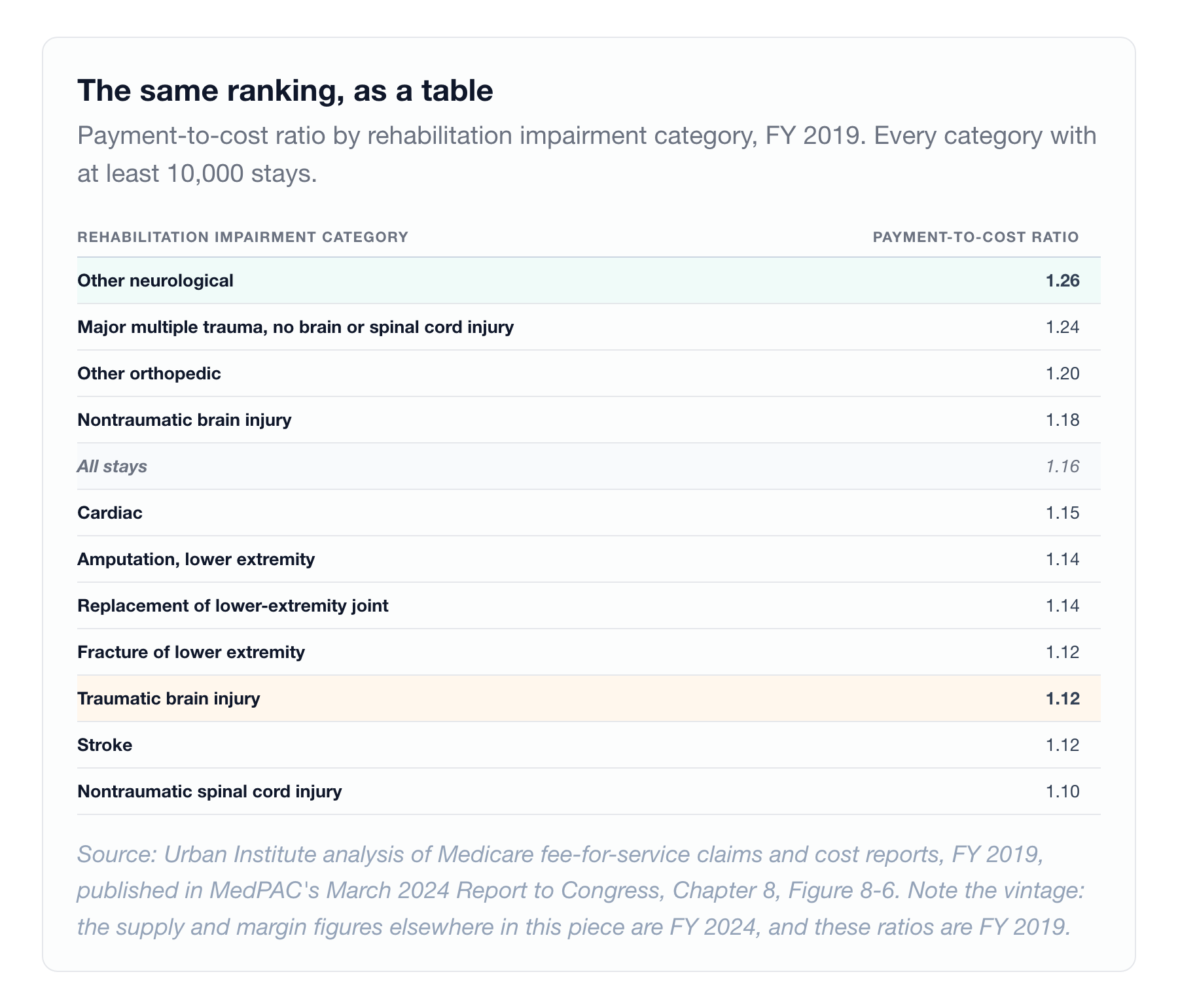
Traumatic brain injury sits at 1.12, four points below the all-stays average and fourteen points below the category at the top. Multiple trauma pays 1.24 specifically when there is no brain or spinal cord injury involved. The same catastrophic accident is worth more to a rehabilitation hospital when the head was spared.
MedPAC's conclusion from its own data is one sentence: "Profitability differences across RICs may create financial incentives to select some patients over others" 11. In its comment letter on this year's rule the Commission repeated it, describing "persistent differences in profitability across IRF RICs, which could incentivize admission of certain types of patients over others" 4.
So: the most profitable category is the one that swings hardest by ownership, and it is concentrated in exactly the facilities that grew 4.3 percent last year. Brain injury pays below average and is identical everywhere.
The system does pay for severity, just not for the right thing. It would be wrong to say the IRF payment system ignores complexity. Within any given category it rewards it. Among stroke stays, the least severe case-mix group ran a payment-to-cost ratio of 0.95, an actual loss, while the most severe ran 1.17. Profitability rose steadily as functional severity and comorbidity burden increased 11. The system is not blind to how sick a patient is. It is making a judgment one level up, about which kind of patient a bed is best spent on. That is a categorical decision, not a severity one, and it is the decision the classification rewrite is about to re-make.
A category that is identical across every owner, in every setting, in every market, is not a category anyone is competing for. It is a category everyone is carrying. The flat line is the tell.
Why carry it at all? Because of the 60 percent rule. To be paid as an IRF rather than as a general acute care hospital, a facility must draw at least 60 percent of its admissions from a list of thirteen qualifying conditions. Brain injury is on that list, alongside stroke, spinal cord injury, amputation, major multiple trauma, hip fracture, congenital deformity, burns, certain other neurological conditions, three qualifying arthritis conditions, and certain hip or knee replacements 3. Fail the threshold and you lose the payment classification entirely.
Brain injury is therefore not only a clinical service line. It is compliance ballast. Every IRF needs enough of it to stay an IRF, and no IRF has an economic reason to want more than that. Twelve percent is what "enough" looks like when it is measured across 1,169 facilities.
What that costs, measured in patients
The access number for this population is not subtle. Only about 13 to 25 percent of people who survive a moderate, severe, or penetrating traumatic brain injury receive comprehensive, interdisciplinary inpatient rehabilitation 6,7. The rest go to less intensive settings, or home without specialized therapy.
The barriers are documented and they are structural, not clinical. Securing preauthorization for comprehensive inpatient rehabilitation "can sometimes take several days." Acute hospitals under pressure to move patients discharge to a SNF rather than wait. Facilities may want assurance the person can eventually be discharged home. Comprehensive rehabilitation programs concentrate in urban centers, so families in rural areas face distance as a deciding factor 7.
And the setting is not interchangeable. For stroke, where the evidence base is strongest, AHA and ASA guidelines recommend IRF placement over SNF for patients who qualify 3,9. A 2019 JAMA Network Open study linking Medicare claims to facility assessments found stroke patients in IRFs improved 11.6 points on mobility versus 3.5 in SNFs, and 13.6 points on self-care versus 3.2 10. Multivariable, propensity score, and instrumental variable analyses all pointed the same direction. For TBI specifically the direct comparative literature is thinner, which is worth stating plainly rather than overselling, but the gap in the stroke data is not a rounding error. It is roughly a factor of three to four.
What is not thin is the outcome data on TBI patients who do get in. Across 99,804 older Medicare beneficiaries with traumatic brain injury treated in IRFs from 2013 to 2018, community discharge rose from 67.8 percent to 71.6 percent, while nursing home placement fell from 19.3 percent to 16.2 percent 8. Just under a third had moderate cognitive impairment and about 14 percent had severe cognitive impairment 8. These are complex patients, and roughly seven in ten went home.
The system works when people reach it. The problem is the reaching.
Two changes that will be felt by the same patients
The final rule tightened two operational requirements, and both were finalized over stakeholder objection.
All therapies within 36 hours. CMS revised § 412.622(a)(3)(ii) to specify that all, not just some, therapies must be initiated within 36 hours of admission 1. The final fact sheet describes this as a change that "will significantly reduce inquiries and support the IRF industry." The April proposal was more forthcoming about its purpose: it aligns enforcement "under the Center for Program Integrity Review Choice Demonstration, Medicare Administrative Contractor audit and oversight, and the IRF PPS program" 2. This is not a documentation preference. Missing it puts the reasonableness and necessity of the entire stay in question.
The American Hospital Association asked CMS to rewrite it, warning of "the unintended consequence of precluding IRFs from being able to order and provide therapies for which the need only arises later in a patient's stay" 5. CMS finalized it as proposed.
Interdisciplinary team meeting by day four. The initial IDT meeting must now occur on or before the fourth day of admission, with subsequent meetings weekly, defined as seven days from that first one 1. The AHA's comment was one sentence long: "we urge CMS not to finalize this policy change" 5. CMS finalized it.
Neither change is unreasonable on its face, and CMS may well be right that most facilities benefit from a bright line. The question worth asking is who lives in the exception. A clock that starts at admission and requires every discipline to be underway within a day and a half is easiest to meet for a scheduled post-surgical patient and hardest to meet for someone who is medically unstable, agitated, or not yet able to participate. That describes a substantial share of the severe brain injury population. When the standard is uniform and the patients are not, the burden lands unevenly, and it lands on the category that already has the flattest line in the table.
The part almost nobody read
Buried in the same rule is a request for information that matters more than the payment update, the 36-hour clock, and the IDT meeting combined.
CMS is preparing to replace the entire IRF patient classification system.
The current architecture dates to 2002. Seventeen major impairment group codes, comprising 85 specific codes, map into 21 Rehabilitation Impairment Categories. Up to three ICD-10-CM etiologic diagnosis codes run through a multi-step process from impairment codes to categories to the case-mix groups that determine payment 4. CMS's stated problem is that "the primary reason for IRF admission, the clinical care delivered, and the resulting payment have become misaligned" 4.
Its proposed direction is to borrow the clinical categories from the skilled nursing facility Patient-Driven Payment Model and build IRF-specific categories on that frame, replacing the impairment-code mapping with a direct crosswalk from diagnosis codes to clinical categories, with age and motor score bins layered in 1,4.
Both major reviewers pushed back.
MedPAC warned that while there is overlap between SNF and IRF populations, prior work "shows meaningful differences in patient mix across the two settings, with many patients more appropriately treated in one setting than the other," and urged CMS to verify that SNF-derived categories actually classify IRF patients accurately 4. It also flagged the motor score component: providers "have incentives to code functional status in ways that increase payment," and CMS should pair any such change with auditing and required hospital discharge assessments 4.
The AHA was blunter, urging CMS "not to move forward with a wholesale replacement of the current IRF clinical classification methodology based on the SNF PDPM framework" 5.
Here is why this is the story for anyone who cares about brain injury.
The current system's flaw, in MedPAC's own framing, is that profitability differs by impairment category in ways that shape who gets admitted 4. Rewriting the classification system is the one opportunity in a generation to fix that. It is also the one opportunity in a generation to encode it more deeply. A crosswalk built primarily on diagnosis codes, borrowed from a setting where cognitive and behavioral complexity is managed very differently, will decide whether a severe brain injury with agitation, impaired awareness, and a long functional runway is priced for what it actually costs to treat.
Whoever writes that crosswalk decides whether severe brain injury is finally paid for what it costs, or gets flattened one more time. That decision is being made right now, inside a request for information that generated a handful of comment letters.
What to do with this
If you run an IRF or a rehabilitation service line. The 36-hour requirement is now a coverage condition, not a documentation preference, and it is explicitly tied to Review Choice Demonstration and MAC audit alignment 2. Pull your last ninety days of admissions and identify how many had all disciplines documented as initiated inside 36 hours. That is your exposure. Do the same for initial IDT timing against a day-four line. Neither is hard to fix prospectively. Both are expensive to fix retroactively.
If you are a hospital executive without an IRF. The QRP data submission window compresses from 4.5 months to roughly 45 days beginning with the FY 2029 program, cutting public reporting lag by up to three months 1. Your referral partners' quality data is about to get considerably fresher on Care Compare. So is yours, to them.
If you work in brain injury. The RFI is the leverage point. Comment letters on payment classification are read by a small number of people and are read carefully. The argument that needs making is not that IRFs deserve more money in aggregate, which MedPAC has already answered convincingly in the negative. It is that a classification system which prices brain injury as compliance ballast produces exactly the map we have, and that a rebuild is the moment to change the price signal rather than port it forward.
If you are a family trying to place someone. Ask whether the facility you are being offered is an IRF or a SNF, and ask what the facility's brain injury volume is. Twelve percent is the national average across every ownership type. A program meaningfully above it has made a choice.
The thing the rule does not say
Medicare's inpatient rehabilitation system is well funded. Margins near 18 percent, empty beds, growing volume, and a payment increase granted over an advisory recommendation to cut. By every aggregate measure of payment adequacy, it is working.
And there are 144 rural rehabilitation hospitals, one more than in 2019, in a country where fewer than three in ten hospital service areas have an IRF at all.
Both things are true, and the distance between them is the whole point. A payment system can be more than adequate in aggregate and still fail to put a bed within reach of the person who needs it most. Rehabilitation for severe brain injury is the clearest case of that failure in Medicare, and this rule, which raised the rate and left the map alone, is the clearest recent demonstration of why it persists.
The scoreboard says the system is fine. Ask it where the beds are.
Status note, July 31, 2026. CMS issued the FY 2027 IRF PPS final rule (CMS-1845-F) on July 30, 2026, and the figures above come from the agency's own fact sheet and from the April proposed rule. As of publication the final rule has not yet appeared in the Federal Register and carries no document number. A Federal Register query for IRF PPS documents published on or after July 25 returns only the FY 2027 IPF rule and the FY 2027 SNF rule, both dated July 31. The IRF rule went on public inspection July 30 and should publish within days. This note will be updated with the Federal Register citation, and with any variance in the impact table or the finalized regulatory text, once it publishes.
Is brain injury a service line in your organization, or is it compliance ballast?
A3HCS helps health systems, rehabilitation operators, and post-acute leaders read their own numbers the way MedPAC reads them: case-mix and payment-to-cost analysis by impairment category, 60 percent rule exposure, IRF coverage-condition readiness against the new 36-hour and day-four requirements, and referral-map assessment for the catastrophic diagnoses your market cannot currently serve. The national average is twelve percent. What yours should be is a decision, not an accident.
References
- Centers for Medicare & Medicaid Services. "FY 2027 Inpatient Rehabilitation Facilities (IRF) Prospective Payment System (PPS) Final Rule (CMS-1845-F)." Fact Sheet, July 30, 2026. https://www.cms.gov/newsroom/fact-sheets/fy-2027-inpatient-rehabilitation-facilities-irf-prospective-payment-system-pps-final-rule-cms-1845-f
- Centers for Medicare & Medicaid Services. "Fiscal Year 2027 Inpatient Rehabilitation Facility Prospective Payment System Proposed Rule (CMS-1845-P)." Fact Sheet, April 2, 2026. https://www.cms.gov/newsroom/fact-sheets/fiscal-year-2027-inpatient-rehabilitation-facility-prospective-payment-system-proposed-rule-cms-1845
- Medicare Payment Advisory Commission. Report to the Congress: Medicare Payment Policy, March 2026. Chapter 9, "Inpatient rehabilitation facility services: Assessing payment adequacy and updating payments." https://www.medpac.gov/wp-content/uploads/2026/03/Mar26_Ch9_MedPAC_Report_To_Congress_SEC.pdf
- Medicare Payment Advisory Commission. Comment letter to Administrator Mehmet Oz on CMS-1845-P, April 30, 2026. https://www.medpac.gov/wp-content/uploads/2026/04/04302026_MedPAC_FY27_IRF_comment_V2_SEC.pdf
- American Hospital Association. "AHA Comments on CMS FY 2027 Inpatient Rehab Hospital Proposed Payment Rule," June 1, 2026. https://www.aha.org/lettercomment/2026-06-01-aha-comments-cms-fy-2027-inpatient-rehab-hospital-proposed-payment-rule
- Corrigan JD, Selassie AW, Orman JA. "The epidemiology of traumatic brain injury." The Journal of Head Trauma Rehabilitation. 2010;25(2):72-80. (Source of the 13 to 25 percent figure, cited via reference 7. Note that the NASEM chapter's in-text attribution reads "Corrigan et al., 2012," which does not match its own reference list; the underlying citation is the 2010 paper.)
- National Academies of Sciences, Engineering, and Medicine. "Rehabilitation and Long-Term Care Needs After Traumatic Brain Injury," in Traumatic Brain Injury: A Roadmap for Accelerating Progress. https://www.ncbi.nlm.nih.gov/books/NBK580075/
- Deutsch A, Kumar R, Sevigny M, Potelle J, McMullen T. "Trends in the Characteristics and Outcomes of Older Medicare Patients with Traumatic Brain Injury Treated in Inpatient Rehabilitation Facilities: 2013 to 2018." Archives of Physical Medicine and Rehabilitation. 2024;105(6):1058-1068.
- Winstein CJ, et al. "Guidelines for Adult Stroke Rehabilitation and Recovery: A Guideline for Healthcare Professionals From the American Heart Association/American Stroke Association." Stroke. 2016;47(6):e98-e169.
- Hong I, Goodwin JS, Reistetter TA, et al. "Comparison of Functional Status Improvements Among Patients With Stroke Receiving Postacute Care in Inpatient Rehabilitation vs Skilled Nursing Facilities." JAMA Network Open. 2019;2(12):e1916646. https://pmc.ncbi.nlm.nih.gov/articles/PMC6902754/
- Medicare Payment Advisory Commission. Report to the Congress: Medicare Payment Policy, March 2024. Chapter 8, "Inpatient rehabilitation facility services." Payment-to-cost ratios by rehabilitation impairment category appear at Figure 8-6 (p. 242) and by case-mix group at Figure 8-7 (p. 244), from an Urban Institute analysis of Medicare fee-for-service claims and cost reports, FY 2019. https://www.medpac.gov/wp-content/uploads/2024/03/Mar24_Ch8_MedPAC_Report_To_Congress_SEC.pdf