


On January 1, 2027, Illinois moves its largest Medicaid program onto new contracts. The program is HealthChoice Illinois, the managed care side of Medicaid, where the state pays private health plans a set amount per member each month and the plans arrange and pay for care. About 2.4 million people are enrolled, close to one in five Illinois residents.1
The Illinois Department of Healthcare and Family Services (HFS), the state Medicaid agency, calls this the first competitive procurement of these contracts under the state procurement code and the first procurement of them since 2018.1 The contract that came out of it is long. The model version published with the request for proposals runs more than 370 pages.2 Most providers, practice managers and community organizations will never read it, and they are the ones who will feel it.
I read the 2027 model contract next to the contract it replaces. This piece covers what changes, for whom, by when, and what to do now. One caution first. The 2027 text I used is the model contract the state published during bidding, as revised on October 30, 2025.2 The signed contracts are not posted on the state's managed care contracts page, so a term could differ in the final version.3
On November 17, HFS and five of the six plans shared a panel on these contracts at the Illinois State of Reform Health Policy Conference in Chicago.4 I attended as a registered guest. This article does not quote that session. Everything below comes from public documents, and each one is listed at the end.

Who holds the new contracts
HFS awarded contracts to six health plans on June 8, 2026, and announced them a week later.1,5 Five will serve all 102 counties: Aetna Better Health of Illinois, Blue Cross and Blue Shield of Illinois, Humana, Meridian and Molina. CountyCare, the plan run by Cook County's public health system, serves Cook County only.1,6
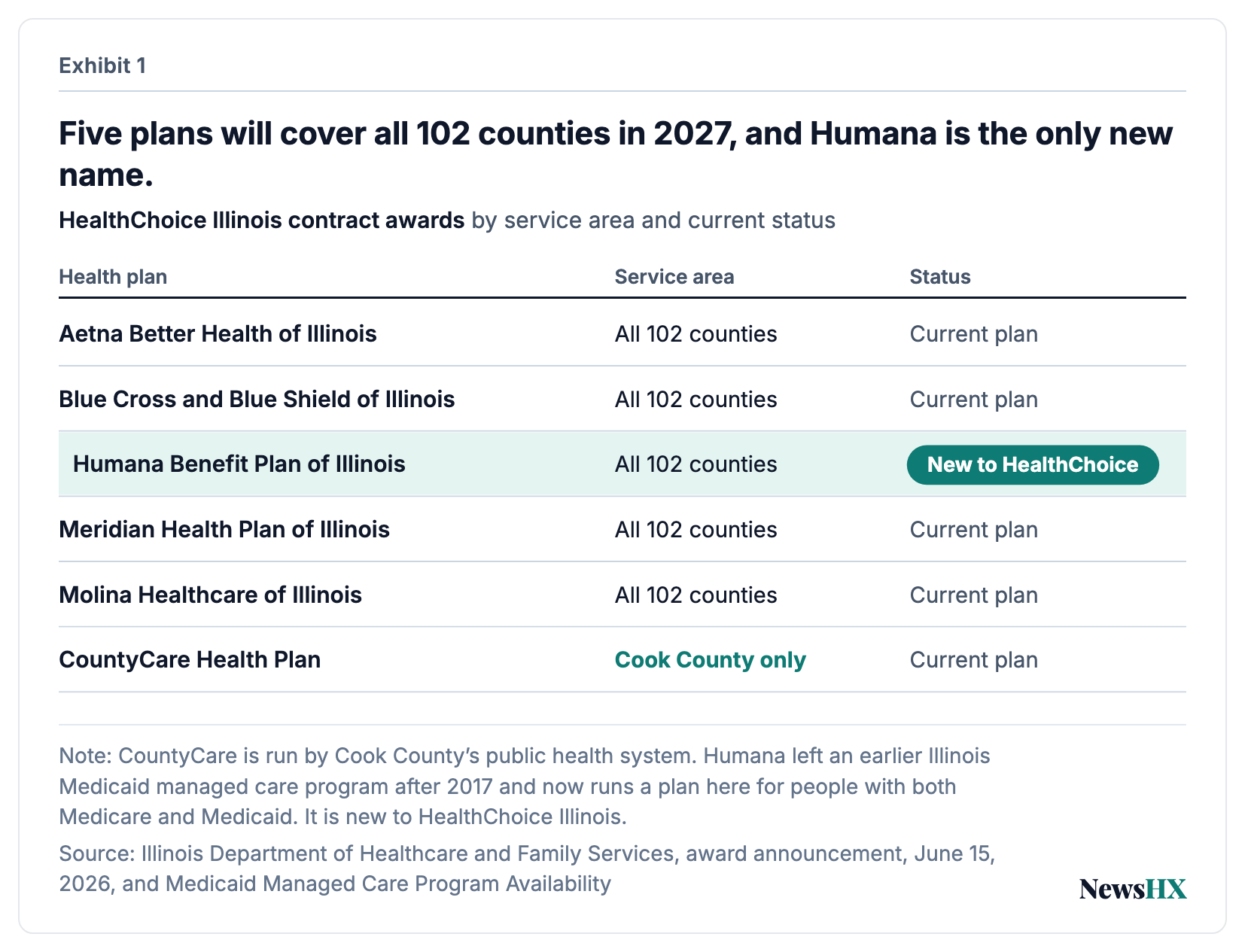
Four of the statewide plans and CountyCare already serve HealthChoice Illinois members today.7 Humana is the newcomer to this program. It is not new to Illinois Medicaid: it left an earlier Illinois managed care program at the end of 2017, and it currently runs a plan here for people who have both Medicare and Medicaid.7,8 For a provider, the practical point is that there is one more plan to contract with and no plan to say goodbye to.
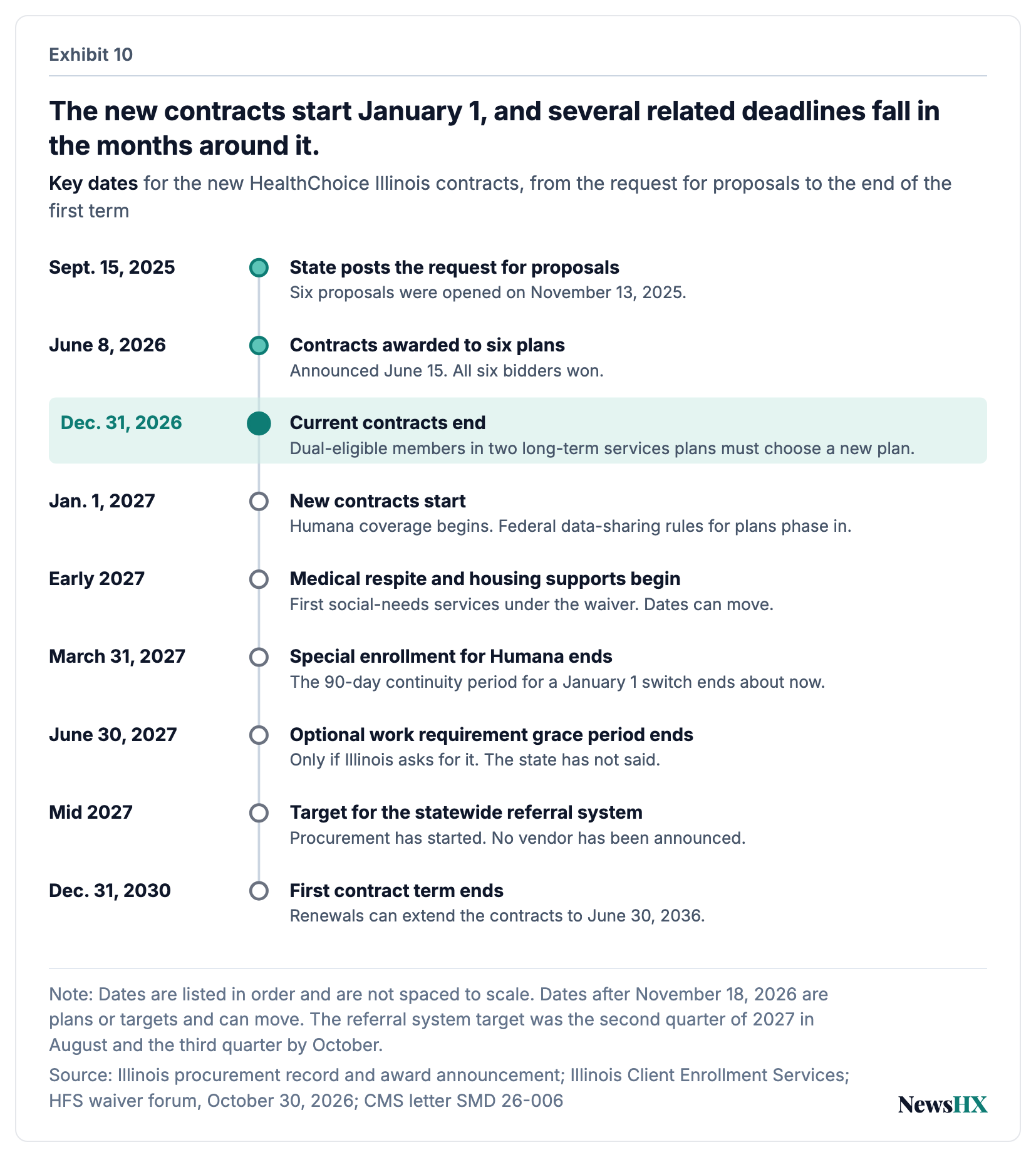
The first term runs through December 31, 2030, and renewals can extend the contracts to June 30, 2036.6,9 The state's award notice estimates the value at about $140 billion for the first term and about $431 billion if every renewal is used. It adds that these are estimates that depend on rates and enrollment.5 The same notice lists zero unsuccessful bidders.5
The contracts cover families and children, adults who qualify under the Affordable Care Act expansion, children with special needs, and adults with disabilities who are not on Medicare.6 People who have both Medicare and Medicaid, and young people in the care of the Department of Children and Family Services, are served under separate contracts.6
One group in those separate contracts has a deadline of its own. People with both Medicare and Medicaid who get long-term services through managed care are losing two plan options. The state's enrollment site says CountyCare and Blue Cross leave that program after December 31, 2026, and that their members must choose a new plan by that date.10 Nursing facilities and home care agencies that serve these members should confirm which plan each one lands in.
Network rules: closer care and a second choice
A health plan's network is the set of providers it has under contract. The state sets minimum standards for how far a member should have to travel, written as a number of providers within a distance or a drive time of the member's home. The 2027 contract tightens most of them.2,3
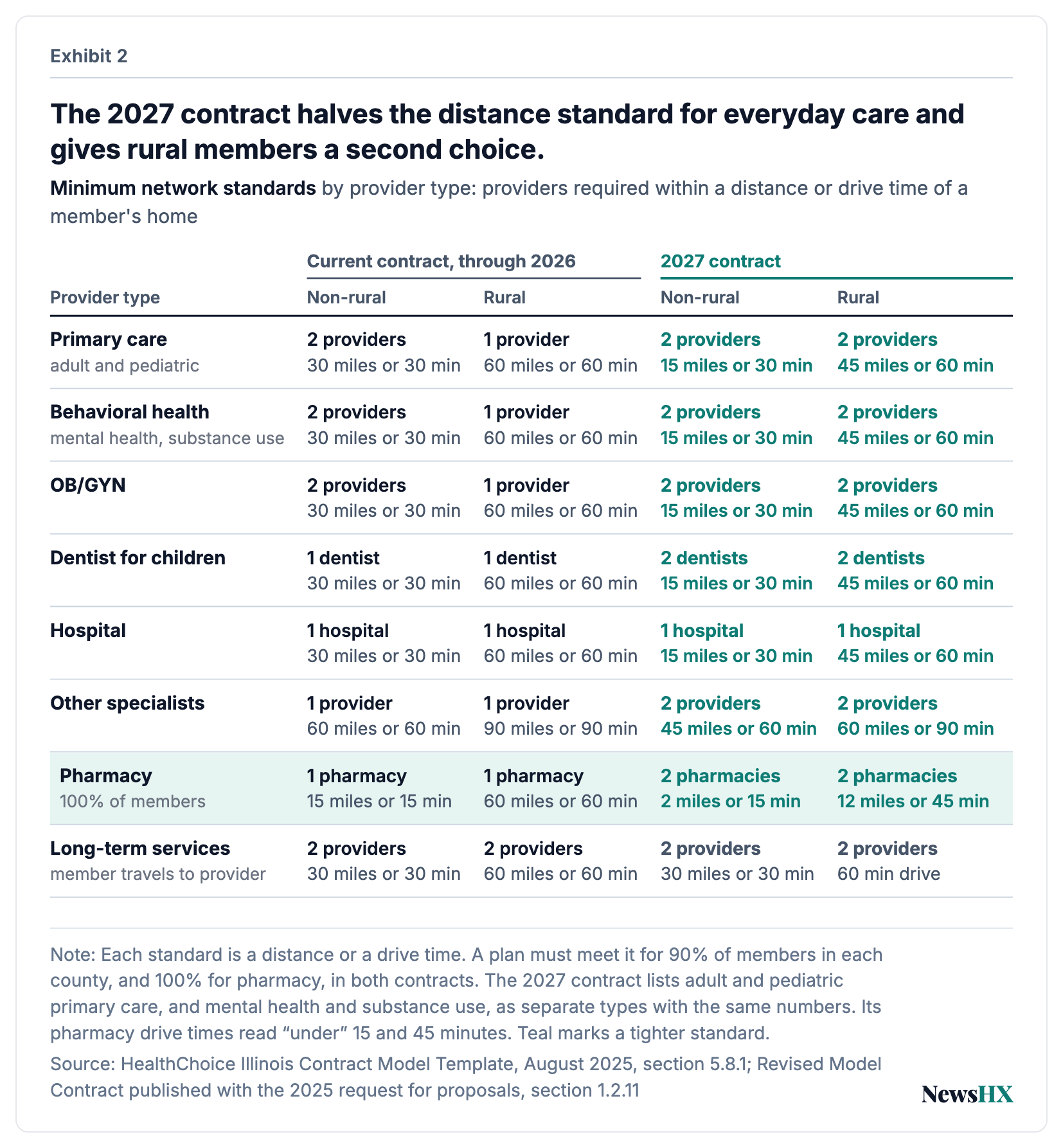
Three changes stand out. The mileage is cut in half for everyday care: primary care, mental health, substance use treatment, and obstetrics and gynecology (OB/GYN) go from 30 miles to 15, and from 60 miles to 45 in rural areas.2,3 Rural members get a second choice: the current contract requires one provider of each of those types within reach, and the new one requires two.2,3 And the pharmacy standard is rewritten, from one pharmacy within 15 miles to two within 2 miles, and in rural areas from one within 60 miles to two within 12.2,3
Read the fine print before assuming every county will look different. Each standard says a distance or a drive time, and for most provider types the drive time did not change: 30 minutes, or 60 in rural areas.2,3 The compliance bar also stays where it was. A plan must meet the standard for 90% of its members in each county, and for all of them for pharmacy.2,3 A plan can ask HFS for a one-year exception in a county with too few providers, and HFS can let telehealth fill the gap.2
One new rule matters more than it looks. To count toward a plan's network, a provider has to be actually seeing members. A primary care provider counts only after billing at least 15 claims in six months, and other providers need at least one claim in the past year, with an allowance for newly contracted providers.2 That is aimed at networks that look full on paper. Each plan must also file a Network Development and Management Plan with the state and report every quarter on where its providers sit compared with its members.2
The contract also sets appointment wait times: within five weeks for routine preventive care, within one business day for urgent problems, and within 10 business days for a first outpatient visit for mental health or substance use.2 On top of that sit new federal limits of 10 business days for mental health and substance use, and 15 for primary care and OB/GYN, tested by independent "secret shopper" callers who must find appointments available 90% of the time.11 The federal limits apply to the first rating period that starts on or after July 9, 2027, and the secret shopper surveys one year after that.11 A rating period is the year a plan's payment rates cover. If Illinois keeps setting rates by calendar year, as its 2027 rate documents do, that points to 2028 and 2029. That last step is my reading, not a published state date.6
The provider directory is now a shared job
The provider directory is the public list members use to find care. Under the 2027 contract each plan's directory must be searchable online without a login and must show, for every provider, whether new patients are accepted, what languages are offered, what disability accommodations exist, and whether telehealth is available.2
The accuracy duties run in both directions. Plans must direct providers to report any change within five days, must ask providers for updates at least twice a year, must check in with any provider who has not billed in six months, and must correct a reported error within 30 days.2 Plans also have to compare the directory with the network file they send the state and report how many records do not match.2 If a wrong listing sends a member to an out-of-network provider, the member cannot be billed for it.2
The tool for all of this is the universal roster, one spreadsheet template that every HealthChoice Illinois plan accepts. It is posted by the Illinois Association of Medicaid Health Plans (IAMHP), the plans' trade group, and state law requires it to be standard across plans.12 HFS updated it on February 1, 2026, adding fields for telehealth and for practitioners' race and ethnicity, and told providers to send it whenever they add a clinician, change a location, or file with IMPACT, the state's provider enrollment system.12 The plans' own guidance asks for more: most of them want roster updates every month.13 Once a plan receives a complete and accurate roster, it has 30 days to load it.2 IAMHP also publishes one billing manual for all of the plans, now in version 36.14
Care coordination: smaller caseloads and a new tier
Care coordination is the plan's job of helping a member get services and connect them, usually through an assigned care coordinator. Plans sort members into risk levels, and the contract caps how many members one coordinator can carry.2
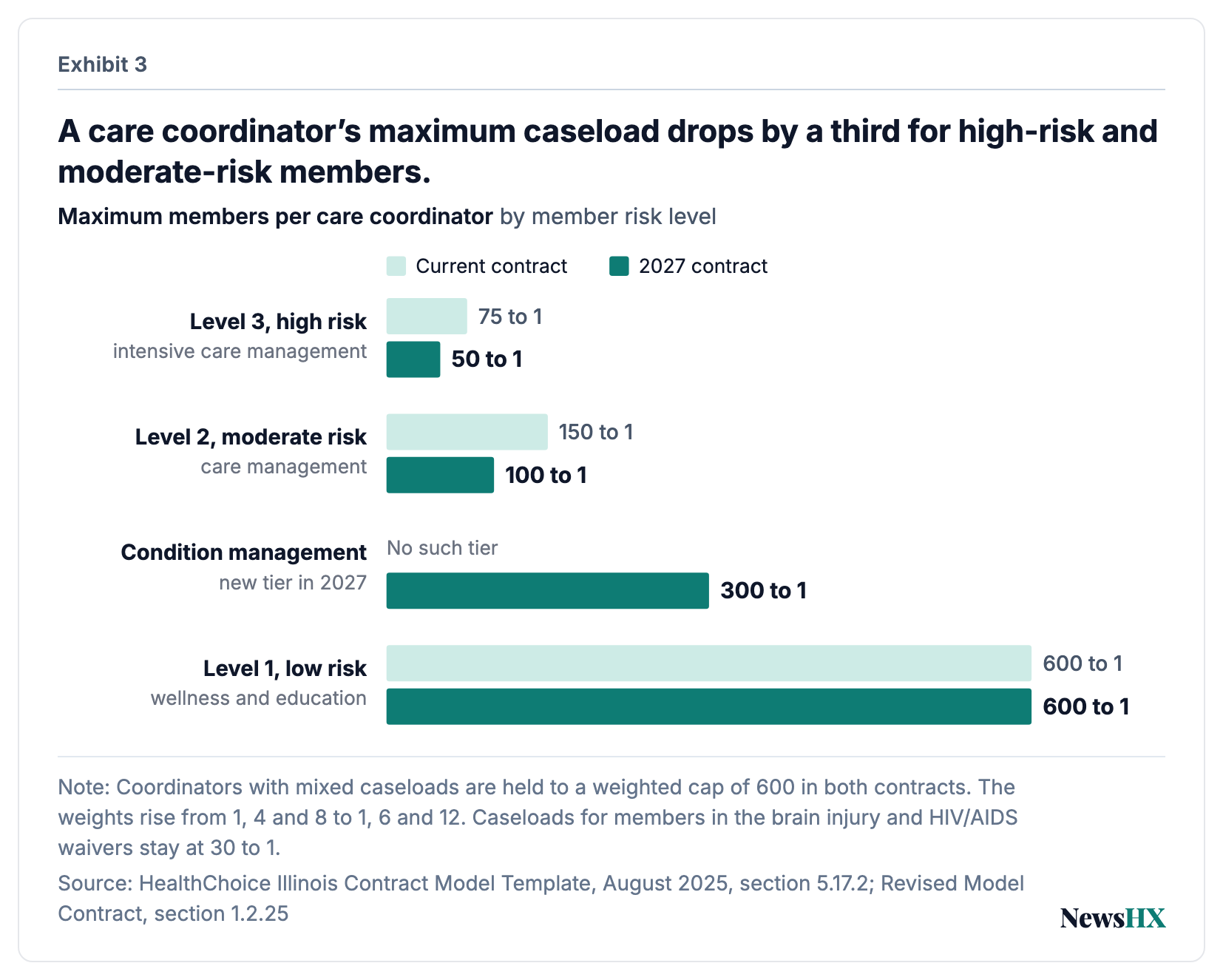
The caps for the members who need the most help fall by a third. A coordinator for high-risk members goes from 75 to 50, and for moderate-risk members from 150 to 100.2,3 Plans must assign every new member a risk level within 15 days, re-sort members monthly, and give care management to at least 4% of their members.2 They must also connect to the state's system of real-time admission, discharge and transfer alerts, so a coordinator learns when a member lands in an emergency department or hospital.2
The new piece is condition management. It is a lighter tier for members who have a specific condition and do not need full care management: education, goal setting, help getting appointments, and up to three individual meetings.2 Plans must run programs for at least asthma, diabetes, hypertension, depression, chronic kidney disease, substance use disorder, and pregnancy and postpartum care, among others.2 The contract says this work may be done by non-clinical staff, with a clinician to escalate to, at up to 300 members per coordinator.2 HFS told bidders it is separate from the risk levels.15
For practices and community organizations, that tier is worth a conversation with each plan. HFS also told bidders that community health workers may be part of a member's care team.15 The contract does not say plans must buy these services from outside organizations, so whether there is a contract in it for you depends on the plan.
Rides and social needs are written in
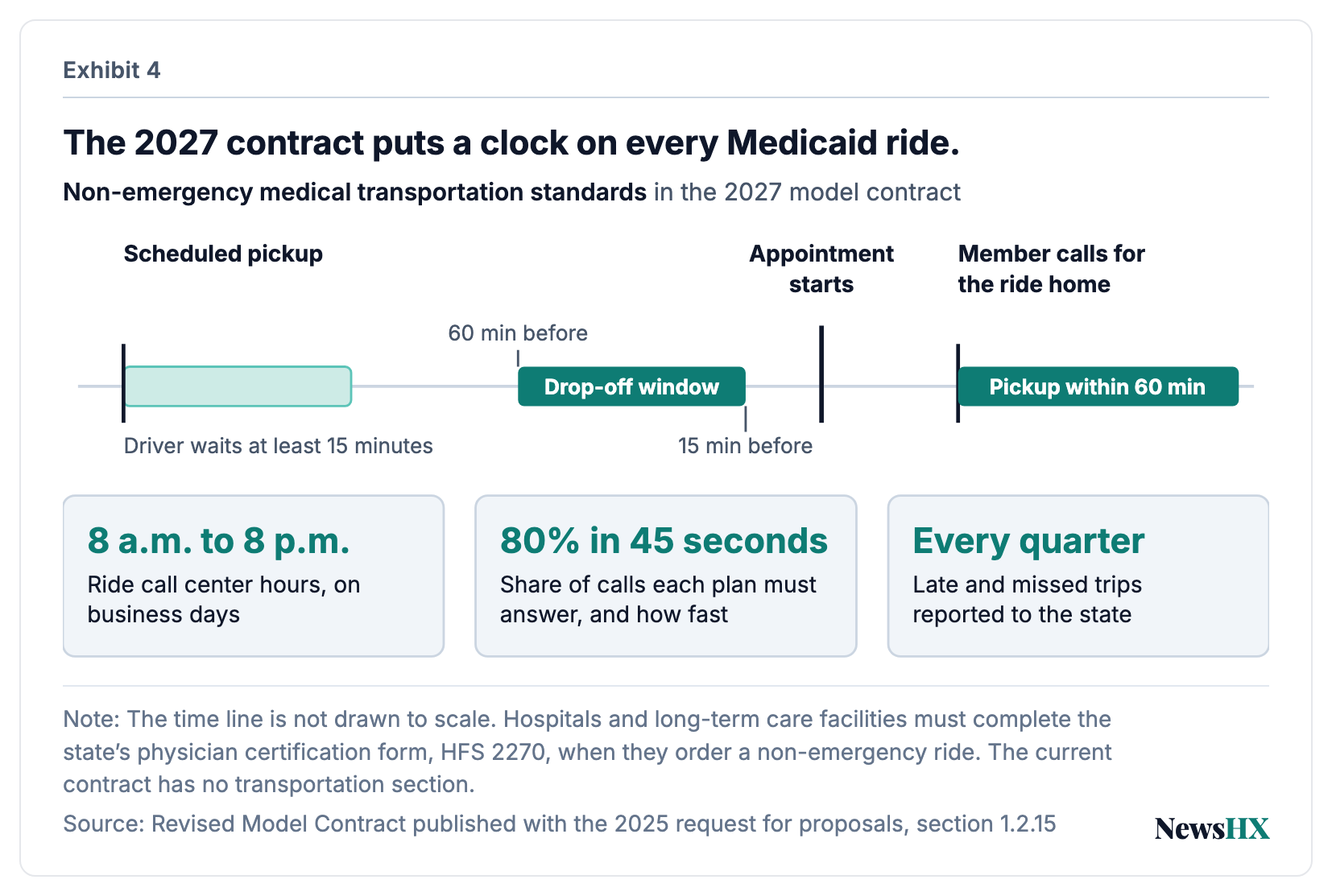
Non-emergency medical transportation, the ride to a medical appointment, gets its own section of the contract for the first time.2,3 A driver must wait at least 15 minutes past the pickup time. A member must be dropped off at least 15 minutes before the appointment and no more than an hour early, and picked up within an hour of calling for the ride home.2 Each plan needs a ride call center open 8 a.m. to 8 p.m. on business days that answers 80% of calls within 45 seconds, and must report late and missed trips to the state every quarter.2 Hospitals and long-term care facilities must complete the state's physician certification form, HFS 2270, when they order a non-emergency ride.2
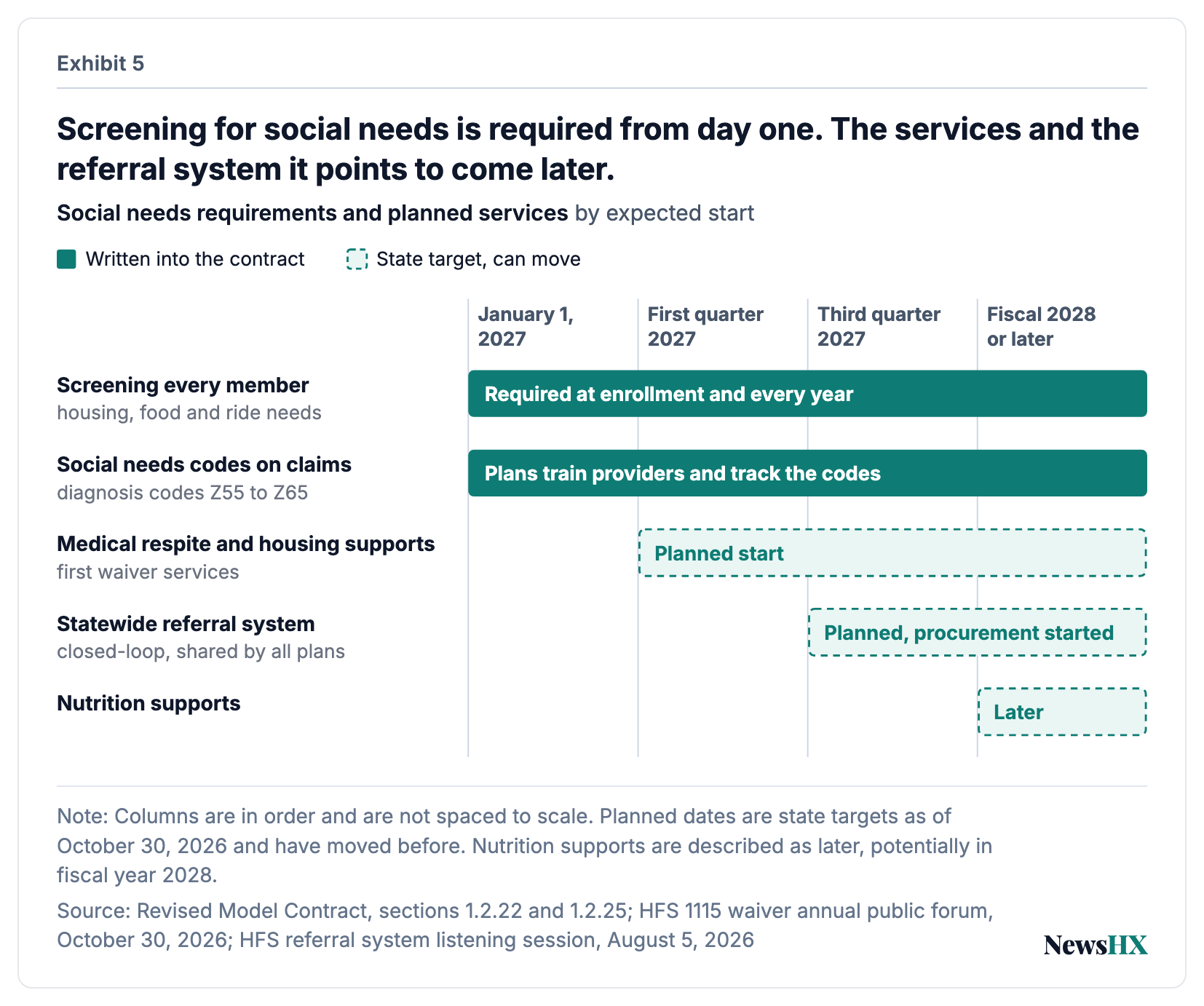
The contract also requires plans to screen every member for housing, food and transportation needs at enrollment and each year after.2 What a plan can do with the answer is about to grow. Illinois holds a Section 1115 waiver, a federal agreement that lets a state test services Medicaid does not normally cover, and it allows Medicaid funds for certain health-related social needs.16 HFS told a public forum on October 30, 2026 that the first two services, medical respite and housing supports, are planned to go live in the first quarter of 2027, with nutrition supports later, potentially in fiscal year 2028.16 An earlier HFS session gave February 1, 2027 as the start for housing providers, subject to change.17
Medical respite is the one hospital discharge planners should learn. HFS describes it as short-term residential care, for up to six months, before a procedure or after a hospital stay. It is for managed care members who are homeless or at risk of it and whose condition can be managed safely in that setting.16 These services are paid outside the plans' monthly rate. The plan approves the service and is reimbursed at rates the state sets.18 The Governor's proposed fiscal 2027 budget put $14.5 million toward the social needs part of the waiver.19
Referrals are the missing piece. The contract says HFS intends to buy a shared platform that plans must use or connect to, to record screenings and track referrals.2 HFS calls it the Illinois Community Access Resource and Referral System. It is meant to be a closed-loop referral system, one where the referring provider can see whether the person actually got the service.20 In August 2026 the agency gave a target of the second quarter of 2027. By the October forum it said procurement had started and it was planning for the third quarter of 2027.16,20 HFS has said every plan and every organization referring for waiver services will have to use it once it exists.18 It does not exist yet. Until it does, plans must train providers on the diagnosis codes for social needs, Z55 through Z65, and track them on claims.2
One program with a similar name is separate. The Tailored Care Management Program also starts January 1, 2027. It serves people covered by two consent decrees, known as Williams and Colbert, who are moving out of specialized mental health facilities and Cook County nursing facilities into the community. HFS has contracted with Telligen to run it, and the proposed budget put $39 million toward it.19,21
Payment, prior authorization and gold cards
On claims, the basic promise is unchanged: plans must pay 90% of clean claims within 30 days and 99% within 90 days.2,3 What is new sits in front of the plan. Since spring 2026 the state has been screening managed care claims for the member's Medicaid ID number, date of birth and eligibility on the date of service, and rejecting claims it cannot verify, with a temporary bypass while providers update their systems.22
Value-based payment, pay tied to quality or cost results instead of volume alone, keeps expanding. Each plan must have a strategy that leans toward arrangements where providers share in savings or take on risk, file a plan with the state every May 1, and raise the share of its spending under these arrangements every year.2 The contract sets no percentage target, and HFS can add one with 90 days' notice.2
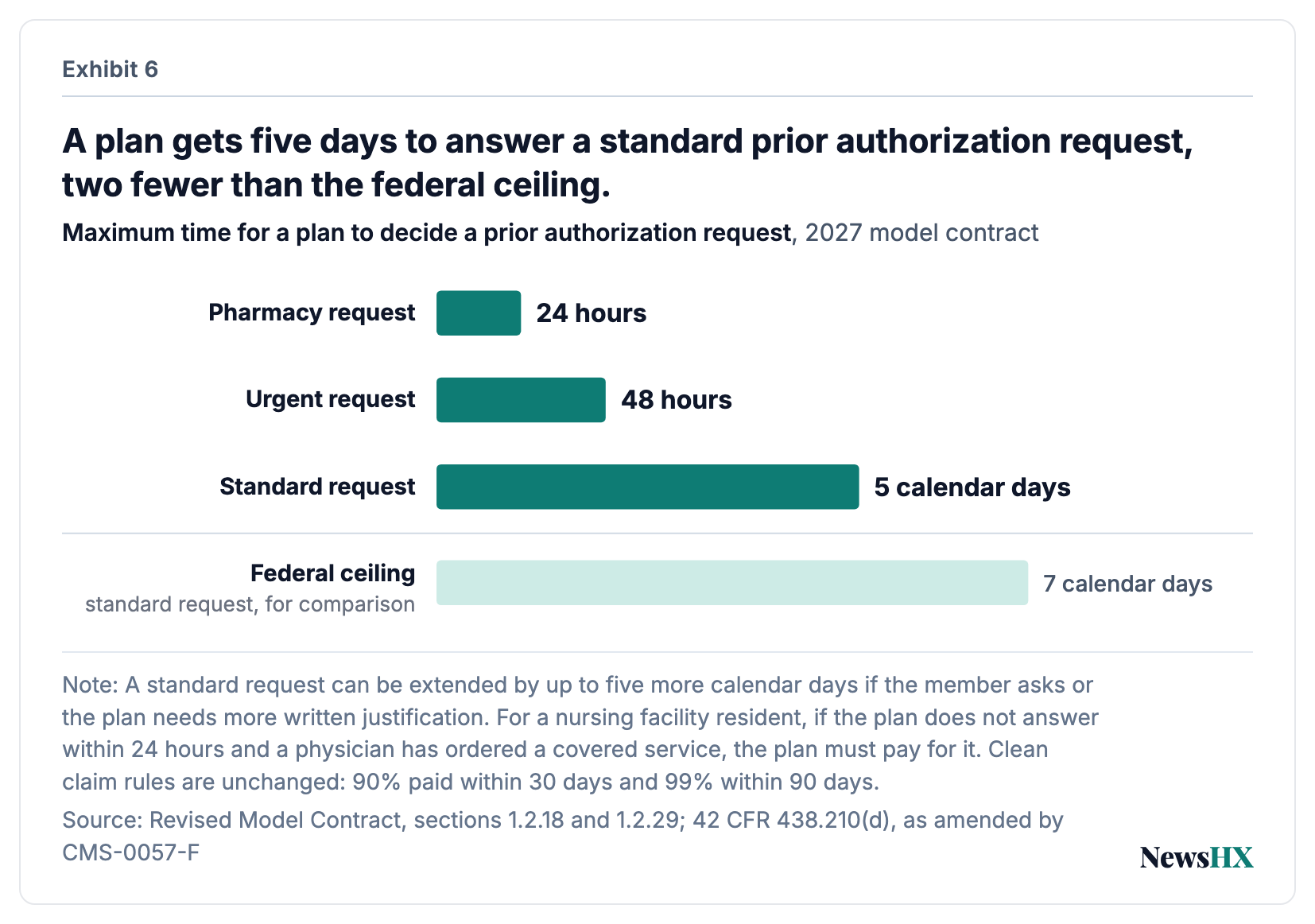
For prior authorization, the plan's advance approval of a service, the contract gives plans five calendar days for a standard request, 48 hours for an urgent one and 24 hours for a pharmacy request.2 That is tighter than the federal ceiling of seven calendar days for standard requests.23 For a nursing facility resident, if the plan does not answer within 24 hours and a physician has ordered a covered service, the plan must pay for it.2
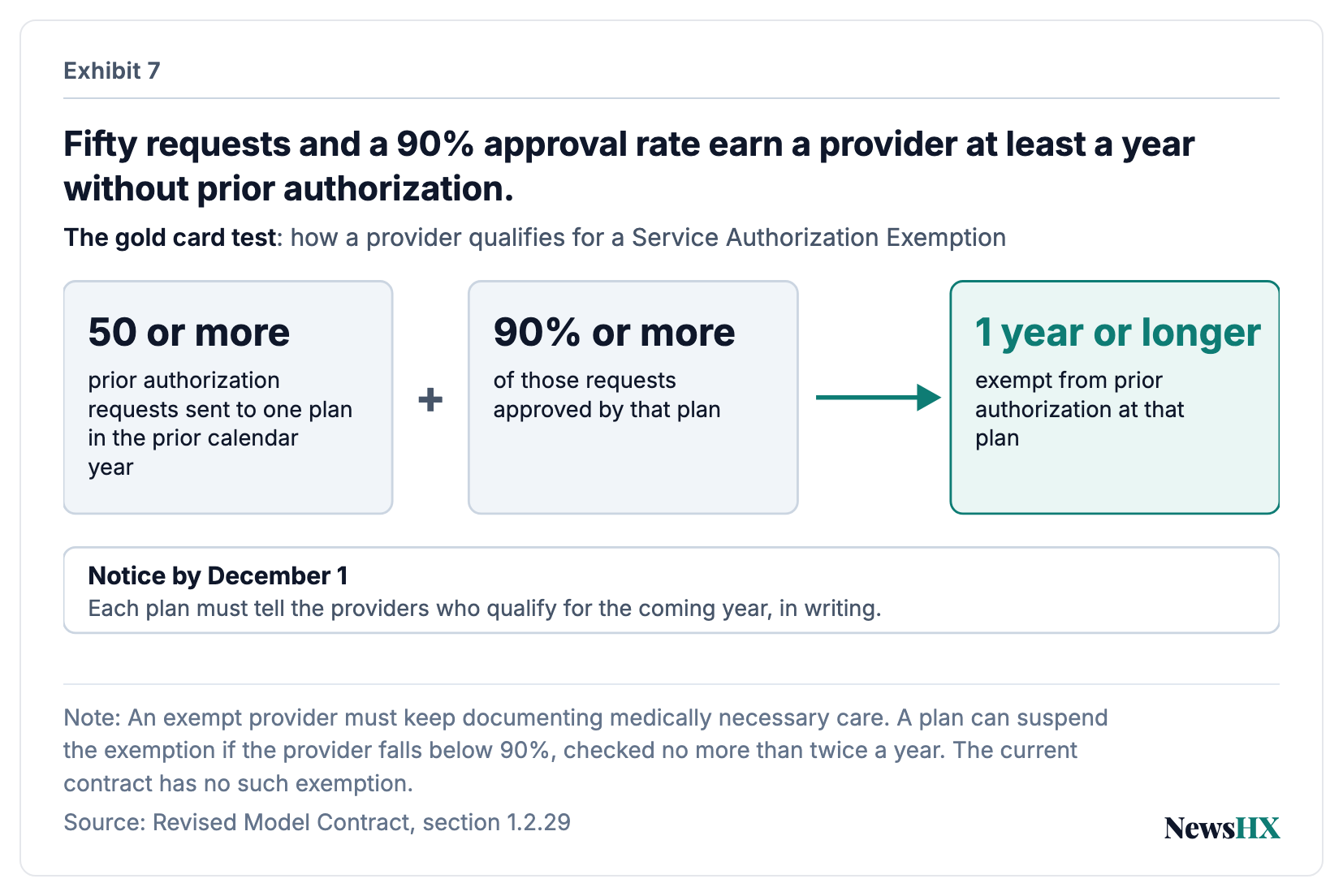
Providers with a strong record can skip the step. Under the contract's Service Authorization Exemption, often called a gold card, a provider who sent a plan at least 50 requests in the prior year and had at least 90% approved is exempt for at least a year. Plans must notify those who qualify by December 1.2 The proposed state budget describes a gold card for hospital inpatient and outpatient services beginning January 1, 2027.19
What happens to care already under way on January 1
This is the question I most wanted answered, because it decides whether a patient in the middle of treatment, and the provider treating them, gets through the changeover without a gap. The documents answer more of it than I expected.
Start with who actually moves. All five current plans continue, so no HealthChoice Illinois member is in a plan that is closing.1,7 The state's enrollment service says members can already choose Humana, with coverage beginning January 1, and that people outside their once-a-year switching window get a special enrollment period through March 31, 2027 to pick it. Until January 1 they stay where they are.10 The model contract also describes an open enrollment period with mailed packets, and automatic assignment for anyone who must enroll and does not choose, using a method meant to keep existing provider relationships.2 I did not find published dates for a statewide mailing.
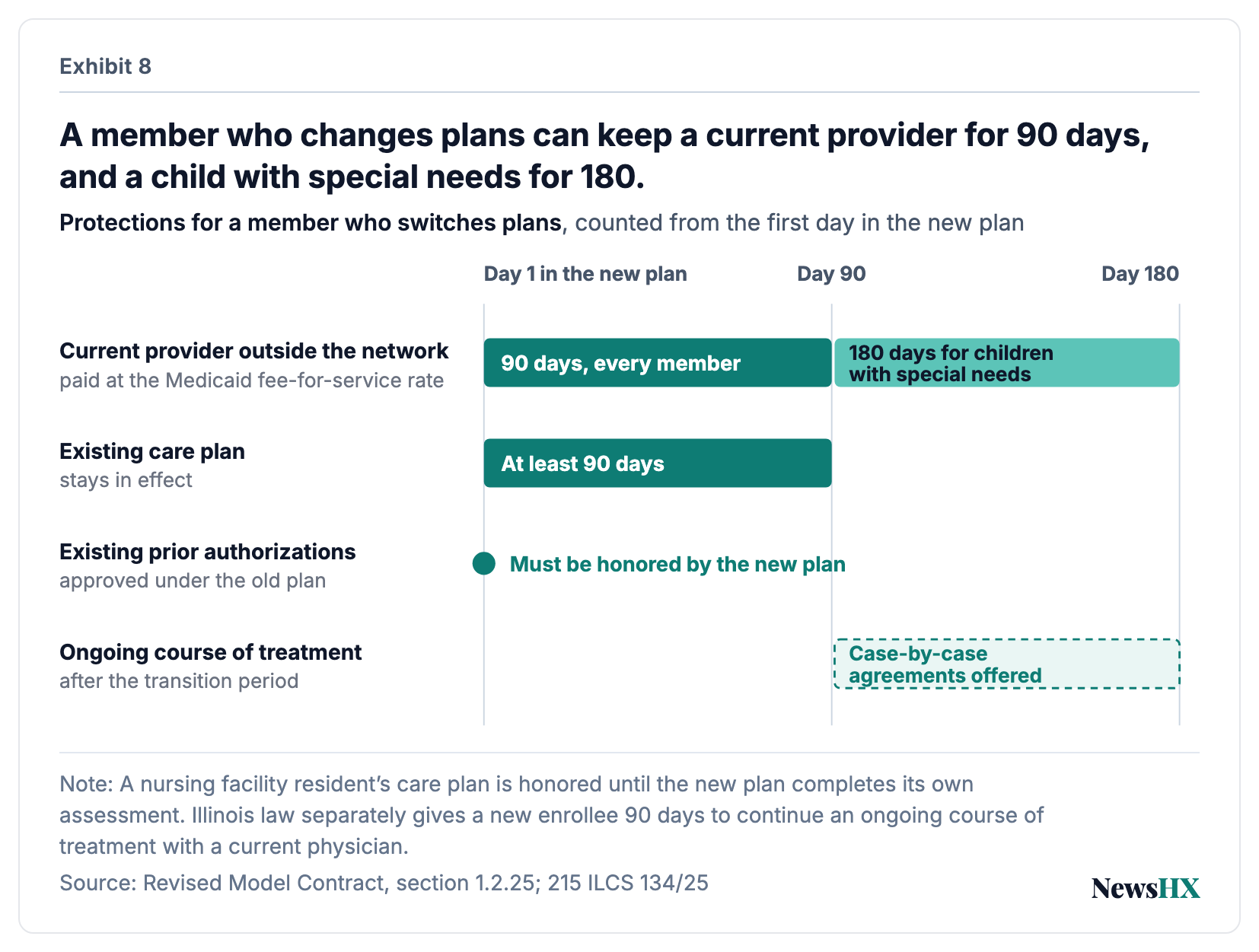
For a member who does change plans, the contract has four protections. First, a 90-day transition period: the member may continue a current course of treatment with a provider who is not in the new plan's network, and the plan must pay that provider at the Medicaid fee-for-service rate. For children with special needs it is 180 days.2 Second, existing prior authorizations must be honored by the new plan.2 Third, an existing care plan stays in effect for at least 90 days, and a nursing facility resident's care plan is honored until the new plan completes its own assessment.2 Fourth, after the 90 days, providers in an ongoing course of treatment are to be offered case-by-case agreements to continue.2
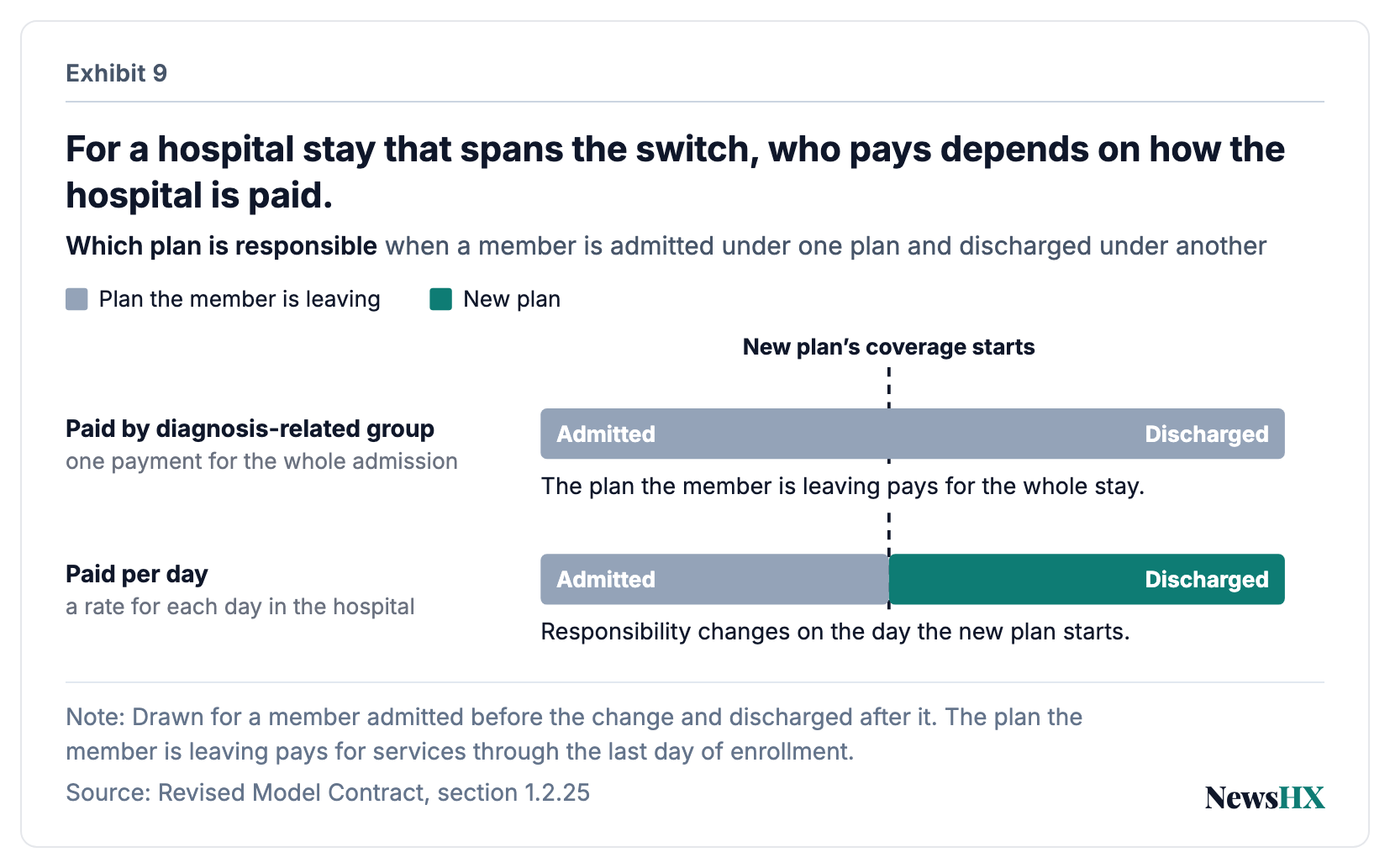
Hospital stays that straddle the switch have their own rule. If the stay is paid by diagnosis-related group, a single payment for the whole admission, the plan the member is leaving stays responsible when the discharge comes after the switch. If the stay is paid per day, responsibility changes on the day the new enrollment takes effect.2 The old plan pays for services through the last day of enrollment.2
These are not only contract terms. Federal rules require every state to have a transition of care policy that lets a member keep a current provider for a time when losing that care would put the member's health at serious risk.24 Illinois law separately gives a new enrollee 90 days to continue an ongoing course of treatment with a current physician.25
What the documents do not spell out is the provider's side of the paperwork: how to tell a plan that a patient is in an active course of treatment, how fast a single-case agreement gets signed, and who to call when a claim for a transition patient is denied in January. The contract requires each plan to file a transition work plan that covers continued services and correct, timely provider payment, and to pass a state readiness review at least 60 days before the start.2 Those plans are not public, and HFS has not issued a provider notice on the changeover. That is the list to raise with each plan now.
The federal dates that land in the same year
Two federal rules and one federal law arrive alongside the new contracts.
Data sharing. A 2024 federal rule requires Medicaid managed care plans to run three electronic connections by the rating period that begins on or after January 1, 2027: one that lets providers pull data on their patients, one that moves a member's history from the old payer to the new one, and one for electronic prior authorization.23 Plans already have to post their prior authorization statistics by March 31 each year.23
Access. The federal wait time limits and secret shopper surveys described above phase in after that.11
Work requirements. The 2025 federal budget law requires adults ages 19 to 64 who are covered through the Medicaid expansion to work, study or volunteer at least 80 hours a month, starting January 1, 2027.26,27 On November 13, 2026 the federal Centers for Medicare & Medicaid Services (CMS) offered every state an optional "hold harmless" period through June 30, 2027. A state that takes it must still check each person, and may hold off on denying or ending coverage for not meeting the requirement.27 States that want it from January 1 were asked to tell CMS by December 11.27 Illinois has not said publicly whether it will. Its Medicaid page still says the first affected renewals are those due in March 2027.26 For providers, the point is that some patients may lose coverage in 2027 for reasons that have nothing to do with which plan they are in.
What to do now
None of this requires waiting for January. Here is the short list.
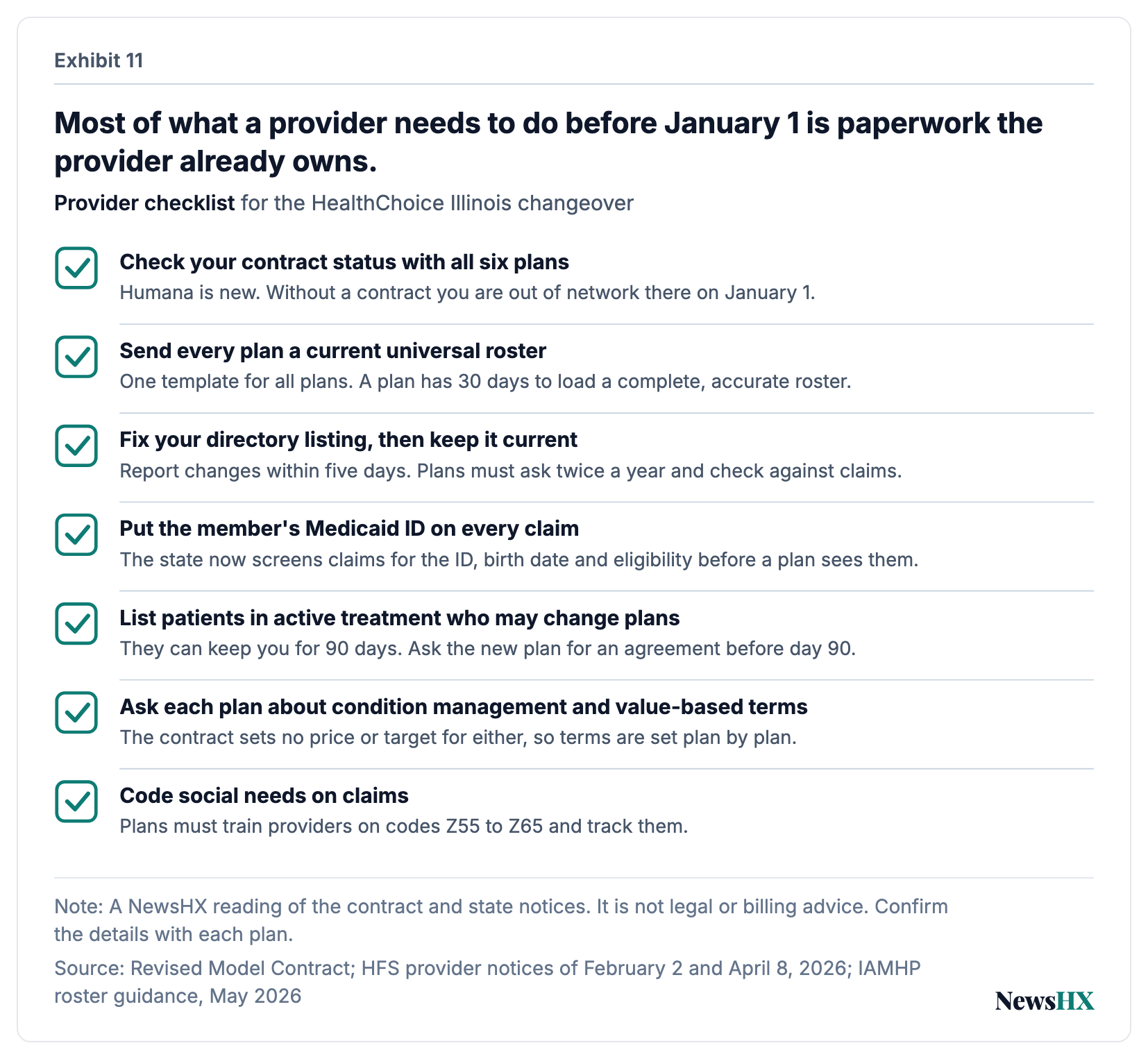
Two additions by setting. Hospitals and post-acute providers should make sure discharge planners know the ride rules and the certification form, learn who will offer medical respite in their area once providers can enroll in early 2027, and keep a list of patients whose stay or authorization will cross January 1.2,16 Community organizations should ask each plan who runs condition management and social needs referrals, and watch for provider enrollment for housing supports and for the state's referral system.2,17,20
And for everyone: when something breaks, say so in writing. The contract requires each plan to staff a provider call center from 8 a.m. to 8 p.m. on business days, and HFS keeps its own complaint portal for claim disputes a plan does not resolve.2
What the contract does not settle
A contract is a list of promises. Three things will decide how much of this providers feel. Rates are set separately and are not in this text. Enforcement depends on the state: the proposed budget adds 38 positions at HFS across medical programs, eligibility, grants and federal compliance, and the contract gives the agency sanctions to use.2,19 And several pieces are not built yet, including the referral system and most of the social needs services.16
The direction is clear enough to plan around. The state is asking plans for networks that are closer and real, coordinators with time for the people who need them, and a changeover that does not interrupt care. Each of those depends on providers doing a small, dull thing well: a current roster, a clean claim, and a list of the patients who cannot afford a gap.
Disclosure: I am Vice President at Entera Healthcare, a home health and hospice organization that works with Medicaid health plans. The views here are my own and not Entera's.
This article describes public documents as read on November 18, 2026. The 2027 contract terms come from the model contract published with the state's request for proposals, and signed contracts may differ. It is not legal, billing or clinical advice.
Getting a practice or agency ready for January 1
A3HCS helps provider organizations turn Medicaid contract changes into contracting, roster and workflow plans.
References
- Illinois Department of Healthcare and Family Services. "HFS Awards New HealthChoice Illinois Medicaid Managed Care Contracts." Press release, June 15, 2026. illinois.gov
- Illinois Department of Healthcare and Family Services. Revised Appendix A, Model Contract for Federally Funded Managed Care Services, HealthChoice Illinois, revised October 30, 2025. Addendum 1 to bid 26-478HFS-MEDPR-B-49167, Illinois BidBuy. Sections 1.2.2, 1.2.3, 1.2.10, 1.2.11, 1.2.12, 1.2.15, 1.2.18, 1.2.22, 1.2.25, 1.2.26, 1.2.29 and 1.2.32. bidbuy.illinois.gov
- Illinois Department of Healthcare and Family Services. HealthChoice Illinois Contract Model Template, August 2025 (the contract in force through December 31, 2026), sections 5.8, 5.17, 5.19 and 5.29. Managed Care Contracts page, accessed November 18, 2026. hfs.illinois.gov
- State of Reform. 2026 Illinois State of Reform Health Policy Conference, detailed agenda, November 17, 2026. stateofreform.com
- State of Illinois, Chief Procurement Office for General Services. Notice of Award, bid 26-478HFS-MEDPR-B-49167, Health Choice Illinois (HCI), signed June 8, 2026. Illinois BidBuy. bidbuy.illinois.gov
- Illinois Department of Healthcare and Family Services. Request for Proposals, HealthChoice Illinois, bid 26-478HFS-MEDPR-B-49167, revised October 30, 2025, sections A.1 to A.6, with rate attachments 17 to 20 for calendar year 2027. Illinois BidBuy. bidbuy.illinois.gov
- Illinois Department of Healthcare and Family Services. Medicaid Managed Care Program Availability. Accessed November 18, 2026. hfs.illinois.gov
- Illinois Department of Healthcare and Family Services. Humana Integrated Care Program Member Plan End Date and Transition Notice, 2017. Listed on the Transition and Expansion Letters page. hfs.illinois.gov
- Illinois Department of Healthcare and Family Services. Medicaid Advisory Committee meeting presentation, August 7, 2026. hfs.illinois.gov
- Illinois Client Enrollment Services. News: "Humana is Here!" and the notice on the MLTSS Duals Specialty Program. Undated, accessed November 18, 2026. enrollhfs.illinois.gov
- 42 CFR 438.68, Network adequacy standards, paragraphs (e), (f) and (h). Electronic Code of Federal Regulations, current as of November 16, 2026. ecfr.gov
- Illinois Department of Healthcare and Family Services. Provider Notice, "Updated Universal Provider Roster for Illinois Medicaid Managed Care Organizations," February 2, 2026. hfs.illinois.gov
- Illinois Association of Medicaid Health Plans. Provider Roster Template FAQs, all plans, updated May 29, 2026. irp.cdn-website.com
- Illinois Association of Medicaid Health Plans. Comprehensive Billing Manual, version 36.0, June 29, 2026. irp.cdn-website.com Provider resources: iamhp.org
- Illinois Department of Healthcare and Family Services. Addendum 1, Vendor Questions and Answers, bid 26-478HFS-MEDPR-B-49167, November 4, 2025. Illinois BidBuy. bidbuy.illinois.gov
- Illinois Department of Healthcare and Family Services. 1115 Waiver: Healthcare Transformation, Annual Public Forum, slides, October 30, 2026. hfs.illinois.gov
- Illinois Department of Healthcare and Family Services. 1115 Waiver Housing Information Session, slides, September 25, 2026. hfs.illinois.gov
- Illinois Department of Healthcare and Family Services. Notice of Funding Opportunity, Social Health Care Network, 3997-20-26-SHCN, June 3, 2026. hfs.illinois.gov
- State of Illinois. Health and Human Services FY27 Budget Presentation, February 18, 2026, slides 24 and 27 (the Governor's proposed budget). hfs.illinois.gov
- Illinois Department of Healthcare and Family Services. Illinois Community Access Resource and Referral System (ICARRS) listening session, slides, August 5, 2026. hfs.illinois.gov
- Illinois Department of Healthcare and Family Services. Provider Notice, "Tailored Care Management Program (TCMP) Webinar," October 29, 2026. hfs.illinois.gov
- Illinois Department of Healthcare and Family Services. Provider Notice, "HealthChoice Illinois (HCI) Managed Care Claim Submission Member Edits," April 8, 2026. hfs.illinois.gov
- 42 CFR 438.242(b)(7) and 438.210(d) and (f), as amended by the CMS Interoperability and Prior Authorization final rule, CMS-0057-F, 89 FR 8758, February 8, 2024. ecfr.gov CMS fact sheet: cms.gov
- 42 CFR 438.62, Continued services to enrollees, paragraph (b). Electronic Code of Federal Regulations. ecfr.gov
- Illinois Managed Care Reform and Patient Rights Act, 215 ILCS 134/25, Transition of services. ilga.gov
- Illinois Department of Healthcare and Family Services. "NEW Changes Coming to Medicaid." Accessed November 18, 2026. hfs.illinois.gov
- Centers for Medicare & Medicaid Services. State Medicaid Director Letter SMD# 26-006, "Optional Hold Harmless Period for Community Engagement Implementation," November 13, 2026. medicaid.gov