


Medicare pays for drugs through two doors, and which door a drug walks through decides almost everything about it: who buys it, what it costs, who carries the risk, and who is allowed to send a bill.
Part D is the pharmacy door. A plan negotiates a price, a formulary decides placement, rebates flow behind it, and the patient pays plan cost sharing. Part B is the clinician door. A provider acquires the drug, administers it, and bills afterward at average sales price plus a statutory add-on. The same molecule can sit on either side depending only on how and where it is given.
Here is the part that should interest anyone planning a service line. We pulled the CMS spending-by-drug files and summed them: Part B drug spending grew 19.7% in 2024, against Part D's 4.7%.1 The clinician-administered side expanded roughly four times faster and took its share of Medicare drug spending from 15.6% to 17.4% in a single year.
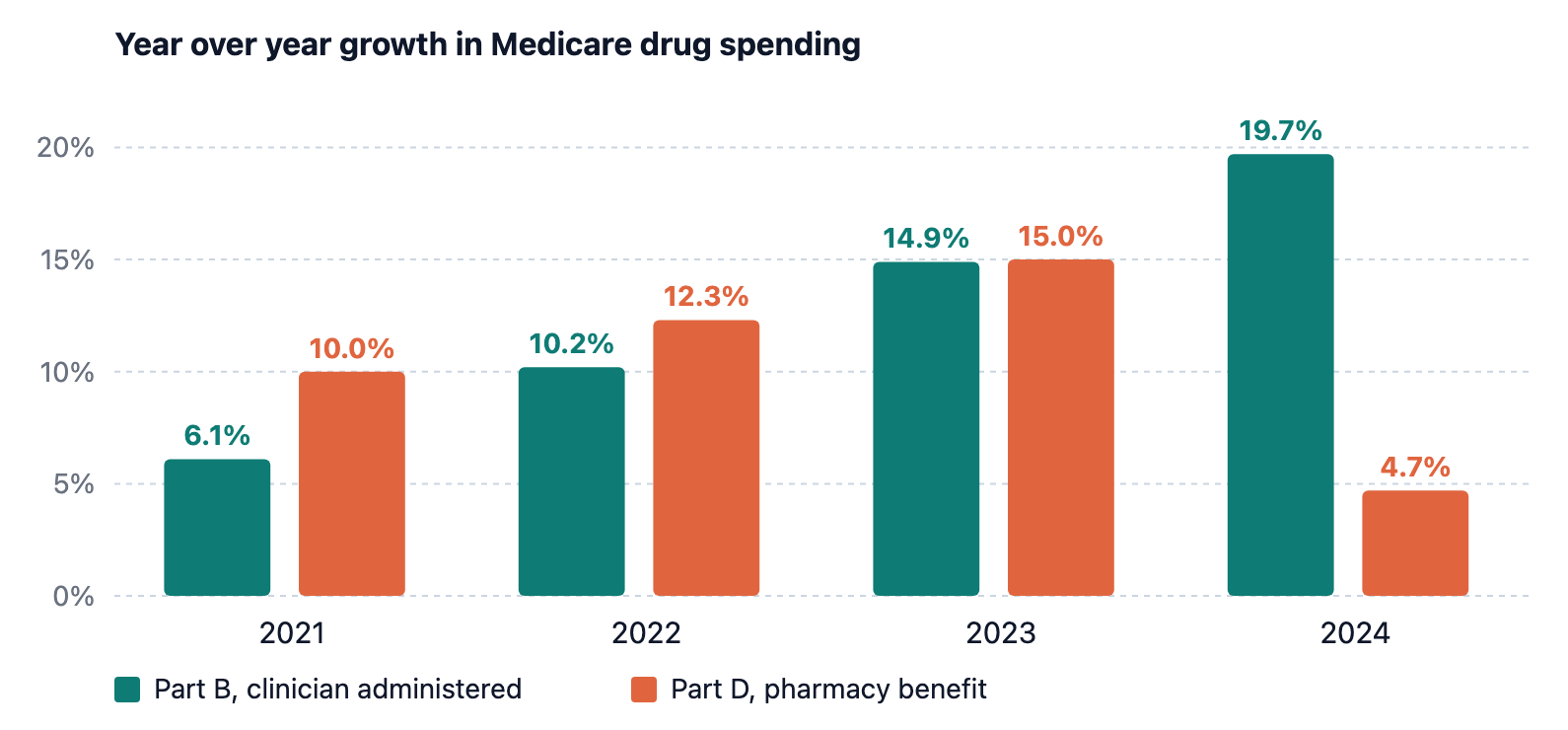
The fastest-growing drug benefit in Medicare pays the person who administers the dose. Pharmacists cannot bill it.
The emergency already ran the experiment
The usual objection to paying pharmacists for clinical services is that nobody knows whether it would work at scale. That objection is unavailable, because the experiment already ran.
During the COVID-19 public health emergency, pharmacists who were trained and licensed to test and treat were able to receive Medicare reimbursement for doing it.2 The House Ways and Means Committee's own summary of the bill puts the volume at more than 42 million COVID-19 tests and over 350 million clinical interventions.2
Then the emergency ended, and so did the authority. The committee states the position plainly: "Medicare does not reimburse pharmacists for testing and treatment services outside of a PHE."2
That sequence is the whole argument in miniature. The capacity exists and has been demonstrated at national scale. The payment pathway existed and was switched off, not because it failed but because the legal instrument that created it was temporary.
What the bill actually does, which is narrower than its name
H.R. 3164 would provide Medicare reimbursement for pharmacist-administered testing and treatment for strep throat, influenza, COVID-19 and RSV, plus certain services during a declared public health emergency.2 It is sponsored by Rep. Adrian Smith (R-NE) and Rep. Brad Schneider (D-IL), with a Senate companion at S. 2426.2,3 The House Ways and Means Committee ordered it reported on May 21, 2026.3
Two details in that sentence deserve more weight than they usually get.
First, the coverage is conditioned on state law. The committee is explicit that "Medicare reimbursement is subject to state law regarding scope of practice, supervision, and collaboration with other providers."2 Medicare would not be defining what a pharmacist may do. It would be agreeing to pay for whatever each state has already decided a pharmacist may do. That makes the practical reach of a federal bill a function of fifty separate state answers, which is a very different thing from a national standard.
Second, this is a service carve-out, not provider status, and the trade press has not settled on which it is. Some coverage describes the bill as writing pharmacists into the Social Security Act as billable Part B providers. Other coverage describes it as explicitly not granting provider status and calls it a stepping stone. Both readings are circulating.4
A carve-out buys access to four diagnoses. Provider status would buy a seat in the benefit category that is growing 19.7% a year.
The committee's own description resolves it. The bill expands reimbursement for a named list of conditions, not for pharmacists as a category of practitioner. Add a fifth infection next year and you need another bill. That is the signature of a carve-out, and it is why the distinction is not pedantry.
The bill has two names, and the newer one is the tell
Congress.gov lists H.R. 3164 as the Ensuring Community Access to Pharmacist Services Act. The Ways and Means Committee calls the same bill the Main Street Pharmacy Access Act.3 The rename happened around the markup.
Renaming a bill from what it does to where it happens is a familiar move, and it is usually a signal about the intended audience. "Ensuring community access to pharmacist services" is an argument addressed to health policy. "Main Street" is an argument addressed to a district. The second framing travels further with members who are not on a health committee, which matters for a bill that still has to clear a second committee.
The evidence in the committee packet is advocacy, and should be read that way
The one-pager supporting the bill carries figures worth looking at directly, because some are structural facts and others are modeled claims.
Start with the one that comes from the government rather than from the sponsor. HRSA's own quarterly summary puts 108.6 million people in primary care health professional shortage areas as of July 1, 2026, against the 92 million the committee cites, which is HRSA's December 2025 count.5 The number has grown by 16 million in seven months, and it is the strongest fact in the packet.5
The other two are the committee's. Nearly 70% of rural counties carry a shortage designation, and nearly 90% of Americans live within five miles of a pharmacy.2 That second figure is a National Association of Chain Drug Stores estimate, and NACDS publishes no method for it; its own wording has moved between 90%, nearly 90%, and more than 90% across releases.6 Read it as the industry's own number. The shortage figure is the government's, and it carries the argument on its own: a shortage of clinicians is a geography problem, and pharmacies are the one clinical footprint already distributed where the shortage is.
Then there are the outcome claims. The same document states that pharmacist action during the emergency "prevented more than 1 million deaths and more than 8 million hospitalizations and saved over $450 billion in health care costs."2
Those are modeled estimates presented without their models. They may well be defensible, and this article does not assert they are wrong. But a number that large, attributed to a single professional group, in a document whose purpose is to advance a bill, is advocacy evidence. It belongs in the record as the sponsor's framing rather than as an established finding, and a clinical audience should be told which is which.
Where this lands on the continuum
For readers who work in post-acute and home health, the relevant question is not what happens at a retail counter. It is where the patient enters the system.
Influenza and RSV are not minor events in an older population, and the window in which treatment changes the trajectory is short. The current structure routes a Medicare patient with a new respiratory infection toward a clinician who can bill, which in a shortage area frequently means an urgent care visit, an emergency department, or a wait. The pharmacy that is five miles away and open can test but cannot be paid to treat.
That is a site-of-care question, and it is the same question this publication keeps running into from different directions. The DME algorithm decides which vendor delivers the oxygen. The hospice benefit decides which setting the last fourteen days happen in. Here, a reimbursement rule decides whether a treatable respiratory infection gets caught at a counter or at a triage desk. In each case the clinical facts are not in dispute and the payment structure is doing the allocating.
What to watch, and what has not happened
H.R. 3164 was ordered to be reported by the Ways and Means Committee on May 21, 2026. It carries a dual referral, which means the Energy and Commerce Committee also has jurisdiction and has not acted.3 There has been no House floor vote.3
A bill that clears one of two committees in May and has not moved by October is not dead, but it is not moving either. The specific thing to watch is Energy and Commerce, not the floor. The second is whether the list of four conditions stays four. A carve-out that grows by amendment is a different bill than the one reported in May, and one that shrinks is a signal that the structural objection won.
The structural objection, for the record, is the one worth arguing about. Nobody seriously disputes that a pharmacist can run a strep test. The question is whether Medicare's clinician-administered benefit, the one growing 19.7% a year, should keep deciding who may bill it by listing professions rather than by listing competencies.
Payment structure decides who can act
A3HCS works with health systems and post-acute operators on where benefit design, site of care and clinical capability actually meet.
References
- Centers for Medicare & Medicaid Services. Medicare Part B Spending by Drug and Medicare Part D Spending by Drug, data year 2024. Retrieved from the CMS data API, October 17, 2026. Totals are NewsHX calculations: CMS publishes these as spending-by-drug files rather than program totals. Part B is one row per HCPCS code and sums directly. Part D lists each drug once per manufacturer and once as an “Overall” row, so only the “Overall” rows are summed. Part D figures are gross drug cost before manufacturer rebates; Part B figures include beneficiary liability. data.cms.gov
- U.S. House Committee on Ways and Means. H.R. 3164, Main Street Pharmacy Access Act one-pager. May 2026. waysandmeans.house.gov
- Congress.gov. H.R. 3164, 119th Congress, listed as Ensuring Community Access to Pharmacist Services Act. Latest action: House, 05/21/2026, ordered to be reported in the nature of a substitute by voice vote. Referred to the Committee on Energy and Commerce and the Committee on Ways and Means. congress.gov
- U.S. Health Resources and Services Administration. Designated Health Professional Shortage Areas Quarterly Summary, primary care, July 1, 2026, and State of the Primary Care Workforce, 2025 (December 2, 2025 count, 8,466 designations, 92 million people). The committee one-pager cites the December 2025 figure. bhw.hrsa.gov
- National Association of Chain Drug Stores. Five-mile pharmacy proximity estimate, as restated in NACDS releases including National Nutrition Month, March 2026 (“nearly 90 percent”). NACDS publishes no methodology for the figure, and its wording varies across releases between 90%, nearly 90%, and more than 90%. Cited as an industry estimate, not as a verified statistic. nacds.org
- Trade coverage of the bill, including Drug Topics, “How the Main Street Pharmacy Access Act Advances Pharmacist Provider Status,” and legal commentary characterizing the bill as not granting provider status. Cited to document that the two readings coexist, not to endorse either.