

On November 17, I sat in a breakout session at the Illinois State of Reform Health Policy Conference in Chicago called Implementing Rural Health Transformation: Achieving Behavioral Health & Primary Care Integration in Rural Communities.1 The published agenda listed the state's program director and leaders of three of the organizations that pass the money down to providers.1 The program is moving fast, the rules are unusual, and most rural providers I talk to are hearing about it in pieces.
This guide puts the pieces in one place. It uses only public documents: the law, the federal funding notice, the state's application and briefings, and the notices each organization published. I do not quote the session. It covers what the money is, who can get it, through whom, by when, and what it cannot do.
What the money is
The Rural Health Transformation Program was created by section 71401 of Public Law 119-21, the budget law also called HR 1, signed on July 4, 2025.2 It gives $10 billion a year for federal fiscal years 2026 through 2030, $50 billion in all, to the Centers for Medicare & Medicaid Services (CMS), the federal agency that runs Medicare and Medicaid.2 Only the 50 states can receive it, and a state does not have to put up matching money.2
Half of each year's $10 billion is split equally, which comes to $100 million per state per year. The other half is scored.2,3 Part of the score comes from fixed facts about a state's rural population and facilities and is calculated once. The rest comes from the state's plan and policy choices, and CMS recalculates it every year from the state's progress reports.4
CMS released the funding notice on September 15, 2025, and applications were due November 5.5,4 On December 29, 2025, it announced awards to all 50 states, from $147 million to $281 million.6 Illinois received $193,418,216.6 On November 9, 2026, CMS announced year two. Illinois received $190,458,454, about $3.0 million less.7 CMS says a state's award "may increase, decrease, or remain similar" from year to year and that year two awards reflect, in part, each state's progress on its plan.3,7 It has not published a reason for the change in Illinois.
How Illinois set it up
The lead agency is the Illinois Department of Healthcare and Family Services (HFS), the state's Medicaid agency.8 HFS reports that before it applied it held more than 38 stakeholder meetings and a public listening session with nearly 300 attendees, and received more than 120 written comments.8
The design has 3 goals, 8 initiatives and 12 funding strategies. The goals are to transform rural healthcare, overcome geographic barriers to care, and build a resilient workforce.5
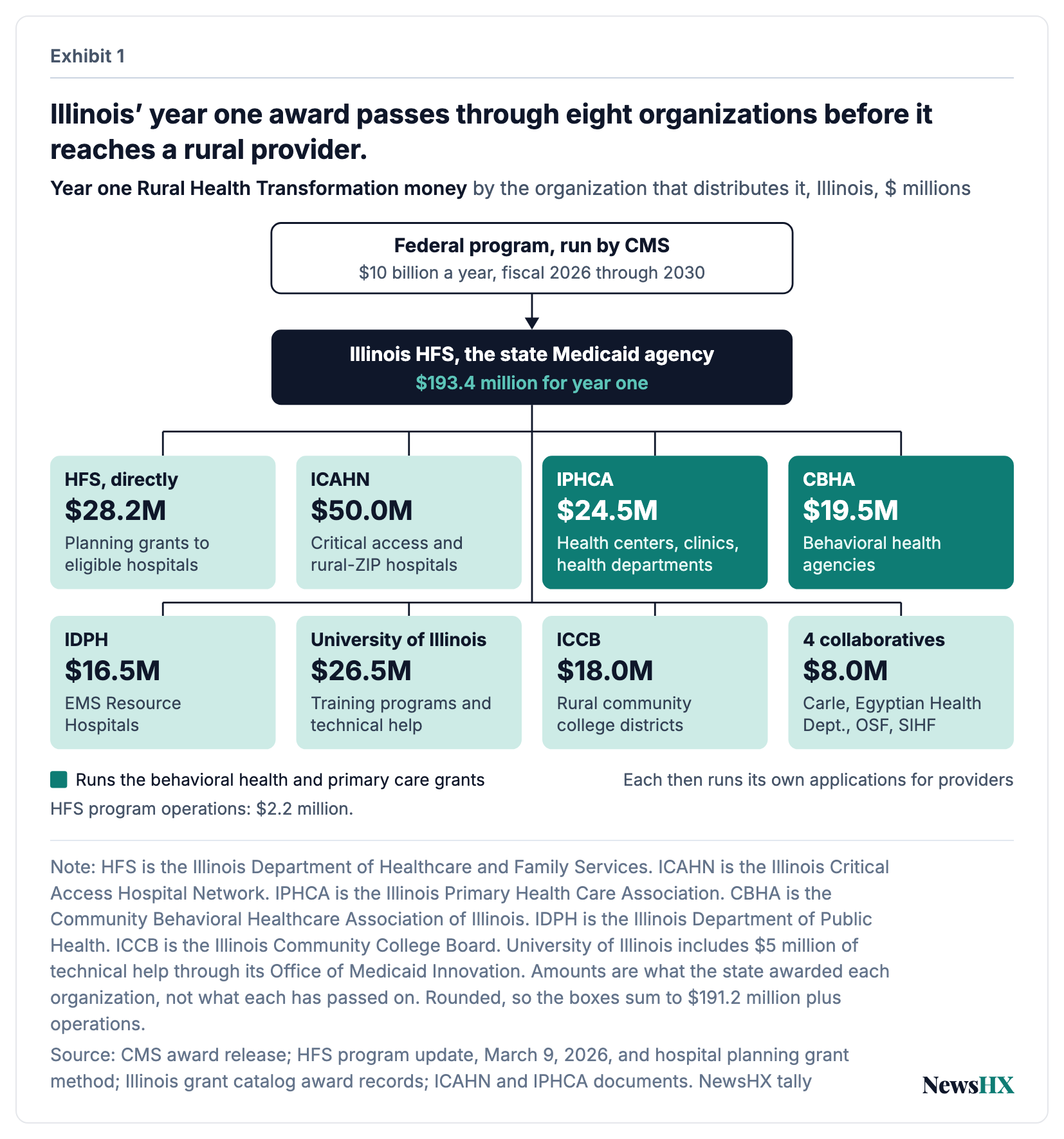
HFS runs one piece itself, the hospital transformation grants. Almost everything else goes first to an organization that already works with one kind of provider, and that organization runs its own application process. State documents call these organizations intermediaries or subrecipients.9,10 The application explains the choice one initiative at a time. For primary care and behavioral health, the two associations are to "develop mechanisms to efficiently distribute funds" to their providers and set up reporting and oversight.10 The state's grant catalog adds that these awards were not competed, because the organizations were named in the federal award.11
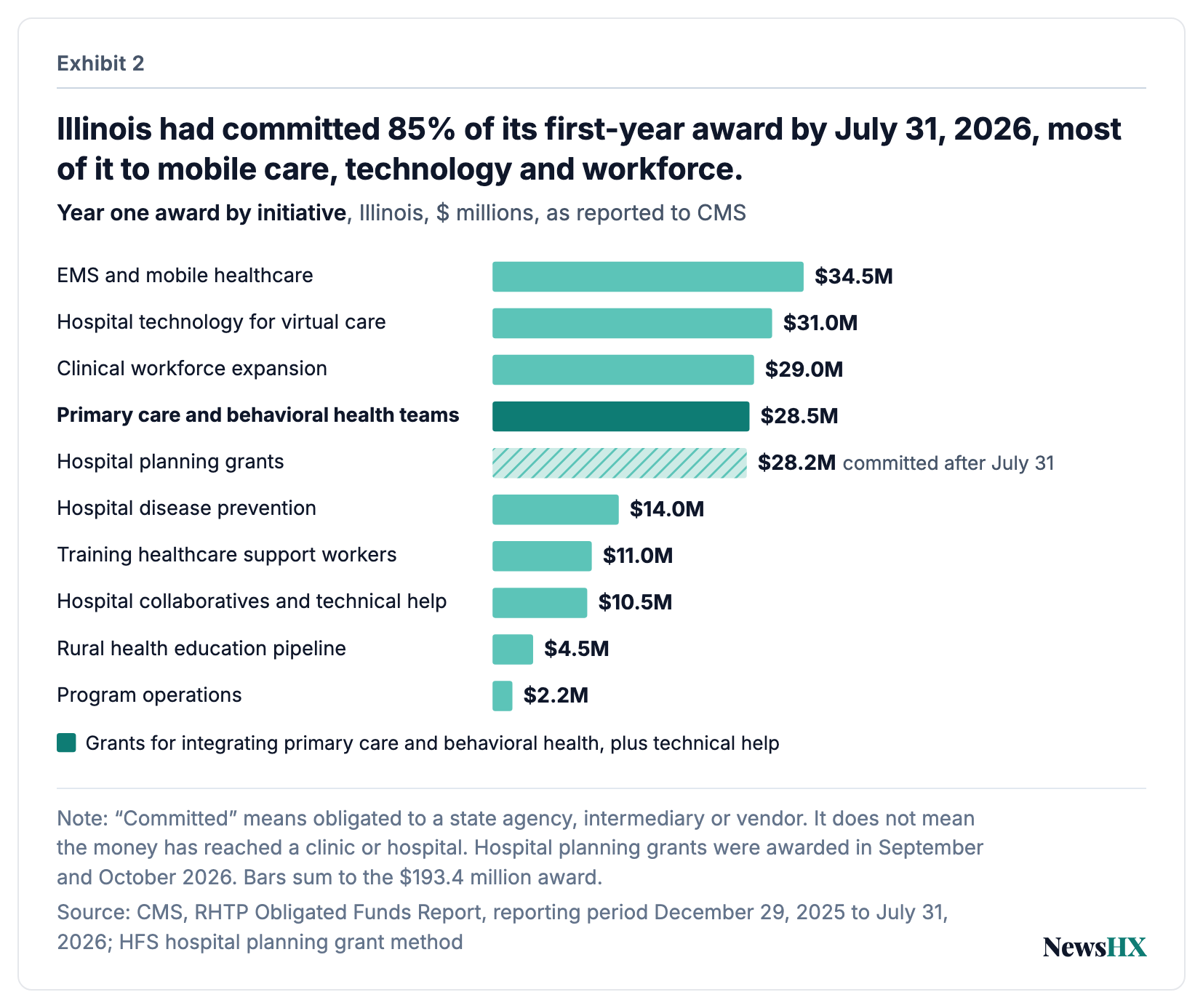
By July 31, 2026, CMS's public report showed Illinois had put $165.2 million of its $193.4 million to work, about 85%.12 By my count from the same report, that was the ninth highest share among the states. Read the word carefully. Here it means committed to a state agency, an intermediary or a vendor. It does not mean the money has reached a clinic.12 Most provider-level awards came after that date or are still pending.
Who can apply for what
There is no single application. Which door you use depends on what kind of organization you are.
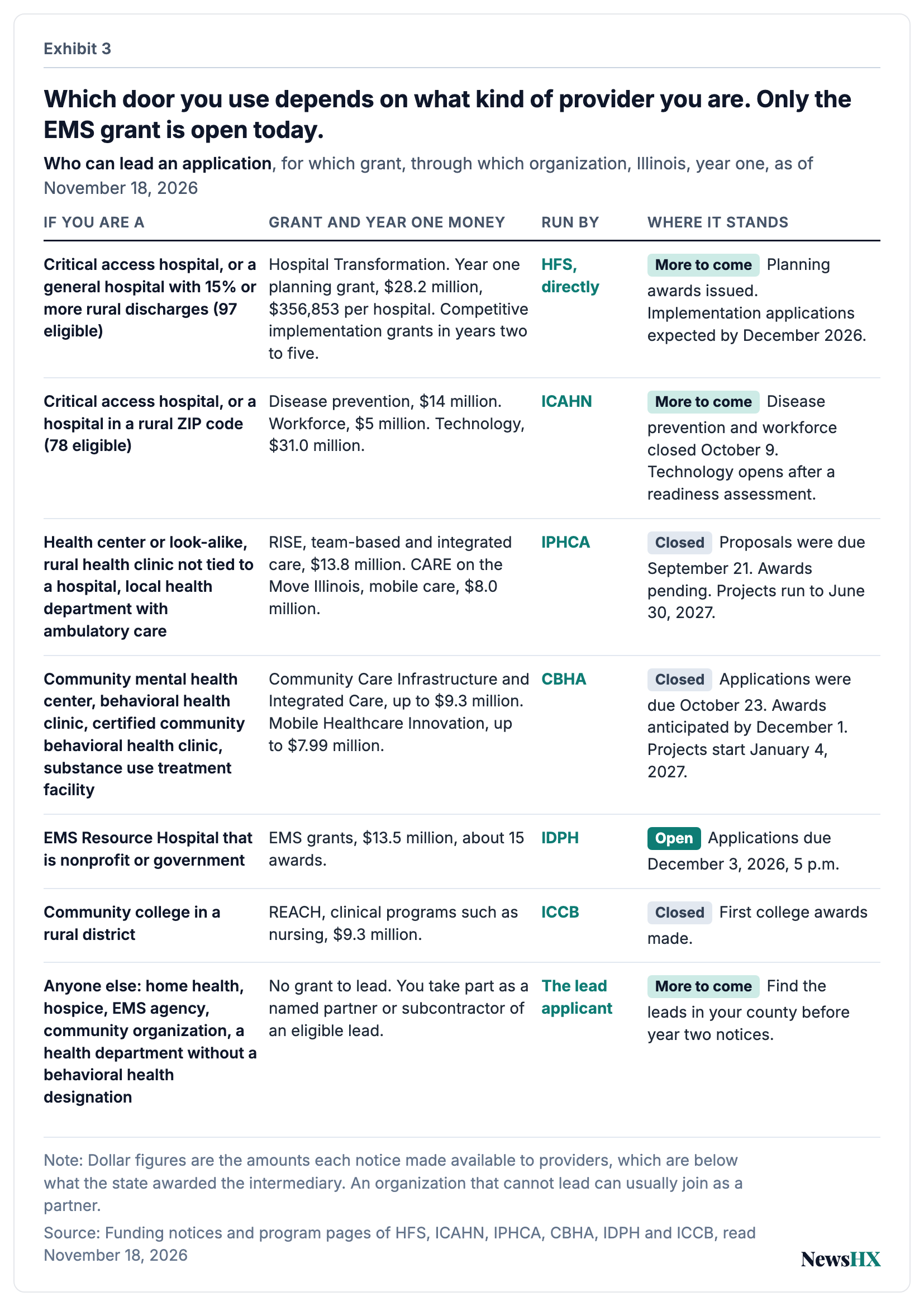
Hospitals. The Hospital Transformation grant is run by HFS directly. Year one is a planning grant. Years two through five are competitive implementation grants, budgeted at $44 million, $52 million, $48 million and $48 million, all contingent on federal funding.5 Eligibility is wider than the phrase "rural hospital" suggests. It covers every critical access hospital, the small rural hospitals that Medicare pays on a cost basis, plus any general hospital where at least 15% of discharges over three years were rural residents. That makes 97 of Illinois' 198 hospitals eligible, including 23 outside rural ZIP codes.13 The year one pool of $28,191,393 is split equally, and HFS set each hospital's award at $356,853.13,14 That works out to 79 equal shares, which is my arithmetic and not a figure HFS has printed. HFS told hospitals it expects applications for the implementation grants by December 2026.9
Separately, the Illinois Critical Access Hospital Network (ICAHN) signed three agreements with HFS totaling $50,008,264: $31.0 million for technology, $14 million for disease prevention and chronic disease programs, and $5 million for workforce.15 ICAHN says 78 hospitals are eligible.16 Applications for the disease prevention and workforce grants opened September 28 and closed October 9, 2026.16 The technology money comes later. ICAHN is choosing a vendor to assess the digital readiness of all 78 hospitals, and hospitals will apply based on their assessment.16
Health centers, rural health clinics and health departments. The Illinois Primary Health Care Association (IPHCA) runs two grants. RISE, short for Rural Integration and Systems Enhancement, has $13.8 million for team-based, integrated care. It is open to federally qualified health centers (FQHCs, the community clinics that receive federal health center funding), look-alikes, rural health clinics not associated with a hospital, and local health departments that provide ambulatory care.17 Whether a site counts as rural is checked with the federal Rural Health Grants Eligibility Analyzer.17 Awardees must connect their electronic health record to a shared data platform and report measures that include depression screening, blood pressure control, diabetes control, and breast and colorectal cancer screening.17 The second grant, CARE on the Move Illinois, has $8.0 million for mobile care, including vehicles, equipment and staffing.18 Proposals for both were due September 21, 2026, and projects run from November 1, 2026 through June 30, 2027.17,18 IPHCA estimated about 40 RISE awards and 20 CARE awards. No list of awardees was posted as of November 18.
Behavioral health. The Community Behavioral Healthcare Association of Illinois (CBHA) runs the behavioral health side, also as two grants.19 Community Care Infrastructure and Integrated Care has up to $9.3 million in year one. Mobile Healthcare Innovation, which includes mobile crisis response, has up to $7.99 million.19 Only four kinds of organization can lead an application: a community mental health center, a behavioral health clinic, a certified community behavioral health clinic (CCBHC), or a substance use treatment facility licensed or certified by the state.20 Everyone else, including a hospital, a health center or a health department without one of those designations, comes in as a partner. The integrated care grant expects partnerships. The mobile grant encourages them.21,20 Applicants can be nonprofit or for-profit, and they must be qualified to do business with the State of Illinois and registered in the state and federal grant systems.20
The mobile grant names the people it is meant to reach: people in a behavioral health crisis who would otherwise rely on an emergency department or law enforcement, people with serious mental illness or co-occurring substance use disorders, children and families, and people involved with the justice system.20 CBHA anticipates 30 to 40 integrated care awards and 15 to 30 mobile awards, most between $200,000 and $1 million.21,20 Applications closed October 23. Awards are anticipated by December 1, 2026, and applicants must be ready to start January 4, 2027.20
EMS and workforce. One grant is still open. The Illinois Department of Public Health (IDPH) posted $13.5 million for emergency medical services (EMS) on November 2, 2026. It is limited to state-designated EMS Resource Hospitals that are nonprofit or government entities, with about 15 awards. Applications are due December 3, 2026.22 Workforce money runs through the University of Illinois and the Illinois Community College Board (ICCB), which has its own grants to rural community college districts for programs such as nursing and respiratory care.5,23 The law ties clinician recruitment money to a commitment to serve a rural community for at least five years.2
The clock
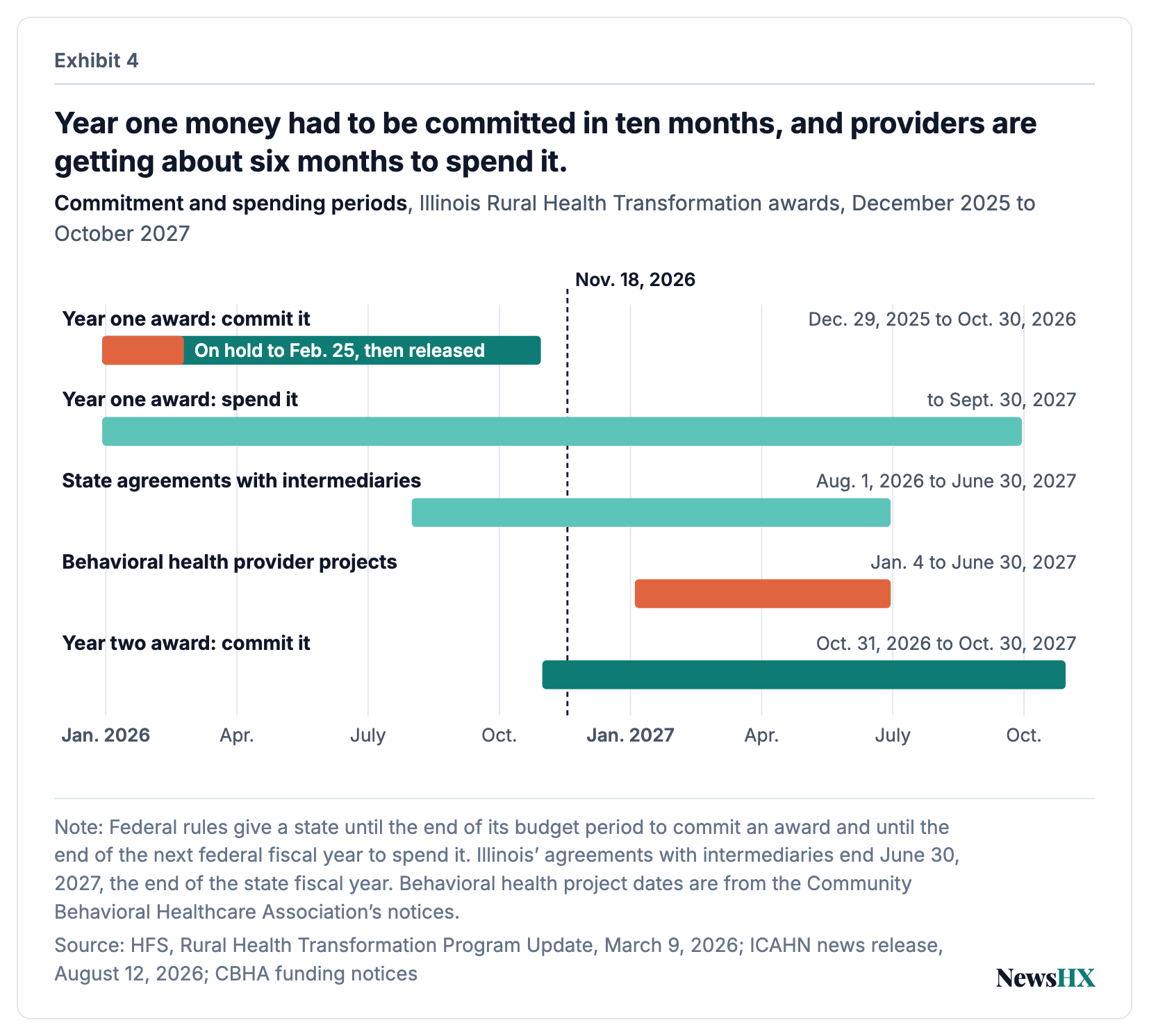
Two federal deadlines sit on every dollar. Each year's award must be committed within that year's budget period, and spent by the end of the following federal fiscal year.5,3 For year one, that meant commit by October 30, 2026, and spend by September 30, 2027.5 Money a state does not spend in time can be taken back and redistributed to other states.2,4
Year one was shorter than it looks. The award came on December 29, 2025. CMS held Illinois' funds until it accepted a revised budget, and released them on February 25, 2026.5 The agreements with ICAHN took effect on August 1.15 So the first provider awards are arriving in the fall of 2026 with a state end date of June 30, 2027.15,20 CBHA's notice says it plainly: year one funds must be spent by June 30, 2027, and costs from before the award start date cannot be charged.20 For a behavioral health agency that starts on January 4, that is under six months to hire, buy a vehicle and begin.
The Government Accountability Office (GAO), the audit agency of Congress, reviewed the program in October 2026. It found CMS's monitoring plans generally consistent with federal grant requirements and said it was too early to judge results. Groups it met with raised concerns about the limited time states had to show progress.24
What the money cannot do
The federal notice lists what is off limits, and the Illinois notices repeat it.4,20
It cannot replace other funding. The notice bars "supplanting" existing state, local or private funding of infrastructure or services, and gives staff salaries as the example.4 CMS repeated in November 2026 that the money may not supplant existing government funding sources or programs.3
It cannot pay for billable care. Funds cannot replace payment for clinical services that insurance, including Medicaid, could reimburse.4,20 Payments to providers for care are capped at 15% of a state's award and must fill a gap that is not otherwise covered.4
It cannot build. New construction is not allowed. Renovation and equipment fall under a cap of 20% of a state's award.4
It cannot pay the state's share of Medicaid, and a state can use no more than 10% for administration.2
And it ends. The law provides money through fiscal 2030. Anything unspent on October 1, 2032 goes back to the Treasury.2
What is left is start-up money: vehicles, technology, training, workflows and planning. The state's answer to what comes after is payment reform. Its application says the approach to value-based payment in Medicaid will be final by the end of the five years.10 CBHA's notice says HFS anticipates added funds in years four and five to support that shift.21
Why behavioral health and primary care together
The strongest evidence is for one model. In collaborative care, the patient stays with their own primary care clinician. A behavioral health care manager keeps every enrolled patient on a registry, checks symptoms with a standard rating scale, and follows up. A psychiatric consultant reviews the caseload with the care manager every week and advises on patients who are not improving.25
A Cochrane review pooled 79 randomized trials with 24,308 participants. It found better depression and anxiety outcomes than usual care in the short, medium and long term, though not in the very long term.26 In the largest single trial, 45% of older adults in collaborative care had their depression symptoms cut by half or more at 12 months, against 19% in usual care.27
The rural evidence adds a warning. In a trial in rural federally qualified health centers, an off-site team working by phone and video did far better than the same model run by on-site staff alone. The authors traced the difference to how faithfully the model was delivered.28 And when Minnesota spread collaborative care to 75 clinics with a new monthly payment and training, depression remission was no better than usual care.29 Buying the parts is not the same as running the model.
Mobile crisis teams rest on thinner evidence. A systematic review published in December 2025 found nine eligible US studies since 2000 and called the support "tentative."30
One point matters for grant budgets. Collaborative care is already billable. Illinois Medicaid has covered it since July 1, 2022, including at health centers and rural health clinics, and Medicare changed how those clinics bill for it on January 1, 2026.31,32 Since the grant cannot pay for billable care, my reading is that the fundable part is what the billing codes do not cover: the registry, the data connection, training, workflow design, a vehicle, and the months before a program has enough patients to carry a care manager's salary.
The rural baseline
Illinois' application puts the rural population at about 1.9 million people, roughly 15% of the state. It uses the federal definition by census tract, which reaches into 85 of 102 counties.8,10
Hospitals. Illinois has 56 critical access hospitals. Five converted since 2022, the latest in February 2026, which is why the state's own program documents count 55.33,34,13 The Center for Healthcare Quality and Payment Reform, a nonprofit policy center, counts 79 rural hospitals with inpatient care in Illinois. It estimates that 24 lose money on patient services, 15 are at risk of closing and 8 are at immediate risk.35 The state's application cites nine hospitals at risk of closure and four rural hospital closures since 2005.10
Services. Five rural labor and delivery units in Illinois have closed since 2020, and 59 rural hospitals have none.36 HFS says 34% of Illinois counties have no obstetric service.8
Behavioral health workforce. Rural Illinois counties have 4.9 psychiatrists per 100,000 people. Urban counties have 19.6.37 Illinois has 245 federally designated mental health shortage areas, where 21% of the estimated need is met.38
Revenue. Outpatient services bring in 77.8% of net revenue at Illinois rural hospitals, against 51.4% at urban ones. Medicare and Medicaid are the primary payers for 74.7% of inpatients at small and rural hospitals. Both figures are from the state hospital association.34
What it does not replace
KFF, a nonpartisan health policy research organization, estimates that the Medicaid provisions of the same law will reduce federal Medicaid spending in rural areas by $137 billion over ten years. The fund is $50 billion over five.39 KFF's figure for rural Illinois is $6.36 billion.39 The fund has awarded Illinois $384 million in two years.6,7 If the next three awards each matched year two, the five-year total would be about $950 million. That is my arithmetic, and later awards are not guaranteed.
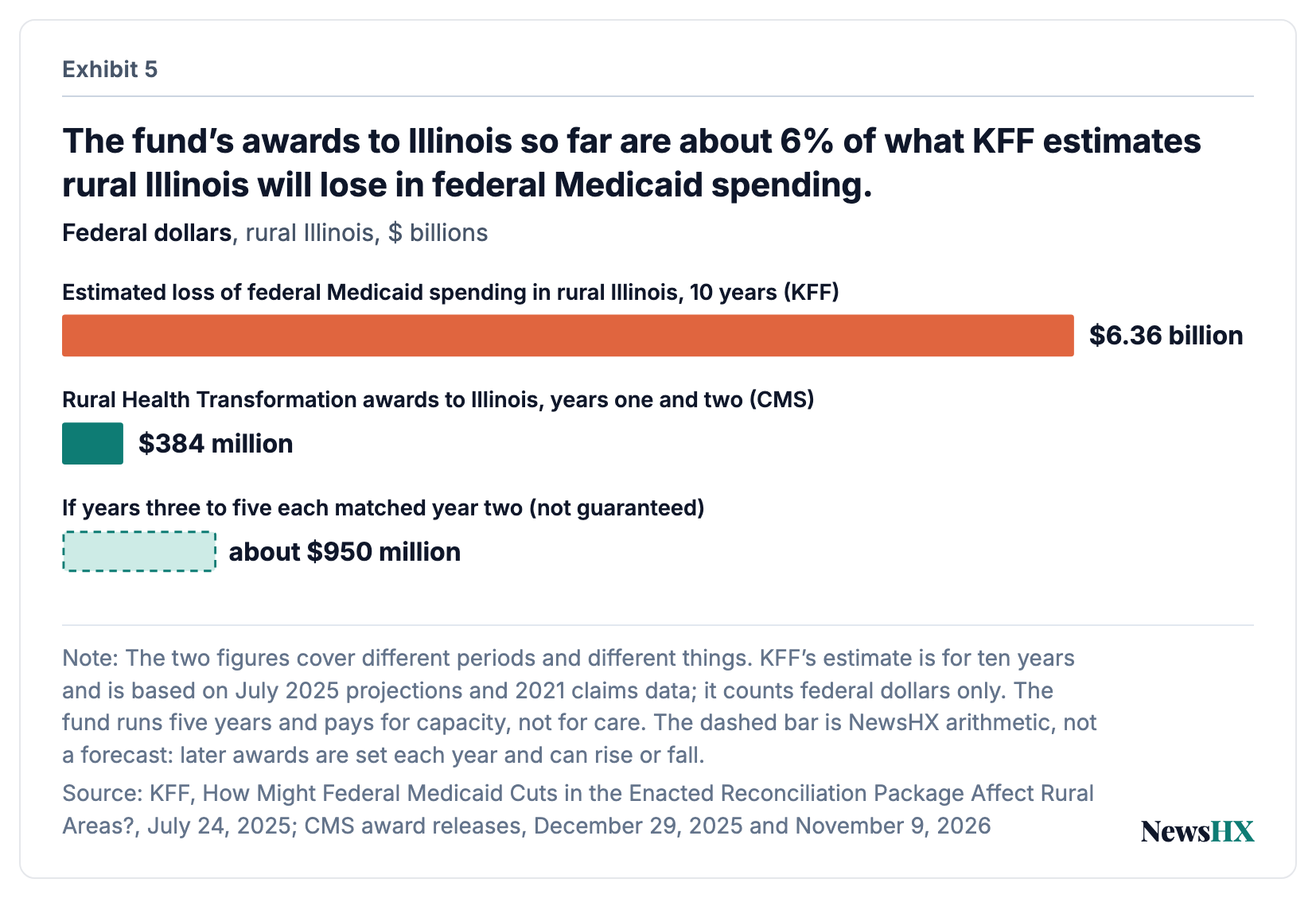
KFF states its own limits. It uses 2021 claims data to estimate the rural share, it counts federal dollars only, and it does not predict how states will respond.39 The two numbers also measure different things. The fund buys capacity. Medicaid pays for care. One cannot stand in for the other, which is the point of the rule against supplanting.
The state has said as much in print. Its announcement of the award said the money "will be far from enough to counteract the cuts" to Medicaid in the same law.40
There is one question I could not answer from any published document: what happens to a grant if a rural hospital closes during the five years. The application says hospital grants will give priority to partnerships with distressed hospitals.10 The fiscal 2027 state budget separately includes $85 million for a new Distressed Hospital Loan Program.41 Neither is a closure plan. A hospital that is losing money now should read this grant as help building the next model, and plan its cash separately.
How three other states did it
Of the states I compared, Illinois is the one that leans on statewide associations. Wisconsin runs mostly state-run competitive grants from its health department, with sub-awards to other state agencies and technical colleges. It had committed 37% of year one by July 31.42,12 Missouri, also led by its Medicaid agency, built 27 local hubs, each led by an anchor organization, and paid a vendor to distribute the funds. It had committed 49%.43,12 Texas, with the largest award at $281 million, planned sub-awards straight from its state health agency to rural providers, and had committed 19%.44,12
Illinois, at 85%, moved money out of the state agency faster than all three. Whether it reaches patients faster is not yet knowable. CMS's report does not show what intermediaries have passed on, and CMS says these figures do not, by themselves, measure a state's progress.12,3
Where to track the money
The official word on every Illinois grant is the HFS program page and the notice from the organization running that grant.8 Three free trackers make it easier to watch for what comes next. Read each one as a lead, and confirm dates and status against the notice itself.
Rural Care Journey follows funding opportunities and awards state by state and says it updates daily from public sources. Its Illinois page listed 14 items on November 23, 2026, including both federal awards. It is run by AME Mobile, a company that describes its work as mobile and technology-enabled care, and the site also offers paid subscriptions and a vendor matching service.45
KFF Health News collects the plans and other public documents that states have released, in one place, updated November 19, 2026. It is the quickest way to read another state's plan next to Illinois'. It links to documents, not to grant deadlines.46
The National Rural Health Association keeps a state-by-state table of funding opportunities, with open, due and award dates for each. Its page said it was last updated in May 2026, so check any date there against the state.47
What to do now
If you run an EMS Resource Hospital, the IDPH application closes December 3, 2026.22
If you applied through CBHA, IPHCA or ICAHN, decisions are due within weeks. Have hiring, purchasing and partner agreements ready to sign, because the state end date for year one is June 30, 2027.20,15
If your hospital has a planning grant, the implementation application is the real competition. HFS expects it by December 2026.9 The purpose HFS gives for those grants is to reshape and right-size hospital services and test value-based payment models.5
If you cannot lead an application, your way in is as a named partner. That applies to most local health departments on the behavioral health grants, and to home health, hospice and community organizations on all of them. Find the eligible leads in your county before the year two notices come out.
Everyone: finish the state grant pre-qualification under the Grant Accountability and Transparency Act (GATA) and your federal SAM.gov registration now. CBHA's notice says it may not make an award until both are complete.20
The money is real, the clock is short, and it stops after 2030. What lasts is what a provider can keep paying for once the grant is gone: a billing workflow that works, a partner that answers the phone, and a team that stays.
Disclosure: I am the founder of A3HCS, a consulting firm that advises community and rural hospitals under financial pressure, including hospitals that may be eligible for the grants described here.
This article describes public documents as read on November 18, 2026. Grant terms and dates change; check each funding notice before you act. It is not legal, billing or grant-writing advice.
A grant is not a margin
A3HCS helps community and rural hospitals turn one-time grant dollars into service lines and partnerships that still pay for themselves after the grant ends.
References
- State of Reform. 2026 Illinois State of Reform Health Policy Conference, detailed agenda, November 17, 2026. stateofreform.com
- Public Law 119-21, section 71401, Rural Health Transformation Program. 139 Stat. 327 to 332, July 4, 2025, adding 42 U.S.C. 1397ee(h). govinfo.gov
- Centers for Medicare & Medicaid Services. Rural Health Transformation Program: Year 2 Awards. Fact sheet, November 9, 2026. cms.gov
- Centers for Medicare & Medicaid Services. Rural Health Transformation Program, Notice of Funding Opportunity CMS-RHT-26-001. September 2025. grants.gov
- Illinois Department of Healthcare and Family Services. Rural Health Transformation Program Update. March 9, 2026. hfs.illinois.gov
- Centers for Medicare & Medicaid Services. CMS Announces $50 Billion in Awards to Strengthen Rural Health in All 50 States. Press release, December 29, 2025. cms.gov
- Centers for Medicare & Medicaid Services. Trump Administration Announces $10 Billion in Second Year of Rural Health Transformation Awards to All 50 States. Press release, November 9, 2026. cms.gov
- Illinois Department of Healthcare and Family Services. Rural Health Transformation Program. Web page, read November 18, 2026. hfs.illinois.gov
- Illinois Department of Healthcare and Family Services. RHTP Hospital Planning Grant Town Hall. Slides, June 10, 2026. hfs.illinois.gov
- Illinois Department of Healthcare and Family Services. Rural Health Transformation Application, Project Narrative. November 2025. hfs.illinois.gov
- Illinois Governor's Office of Management and Budget. Catalog of State Financial Assistance, Rural Health Transformation programs 478-00-3950 and 478-00-3979 through 478-00-3987, program pages and award lists. Read November 18, 2026. omb.illinois.gov
- Centers for Medicare & Medicaid Services. RHTP Obligated Funds Report, reporting period December 29, 2025 to July 31, 2026. medicaid.gov
- Illinois Department of Healthcare and Family Services. Rural Health Transformation Program Hospital Planning Grant, Appendix A: Eligibility Criteria and Rurality Threshold Methodology and Eligible Hospitals. 2026. hfs.illinois.gov
- Illinois Department of Healthcare and Family Services. RHTP Hospital Planning Grant Town Hall. Slides, July 24, 2026. hfs.illinois.gov
- Illinois Critical Access Hospital Network. ICAHN Awarded More Than $50 Million by the State of Illinois to Advance Rural Healthcare Transformation Across Illinois. News release, August 12, 2026. prnewswire.com
- Illinois Critical Access Hospital Network. Rural Health Transformation Program, Information and Tools. Web page, read November 18, 2026. icahn.org
- Illinois Primary Health Care Association. Rural Integration and Systems Enhancement (RISE), Request for Proposals. August 21, 2026. iphca.org
- Illinois Primary Health Care Association. Community Access and Rural Engagement (CARE) on the Move Illinois, Request for Proposals. August 21, 2026. iphca.org
- Community Behavioral Healthcare Association of Illinois. Rural Health Transformation Program. Web page, read November 18, 2026. cbha.net
- Community Behavioral Healthcare Association of Illinois. Notice of Funding Opportunity: Overcoming Geographic Barriers to Care, Mobile Healthcare Innovation for Rural Illinois. September 2026. cbha.net
- Community Behavioral Healthcare Association of Illinois. Notice of Funding Opportunity: Community Care Infrastructure/Integrated Care. September 2026. cbha.net
- Illinois Department of Public Health. Notice of Funding Opportunity RHT-27, Rural Health Transformation EMS grants. Posted November 2, 2026. omb.illinois.gov
- Illinois Community College Board. FY2027 Illinois Rural Health Initiative REACH, Notice of Funding Opportunity. August 2026. iccb.org
- US Government Accountability Office. Rural Health Transformation Program: Early Implementation Actions and Monitoring Plans. GAO-27-108853, October 6, 2026. gao.gov
- Centers for Medicare & Medicaid Services. Behavioral Health Integration Services. Medicare Learning Network booklet MLN909432, January 2026. cms.gov
- Archer J, Bower P, Gilbody S, et al. Collaborative care for depression and anxiety problems. Cochrane Database Syst Rev. 2012;10(10):CD006525. doi.org
- Unützer J, Katon W, Callahan CM, et al. Collaborative care management of late-life depression in the primary care setting: a randomized controlled trial. JAMA. 2002;288(22):2836-2845. doi.org
- Fortney JC, Pyne JM, Mouden SB, et al. Practice-based versus telemedicine-based collaborative care for depression in rural federally qualified health centers: a pragmatic randomized comparative effectiveness trial. Am J Psychiatry. 2013;170(4):414-425. doi.org
- Solberg LI, Crain AL, Maciosek MV, et al. A stepped-wedge evaluation of an initiative to spread the collaborative care model for depression in primary care. Ann Fam Med. 2015;13(5):412-420. doi.org
- Peters RL, Fine J, Newton H, Dalack GW, Watson A, Lich KH. Mobile crisis effectiveness: a systematic review and associated functions and forms framework. BMC Health Serv Res. 2025;26(1):60. doi.org
- Illinois Department of Healthcare and Family Services. Coverage of Psychiatric Collaborative Care Model Services. Provider notice, June 21, 2022. hfs.illinois.gov
- Centers for Medicare & Medicaid Services. Federally Qualified Health Centers, News and Announcements: CY 2026 Physician Fee Schedule Final Rule, effective January 1, 2026. cms.gov
- Flex Monitoring Team. Critical Access Hospital Locations List. Read November 18, 2026. flexmonitoring.org
- Illinois Health and Hospital Association. Advancing Rural Health: Illinois Small and Rural Hospitals. 2026. team-iha.org
- Center for Healthcare Quality and Payment Reform. Rural Hospitals at Risk of Closing, state table. Read November 18, 2026. ruralhospitals.chqpr.org
- Center for Healthcare Quality and Payment Reform. Rural Maternity Care at Risk, state table. October 2026. ruralhospitals.chqpr.org
- Woolcock SC, Andrilla CHA, Garberson LA, Graves JM. The Supply and Rural-Urban Distribution of the Behavioral Health Workforce in Illinois. WWAMI Rural Health Research Center, University of Washington; July 2025. familymedicine.uw.edu
- Health Resources and Services Administration. Designated Health Professional Shortage Areas Statistics, Fourth Quarter of Fiscal Year 2026, as of September 30, 2026. data.hrsa.gov
- Saunders H, Burns A, Levinson Z. How Might Federal Medicaid Cuts in the Enacted Reconciliation Package Affect Rural Areas? KFF, July 24, 2025. kff.org
- State of Illinois. Illinois awarded $193 million to expand healthcare access in rural areas. Press release, December 31, 2025. illinois.gov
- Illinois Governor's Office of Management and Budget. Fiscal Year 2027 Budget Highlights (enacted). June 2026. budget.illinois.gov
- Wisconsin Department of Health Services. Rural Health Transformation Program. Web page, revised November 18, 2026. dhs.wisconsin.gov
- Missouri Department of Social Services, MO HealthNet Division. Rural Health Transformation Program. Web page, read November 18, 2026. dss.mo.gov
- Centers for Medicare & Medicaid Services. Rural Health Transformation Program, State Project Abstracts. December 2025. cms.gov
- AME Mobile. Rural Care Journey: Illinois. Web page, data as of November 23, 2026, read November 25, 2026. ruralcarejourney.com
- Zionts A, Tribble SJ, Zuraw L. Tracking State Rural Health Transformation Plans. KFF Health News, July 27, 2026, updated November 19, 2026. kffhealthnews.org
- National Rural Health Association. Rural Health Transformation Program: State-by-State Funding Opportunities. Web page, last updated May 2026, read November 25, 2026. ruralhealth.us