

A family sits in a conference room on day four after a severe traumatic brain injury. Somewhere in that conversation, a number appears: a probability of unfavorable outcome at six months. It may come from a formal prognostic model, from a scoring tool embedded in the chart, or from a clinician's internalized version of the same evidence. Increasingly it arrives through software.
The two dominant models in this space, IMPACT and CRASH, both predict outcomes at six months, and both were derived from cohorts collected two to four decades ago, largely outside North America.1 External validation studies have found something consistent and, to me, haunting: calibration plots show observed outcomes were systematically better than the models predicted.2
The models are pessimistic. In most of medicine, a pessimistic model is a tolerable error that gets corrected by the next data point. In severe brain injury it is not, because the prediction participates in the outcome. A pessimistic six-month number shapes goals-of-care conversations, and goals-of-care conversations shape withdrawal of life-sustaining therapy, and withdrawal decisions in the first days determine whether there is a six-month outcome to observe at all. It also shapes whether a payer authorizes inpatient rehabilitation, which is the intervention most likely to move the number the model just predicted.
And six months is the wrong horizon anyway. Recovery after brain injury keeps going at twelve and twenty-four months, well past where these models stop looking. A tool calibrated to six months does not know that the person in front of it may still be improving a year later.
I work in brain injury, which is why that is the room I see first. The question underneath it belongs to every specialty now: who is supposed to be the person in the building who asks what cohort that model was built on, and whether this patient resembles it?
Medicine has answered that question, and the answer got narrower.
Start with the question I was actually asked. Someone wanted to know how many hours it takes to become an expert in something. Then how many to become a physician. Then the real one, the question they had been circling: how many to become a physician who genuinely understands AI.
The first two questions have answers. The third one broke, and the way it broke is the story.
Medicine is the only profession that has ever answered the expertise question with arithmetic instead of opinion. We do not ask whether someone feels ready. We count. Four years, then three to seven more, then a fellowship if the work demands one, every hour logged against a federal duty-hour ceiling. That system is slow and expensive and it is also the most honest apprenticeship left in professional life.
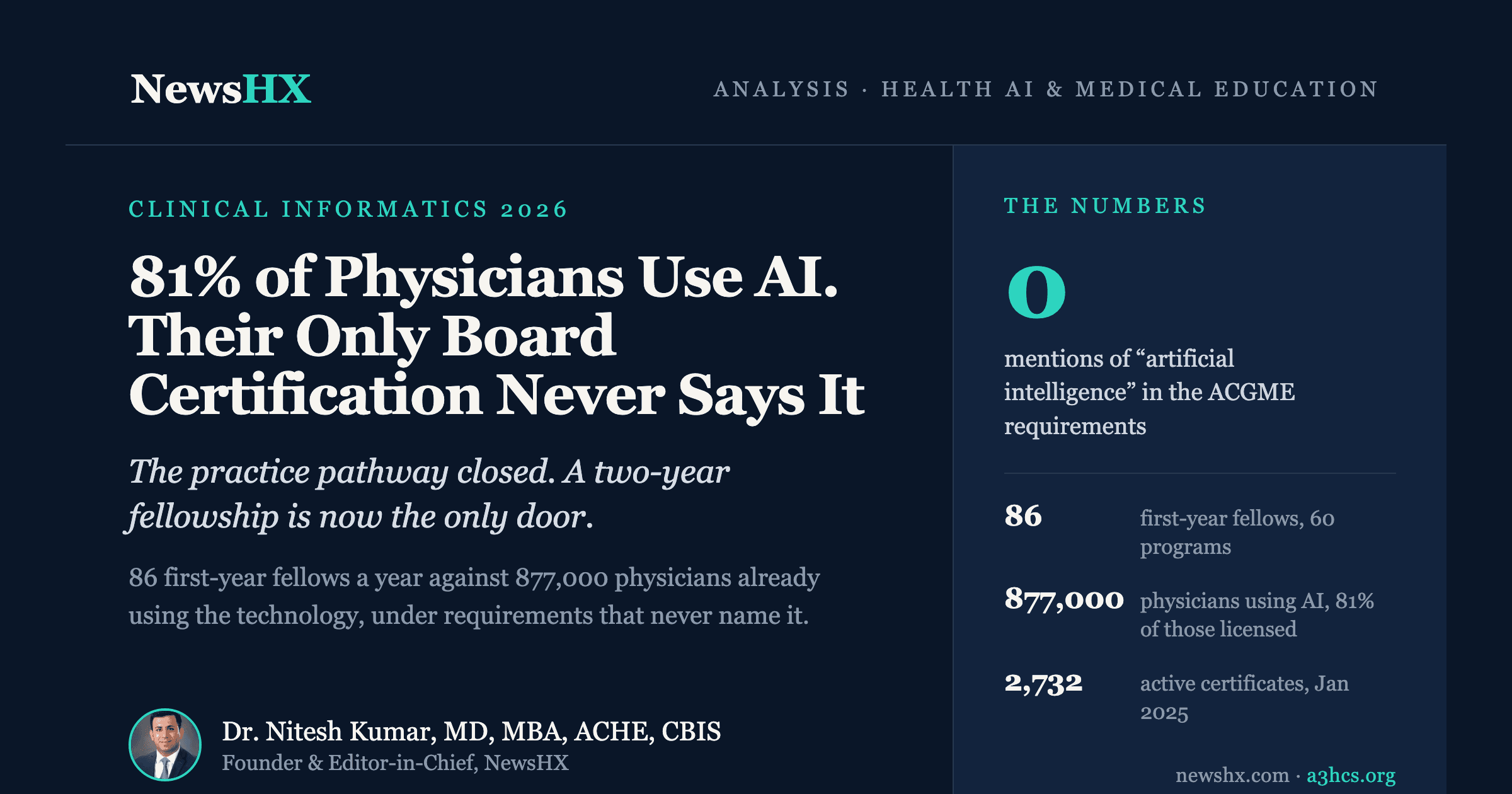
Medicine has now applied that same machinery to artificial intelligence for the first time. The American Board of Preventive Medicine closed the practice pathway for Clinical Informatics certification after the 2025 exam cycle, counting qualifying experience only through June 30, 2025.3 Starting with the 2026 cycle, the only route to the one American Board of Medical Specialties credential that touches health AI is a two-year ACGME-accredited fellowship.4
The consensus read is that this is a quality story. A practice pathway is a grandfathering clause, grandfathering clauses get abused, and closing one after twelve years is exactly what a serious board does. Informatics leaders argued for this closure in print, and their argument was good.5 I do not think they were wrong.
I think they solved a credibility problem and created a supply problem, and that the supply problem is now the larger one by several orders of magnitude.
What medicine actually requires, in hours
Start with the honest numbers, because they are the reason the credential carries weight in the first place.
The 10,000-hour figure everyone quotes comes from a 1993 study of violinists at the Berlin Music Academy, where the strongest players had accumulated roughly that much deliberate practice by age 20.6 It was an average, not a threshold, and Anders Ericsson spent the rest of his career objecting to the way it got popularized. But the order of magnitude survived scrutiny, and it is a reasonable yardstick.
Set it against American medical training. Using conservative assumptions, two preclinical years at about 50 hours a week and clerkship years at about 60, medical school runs somewhere near 9,000 hours. Residency is governed by a real ceiling: the ACGME caps clinical and educational work at 80 hours a week averaged over four weeks, and most programs run 60 to 70.7 At 65 hours across 48 weeks, a residency year is roughly 3,100 hours, so a three-year internal medicine residency delivers about 9,400.
Which means a newly board-eligible internist crosses 10,000 hours of supervised clinical work within a few months of finishing training. A subspecialist who adds a fellowship clears 20,000 before practicing independently. American graduate medical education arrived at Ericsson's number decades before Ericsson did, without knowing it, by asking a different question and getting the same answer.
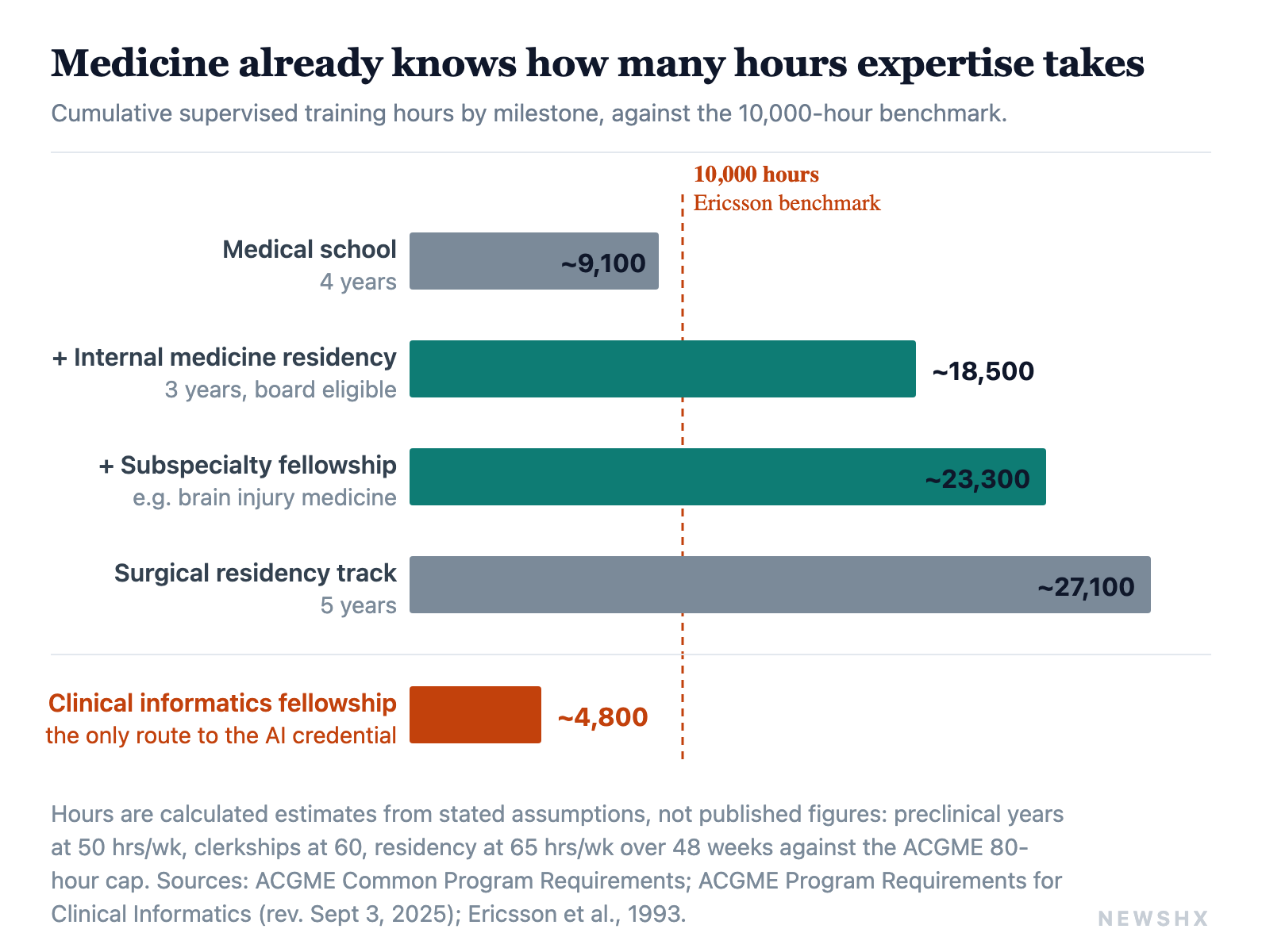
Medicine did not adopt the 10,000-hour rule. It discovered the same number independently, and then built a federal regulatory apparatus around defending it.
That convergence is why the fellowship requirement feels right. It is the mechanism medicine trusts, and it has earned that trust everywhere else.
The number that should stop you
The Federation of State Medical Boards counted 1,082,187 actively licensed physicians in the United States in its 2024 census.8 The American Medical Association's 2026 Physician Survey on Augmented Intelligence, fielded among nearly 1,700 doctors, found that 81% now use AI professionally, up from 66% in 2024 and 38% in 2023.9
That is roughly 877,000 physicians using AI in their work right now.
Clinical informatics fellowships run 60 accredited programs, and in the 2023-2024 academic year those programs carried 86 first-year fellows against 148 fellows in training in total.10 Take that at face value and divide.
Credentialing the physicians who are already using AI, at current fellowship capacity, takes about 10,000 years.
I have checked that arithmetic more than once because it reads like a typo. It is not. Eighty-six first-year fellows against 877,000 users is not a bottleneck, it is a rounding error, and the conclusion survives any plausible seat count: even at 200 fellows a year it is roughly 4,400 years. And the denominator is growing faster than the numerator: physician AI use more than doubled in three years while the number of fellows in training went from 88 to 148.10
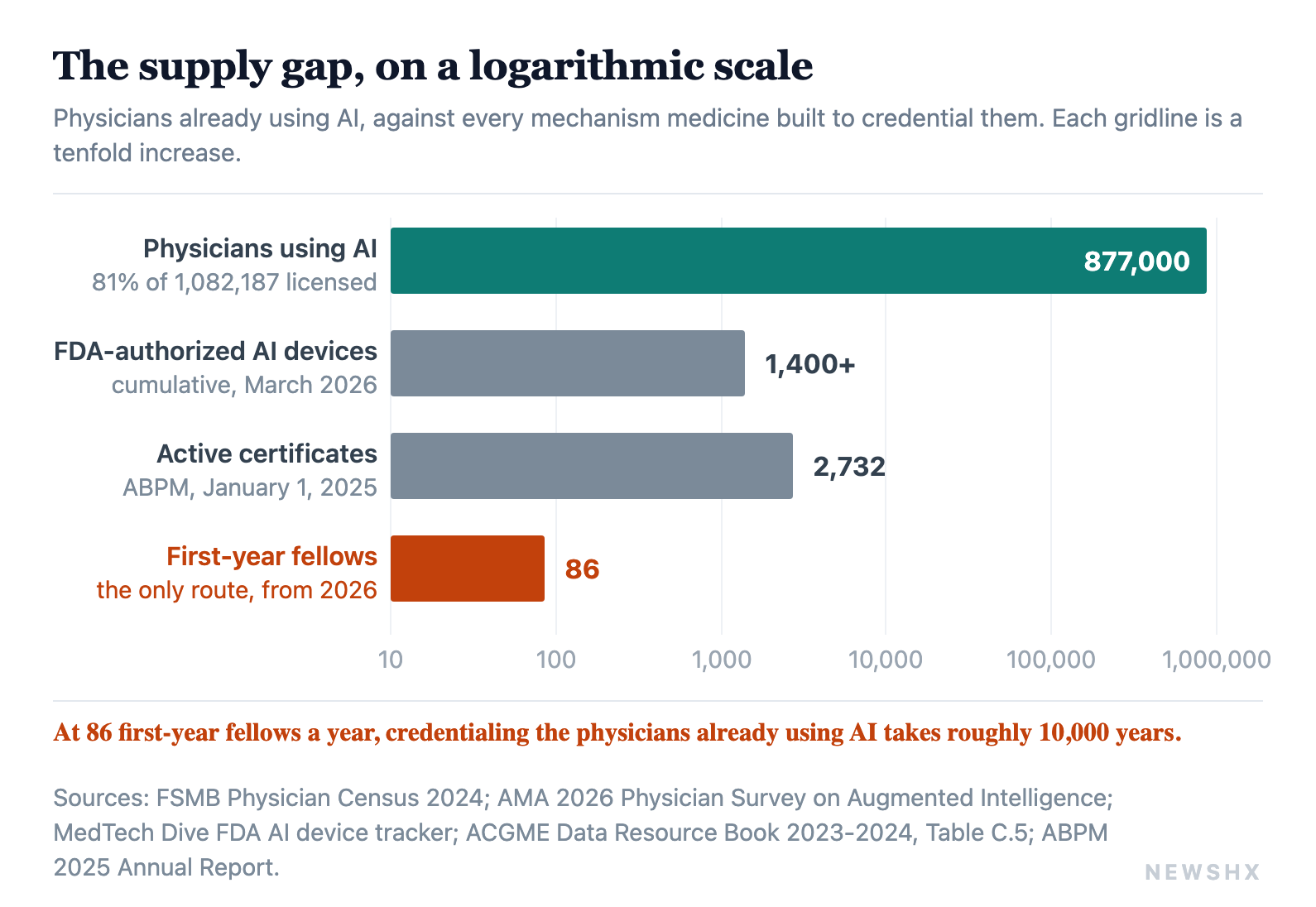
The device side tells the same story from the other direction. The FDA has authorized more than 1,400 AI-enabled medical devices, with 331 authorized in 2025 alone, the most in the agency's history.11 The ABPM held 2,732 active clinical informatics certificates as of January 1, 2025, and most of those physicians came through the pathway that just closed.12
That is roughly two board-certified clinical informaticists for every AI device the FDA has authorized. Going forward the ratio flips: 331 devices authorized in 2025 against 86 new fellows is about four new devices for every one new fellow.
What the credential actually contains
Here is where I stopped arguing about supply and went and read the document.
The ACGME Program Requirements for Graduate Medical Education in Clinical Informatics run 50 pages. The version in force was approved as an interim revision on September 3, 2025, and took effect the same day.4 That is thirteen months ago. It is the rulebook for the fellowship that is now the only door.
I searched the full text. The phrase "artificial intelligence" appears zero times. "Machine learning" appears zero times. So do "predictive," "validation," and "bias." The word "algorithm" appears exactly once, at requirement 4.11.e.1, listing "algorithm development" as one possible focus an educational assignment might take, alongside bioinformatics and user interface design. It is tagged (Detail), the ACGME's lowest requirement tier, meaning programs may satisfy it in whatever way they choose or emphasize something else entirely.
What the Core requirements do mandate is competence in workflow analysis, user needs assessment, project management, organizational change, and "analyzing, developing, implementing, and refining clinical decision support systems." That is a coherent and valuable curriculum. It is also, unmistakably, the curriculum of the electronic health record era, which is exactly what it was designed to be. The subspecialty was approved in 2011 and gave its first exam in 2013, four years before the transformer architecture was published.
So the position medicine now holds is this. The single ABMS credential a physician can earn that anyone reads as an AI qualification requires two years of full-time training, offers 86 first-year positions a year, and its governing requirements do not contain the words "artificial intelligence."
A credential that takes two years to earn, in a field that rebuilds itself in eighteen months, is not a standard. It is a lag with a certificate attached.
I want to be fair to the ACGME here. Program requirements are deliberately written at a level of abstraction that outlasts specific technologies, and good fellowships teach far more than the minimum on paper. Several of them teach model evaluation seriously. But requirements are the floor, the floor is what accreditation enforces, and a floor that never names the dominant technology of the decade is not enforcing anything about it.
Why the hours question fails here, specifically
The reason this cannot be fixed by adding hours is more interesting than the supply math.
In 2014, Macnamara, Hambrick and Oswald published the largest meta-analysis of deliberate practice ever assembled, asking how much of the performance gap between people practice actually explains. For games it was 26%. Music, 21%. Sports, 18%. Education, 4%. For professions, less than 1%.13
Less than 1%. Hours explain almost nothing about who is good at a job.
That finding is not a knock on training, and it does not mean residency is wasted. It means deliberate practice only compounds under conditions that games and music satisfy and professions usually do not: a settled body of technique, an unambiguous performance metric, immediate feedback, and a teacher who has already mastered the thing. Where those hold, repetition converts to skill. Where they fail, hours accumulate without becoming expertise.
Health AI fails all four at once. There is no settled technique, because the tooling turns over annually. There is no clean metric, because a model that improves AUC can still worsen care. Feedback is delayed by months and confounded by everything else happening to the patient. And there is no one who has already mastered it, because the technology is younger than a residency.
Layer on depreciation. Peter Densen's often-cited projection had the doubling time of medical knowledge falling from 50 years in 1950 to 3.5 years in 2010, and to roughly 73 days by 2020.14 Treat that figure as directional rather than measured, because it is a projection and it has been fairly criticized. Even so, the direction is not controversial, and AI tooling turns over faster than the clinical literature it is being pointed at. When the effective half-life of what you learned is shorter than the program you learned it in, the second year of the fellowship is depreciating the first.
This is why I do not think the answer is a longer credential, or a faster one, or a new subspecialty board. The transferable asset was never the AI hours. It is the 20,000 clinical hours, plus a much thinner judgment layer on top, call it several hundred hours, aimed at a narrow set of questions: what population was this validated on, how does that population differ from mine, what does failure look like here, and who notices when it fails.
A data scientist cannot acquire the 20,000 hours. A physician can acquire the several hundred. That asymmetry is the entire opportunity, and the current credential is not how you harvest it.
What this looks like when nobody local is asking
Brain injury is where I notice it. It is not where the problem is biggest.
The Epic Sepsis Model is a proprietary sepsis prediction tool built into the Epic electronic health record and, when it was studied, implemented at hundreds of US hospitals.15 In 2021 a University of Michigan team ran the external validation that had never been done, across 38,455 hospitalizations at Michigan Medicine.
It found an area under the curve of 0.63, against the 0.76 to 0.83 the vendor had reported. The model missed 1,709 of the patients who developed sepsis, 67% of them. It generated alerts on 6,971 hospitalizations, 18% of everyone admitted. The authors concluded the model had poor discrimination and calibration, and wrote that its widespread adoption despite that performance "raises fundamental concerns about sepsis management on a national level."15
Read that as a credentialing story rather than a vendor story. The model was not hidden. It shipped inside the most widely deployed EHR in American medicine, it scored every admitted patient every fifteen minutes, and it took an academic team with both clinical and methods training to establish that it did not work as advertised. Hundreds of hospitals ran it in the meantime. Every one of those hospitals had clinicians. What most of them did not have was a clinician whose job it was to ask the question.
Catching either of these requires someone who holds both halves at once: enough understanding of a model to ask what cohort it came from and how it calibrates, and enough time on the units to know what the patient in front of it actually does over the following eighteen months. That is not a data science skill and it is not a bedside skill. It is the overlap, and the overlap is precisely what medicine just made harder to produce.
The model was not wrong about the population. It was wrong about your patient, and only one kind of person is positioned to know the difference.
The AMA survey found that 88% of physicians are concerned about AI-related skill loss, and 70% specifically worry about erosion of skills among students and residents.9 They are worried about the right thing. They are worried about it in the same year the formal path to knowing better narrowed to 86 seats.
What operators should do
If you run a health system, a service line, or a practice, the credential is not coming to rescue you. Plan accordingly.
Stop treating AI competence as something you hire. At 86 new fellows a year nationally, you are not recruiting a board-certified informaticist to own your AI portfolio, and neither is anyone else. Identify the physicians you already employ who are curious, credible with their peers, and willing, and fund a few hundred protected hours for them. That is a budget line, not a search.
Name an accountable physician for every deployed model. The FDA authorized the device. Nobody authorized your deployment, in your population, on your workflow. Someone clinical should own each model in production by name, with the standing authority to turn it off. If you cannot name that person for every model you run today, that is the finding.
Put the validation-population question in writing, to every vendor. Ask what cohort the model was derived from, when, where, how it calibrates in a population like yours, and what monitoring detects drift. Ask for it in the contract. A vendor who cannot answer in writing has told you the answer.
Fund the judgment layer, not the credential. The expensive part of your physicians' expertise is already bought and paid for. What is missing is a narrow, teachable capability sitting on top of it, and it costs hundreds of hours rather than two years. Build it internally, on your own patients and your own deployed tools, and you will produce something the fellowship pipeline cannot supply at any speed.
Do not wait for the standard to arrive. The requirements document was revised in September 2025 and still does not name the technology. The gap between what is credentialed and what is deployed is going to stay open for years. Operators who treat that gap as their problem to close will run better AI programs than operators who treat it as somebody else's job to standardize.
And do not commission an AI governance committee with no named physician owner per model. A committee distributes accountability until nobody has it, which is the failure mode this piece describes at the level of the whole profession.
The answer to the original question
So: how many hours to become an AI expert physician?
The honest answer is that the question imports an assumption that does not survive contact with this field. Hours buy expertise when the ground holds still. Here it does not, and the meta-analytic evidence says hours were never doing most of the work in professional performance anyway.
What compounds is the twenty-thousand hours you already have, aimed at a small number of questions the technology cannot answer about itself. Medicine spent a century building the most rigorous apprenticeship in professional life. The mistake would be concluding that the apprenticeship is the answer to everything, including a technology that reinvents itself faster than the apprenticeship takes to complete.
The credential will catch up eventually. Your patients are being scored by these models this quarter.
A3HCS helps health systems build the AI judgment layer they cannot hire.
The fellowship pipeline will not staff your AI program. We work with hospitals, post-acute providers, and specialty groups to stand up model governance that a clinical leader actually owns: an inventory of what is deployed, a named accountable physician per model, the validation-population questions your contracts should already contain, and a focused curriculum that turns the clinicians you employ into credible reviewers of the tools you bought.
References
- Steyerberg EW, et al. IMPACT prognostic models; MRC CRASH Trial Collaborators, CRASH prognostic models. Both predict six-month outcome in moderate to severe traumatic brain injury, and both were derived from cohorts collected two to four decades ago, largely outside North America.
- Han J, et al. Performance of IMPACT, CRASH and Nijmegen models in predicting six month outcome of patients with severe or moderate TBI: an external validation study. Scandinavian Journal of Trauma, Resuscitation and Emergency Medicine, 2014. sjtrem.biomedcentral.com And the TRACK-TBI validation, Journal of Neurosurgery, 2024;141(2):417. thejns.org
- American Board of Preventive Medicine. Clinical Informatics Certification. Source of the practice pathway closure after the 2025 exam cycle, the June 30, 2025 experience cutoff, and the three-year window for applicants approved in 2025 to sit through 2027. support.theabpm.org
- Accreditation Council for Graduate Medical Education. ACGME Program Requirements for Graduate Medical Education in Clinical Informatics. 2025 reformatted requirements, interim revision approved and effective September 3, 2025. 50 pages; 24-month program length. The full-text term counts stated in this article were scanned locally on this document and are exact for it. acgme.org
- Silverman HD, et al. An Open Letter Arguing for Closure of the Practice Pathway for Clinical Informatics Medical Subspecialty Certification. Applied Clinical Informatics. pmc.ncbi.nlm.nih.gov
- Ericsson KA, Krampe RT, Tesch-Romer C. The Role of Deliberate Practice in the Acquisition of Expert Performance. Psychological Review, 1993. Source of the 10,000-hour figure, which was an average among Berlin Music Academy violinists by age 20 rather than a threshold.
- Accreditation Council for Graduate Medical Education. Common Program Requirements, clinical and educational work hours, 80-hour weekly maximum averaged over four weeks. acgme.org
- Federation of State Medical Boards. FSMB Physician Census Identifies 1,082,187 Licensed Physicians in U.S. 2024 census. fsmb.org
- American Medical Association. More than 80% of physicians use AI professionally: AMA survey. 2026 Physician Survey on Augmented Intelligence, nearly 1,700 respondents. Source of the 81% current use, the 66% and 38% prior-year series, the 88% skill-loss concern and the 70% trainee skill-loss concern. ama-assn.org
- Accreditation Council for Graduate Medical Education. Data Resource Book, Academic Year 2023-2024. Table A.3 for the 60 accredited clinical informatics programs, Table C.5 for the 86 first-year and 148 total active fellows, and Table C.6 for the 88 active fellows in 2019-2020. acgme.org
- MedTech Dive. AI in medtech is booming. Track new devices here. More than 1,400 FDA-authorized AI-enabled devices as of March 4, 2026, and 331 authorized in 2025. medtechdive.com
- American Board of Preventive Medicine. 2025 Annual Report, Diplomate Statistics, Active Certificates as of January 1, 2025: Clinical Informatics 2,732. theabpm.org
- Macnamara BN, Hambrick DZ, Oswald FL. Deliberate Practice and Performance in Music, Games, Sports, Education, and Professions: A Meta-Analysis. Psychological Science, 2014;25(8):1608-1618. journals.sagepub.com
- Densen P. Challenges and Opportunities Facing Medical Education. Transactions of the American Clinical and Climatological Association, 2011;122:48-58. The doubling-time series is a projection rather than a measurement and is treated as directional in this article.
- Wong A, Otles E, Donnelly JP, et al. External Validation of a Widely Implemented Proprietary Sepsis Prediction Model in Hospitalized Patients. JAMA Internal Medicine, 2021;181(8):1065-1070. AUROC 0.63; 1,709 of 2,552 sepsis patients (67%) missed; alerts on 6,971 of 38,455 hospitalizations (18%). doi.org